EIGHT NORWAYS BURNED IN ONE YEAR
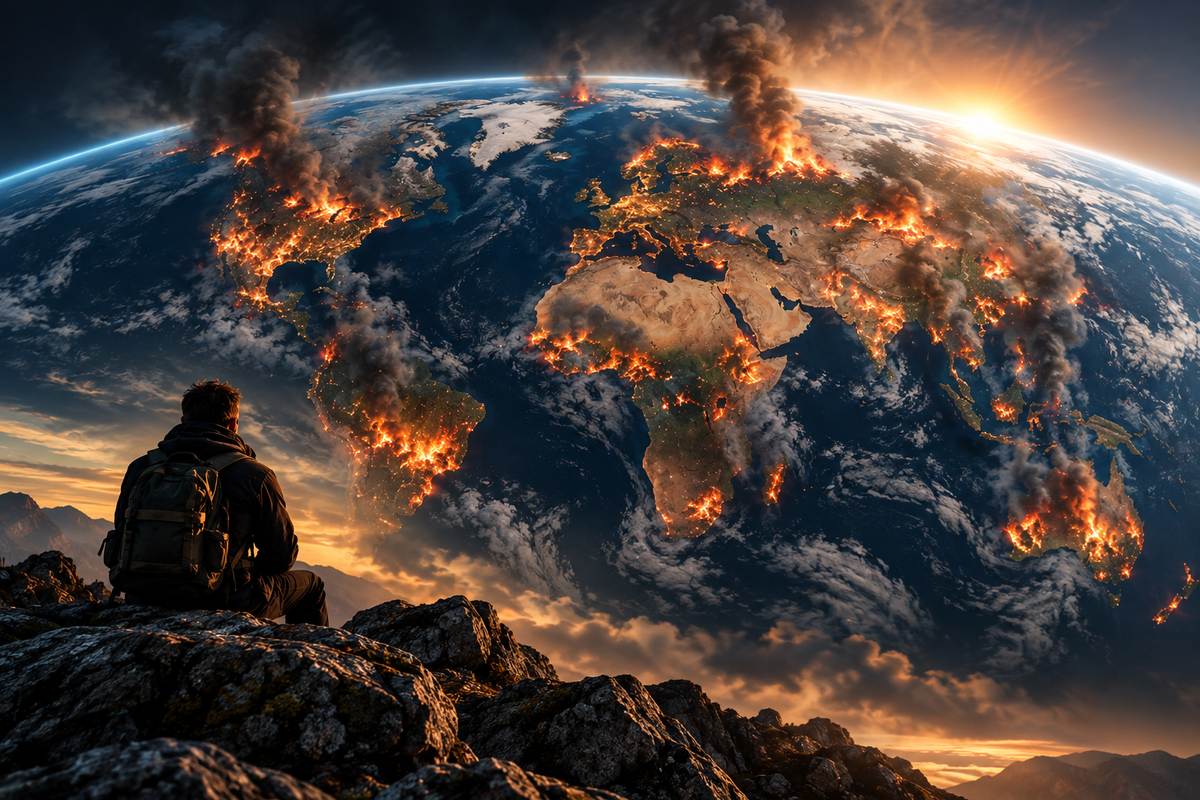
In 2025, satellites recorded roughly 265 million hectares of burned land across the planet — an area equivalent to about eight Norways. But the real story isn't simply how much burned. It's what happened inside all those fires: how they started, how they grew, where they went, and what they became.

There are numbers so large that the human brain simply refuses to take them in.
This is one of them.
By Dag Sandholdt
During 2025, approximately 265 million hectares of land were recorded as burned globally in the Global Wildfire Information System, GWIS.
That is roughly 2.65 million square kilometres.
Norway has a land area of around 325,000 square kilometres.
Which means that, with a little generous rounding, we can say:
In 2025, an area equivalent to roughly eight Norways burned.
Eight.
Not eight forests. Not eight national parks. Not eight randomly selected patches on a map.
Eight Norways.
And before anyone starts calling the County Governor to ask where we're supposed to put the remaining landmass: no. The Earth is not on its way to becoming a giant charcoal briquette before the end of the decade.
That's not how the calculation works.
But the number tells us something.
And it tells us something rather enormous.
FIRST, WE NEED TO STOP COUNTING WRONG
It is easy to imagine that 265 million hectares means satellites watched 265 million hectares disappear into flames.
That's not what the number means.
An area can burn more than once. Grasslands, savannas and other ecosystems have natural fire regimes. Some fires are small. Some are enormous. Some are caused by people. Some are started by lightning. Some are associated with agriculture or deliberate vegetation management.
GWIS itself notes that mapped fires may include fires deliberately set for vegetation management.
And these are satellite measurements. Small fires can be missed. Clouds and vegetation can obscure parts of what actually happened. GWIS data is therefore not a perfect inventory of every flame that existed on the planet.
That does not make the number uninteresting.
Quite the opposite.
It makes it interesting.
Because GWIS is not simply counting every hot pixel as a brand-new fire. Its fire-event methodology uses the spatial and temporal clustering of thermal anomalies detected by MODIS and VIIRS to identify individual events.
That distinction matters.
A satellite can see the same fire many times.
It is still one fire.
AND THEN THERE ARE ALL THE OTHER NUMBERS
This is where things start getting genuinely strange.
We've previously worked with raw VIIRS data from NASA and seen how a single satellite can produce millions of observations.
In our global NOAA-21 dataset for 2025, there were more than 17.6 million individual observations.
That does not mean 17.6 million fires.
They are observations.
GWIS is doing something different.
It is attempting to turn observations into events — to determine which observations belong to the same fire and reconstruct the development of that event over time.
And that produces a completely different scale of numbers.
Depending on the specific GWIS dataset, product and definition being used, the global number of mapped fire events is in the hundreds of thousands.
That is still a number that is difficult to get your head around.
Hundreds of thousands of fire events.
In one year.
Even at 900,000 events, for the sake of scale, that would work out to roughly:
2,500 events every single day.
Or: 104 an hour.
Or: almost two new registered fire events every minute.
That does not mean there are two forests burning out of control every minute.
Fires vary enormously in size, duration and intensity. Many are small. Some are gigantic. And a fire that begins in January can remain part of an event sequence long after the calendar has moved on.
But the scale is worth stopping to consider.
2.65 MILLION SQUARE KILOMETRES
This is perhaps where I think the numbers start getting downright cheeky.
2.65 million square kilometres is roughly the size of Argentina.
It is more than eight Norwegian land areas.
And it happened within a single year.
Of course, we can take a breath and explain why this does not mean the Earth loses 2.65 million square kilometres of productive land every year.
That's good.
We should take the breath.
But we should not use the explanation as an excuse to stop looking at the number.
Because this is not a competition to see how quickly the planet can become uninhabitable.
It is a description of just how enormous the phenomenon of fire actually is.
NOT ALL FIRES ARE DISASTROUS
This is important too.
A fire is not automatically a disaster.
Nature needs fire.
Some ecosystems depend on it. Fire can renew vegetation, release nutrients and form a natural part of a landscape's life cycle.
A small heath fire far from human settlements is something very different from a wildfire moving towards a city.
A controlled vegetation burn is something very different from an uncontrolled fire under extreme drought conditions.
And a fire releasing 100 MW of thermal energy in an area without people is not necessarily a greater societal disaster than a much smaller fire a few kilometres from a city of 328,000 people.
That is why "how much burned?" is only one question.
It is not necessarily the most important one.
BECAUSE THE REAL STORY IS IN EACH FIRE
This is where I start getting interested.
Because if we are going to collect all these events, we should stop treating them as dots on a map.
A fire should be a story.
Where did it start?
How large did it become?
How quickly did it grow?
How long was it active?
How intense was it?
How many satellite observations exist?
What happened to it?
How many people lived nearby?
Was there infrastructure in the area?
Did it get bigger?
Did it get smaller?
Did it die out?
Did it come back?
Did it become part of a larger event?
That is the difference between saying:
"There was a fire."
and:
"This is what happened."
AND THIS IS WHERE WE RUN INTO THE REAL PROBLEM
Because once you start looking at the world this way, it quickly becomes obvious how little a single observation actually tells you.
A satellite sees a hot spot.
Then another satellite sees a hot spot.
Then the first satellite looks at the area again.
The fire grows.
Then it grows some more.
Then it moves.
Then the signal disappears behind clouds.
Then it comes back.
Then the fire is suddenly ten times larger.
If we store every observation as though it were an event, we get a data mess.
If we throw away the observations and simply store "fire: yes", we lose the story.
What we need is something in between.
One event. A lot of data.
2025 WAS NOT "265 MILLION HECTARES OF DISASTER"
That would be a stupid headline.
But:
265 million hectares of recorded burned area
is a hell of an interesting headline.
Because it tells us that fire on this planet is not a niche phenomenon.
It is not a few hundred spectacular wildfires that make the evening news every summer.
It is a global system of hundreds of thousands of events.
Some natural.
Some human-caused.
Some harmless.
Some catastrophic.
Some almost invisible.
Some large enough to create their own weather.
And between those extremes lies an enormous amount of information.
SO, YES. EIGHT NORWAYS.
It is a slightly ridiculous comparison.
I like it.
Because 265 million hectares is a number most people have absolutely no intuitive relationship with.
Eight Norways?
That's easier.
And if eight Norways sounds excessive, you can take comfort in the fact that the Earth still has quite a lot of land left.
There are roughly 149 million square kilometres of land on the planet.
So if, just for fun, we pretend that the same 2.65 million square kilometres burned every year and could never burn again, it would take roughly 56 years before the entire landmass had appeared in the calculation.
Obviously, that is never going to happen.
Not even remotely.
But the calculation tells us something else worth remembering:
We are talking about a process operating on a continental scale.
Every single year.
And perhaps that is exactly why we need a better overview.
Not so we can scream CRISIS! every time a satellite spots a heat signature.
Not so we can pretend all fire is evil.
And not so we can turn every heath fire into the end of the world.
But so we can see the difference.
Because when you have hundreds of thousands of fire events, millions of observations and hundreds of millions of hectares of burned area, the question is no longer simply:
How many fires did we have?
The interesting question is:
What the hell was actually going on?
That is where the story begins.