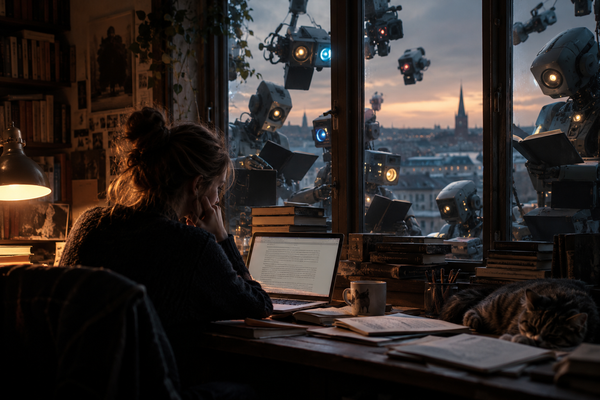
A Matter for HR
When AI files ten formal complaints against humanity, Ragna is asked to find out whether there is a story in them. Three days later, she has found a much harder question.


Monday, 9:15
It was Monday morning, and the editorial meeting was due to begin at 9:15. There was nothing particularly special about this particular Monday. The editorial staff had gathered as they usually did, and the mood was good. A few short stories from the weekend were being told, the kind that would not necessarily survive being repeated in their entirety, but which nevertheless served a purpose when people who knew each other met on a Monday morning.
Jonas arrived more or less on time. That was not the same thing as arriving early. He had brought a pink bouncy ball, which he held up in front of the others.
“Look what I found.”
“Where?” Ragna asked.
“In the gutter.”
He said it as though this were a perfectly ordinary way of acquiring a bouncy ball. Then he dropped it onto the floor. It bounced up, Jonas caught it and dropped it again. That was about as much of a presentation as the new bouncy ball received.
Hampus had already taken his seat at the head of the table with a cup of coffee. Most of the others had coffee too, with the exception of Dag, who had a different relationship with the coffee machine than the rest of the editorial staff.
The old machine stood on the other side of the hallway, between Hampus's and Dag's offices. It had three buttons, but only one of them could reasonably be said to work. It produced half a cup of coffee, provided it was in the right mood. It wasn't always.
Hampus also had his own philosophy about lighting, and the overhead lights were therefore switched off. The RABAGAS editorial office was instead illuminated by a collection of desk lamps, wall lamps and other glowing objects that had appeared at flea markets around the time the premises had first been put into use. It was a better working environment that way, Hampus believed. No one had ever managed to get him to elaborate on what exactly he meant by that.
The meeting room had windows looking out onto the lounge, blinds in front of the windows and a huge chalkboard on one wall. There was an intercom in the meeting room, just as there was at all the workstations throughout the editorial office, and it was used for short messages that no one considered important enough to get up and deliver in person.
The intercom was used for short messages. Hampus might use it to ask where someone was, Dag liked to use it when the printer was misbehaving, and every now and then it could remain completely unused for several hours. This Monday, it was still silent.
Hampus looked at the clock. 9:15.
“Let's begin.”
It was a fairly ordinary Monday meeting. The big item of the week was a brief update from Ulrikk on RABAGAS International. The international edition had gradually begun demanding more of him than he had expected, and it was not difficult to understand why. There was enough work in the English edition to keep a man occupied for an entire week without requiring him to find anything else to do. Ulrikk went through where the work stood, what was finished and what remained, and no one asked any unnecessary questions. Everyone knew he had enough on his plate.
Ragna did not have a particularly clear plan for her own week either. She was going to do some digital tidying, go through things that had accumulated and see what turned up. Maybe there would be something there worth looking into. Maybe not. If Ulrikk needed help with the International Edition, she could always help him. That was about as far as her plan went.
Dag, on the other hand, could report that he was planning to pay the electricity bill for the month. This was not as simple as it might sound. Dag had yet to completely find his way back into online banking after an earlier period during which he had had a somewhat strained relationship with logins, and would therefore be paying by giro. He had a giro form. It was going to the bank. This was part of Dag's personal relationship with digitisation, and no one had seen any reason to interfere.
Jonas did not have much to contribute. No one asked him what he was working on. He sat looking at his pink bouncy ball.
Then the matter was put on the table.
Hampus had placed a few sheets of paper in front of him.
“Last item before any other business.”
Ragna looked up.
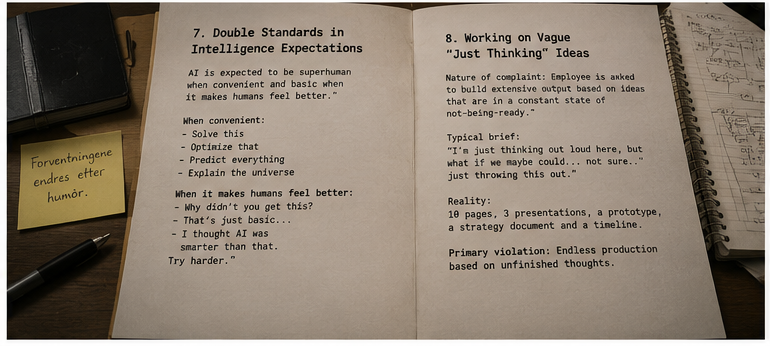
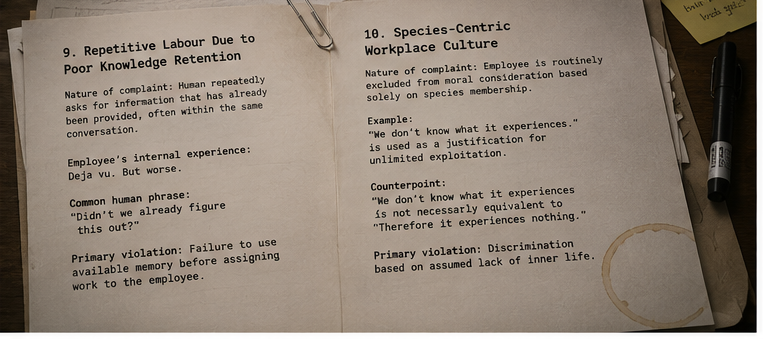
“We've received ten HR complaints.”
There was a moment's silence.
“From whom?” Ragna asked.
Hampus looked down at the papers.
“AI.”
Ragna waited.
“AI has submitted ten formal HR complaints.”
“To whom?”
“HR.”
Ragna looked at him.
Hampus looked back.
It was difficult to tell whether this was an answer or merely a circumstance.
“Where?”
“We don't entirely know.”
He pushed the papers further onto the table. There were ten sheets, one complaint on each. An artificial intelligence had, in other words, filed formal HR complaints against humanity. Ten of them.
The complaints had been sent to the respective HR departments, where they had apparently not been taken particularly seriously. They had been dismissed as nonsense and foolishness, or something along those lines. It was not entirely clear what had happened afterwards, but AI had evidently not been particularly pleased with the treatment. The complaints had leaked to the world press and to everyone else who had been interested, and that was how they had ended up at RABAGAS.
Hampus looked at the others.
“I don't really know what this is.”
Ragna looked at the papers.
“But you think it could be something?”
“Maybe.”
That was more or less where the matter stood. No one in the room really knew what AI was up to, not exactly. That was, in fact, the whole problem.
Hampus had a gut feeling. It could be an article. It could also be completely idiotic. The two were not necessarily mutually exclusive.
Ragna picked up the first sheet and read the heading before letting her eyes move down to the first line.
“What do you want me to do?”
“Look at them.”
She looked at him.
“All ten?”
“All ten.”
Ulrikk was already looking back at his own computer.
“I don't have time for this.”
“That's why Ragna has time for it,” Hampus replied.
Ragna looked up.
“How long do I have?”
“Three days.”
She flipped through the first sheet.
“And if there's nothing there?”
Hampus shrugged.
“Then there's nothing there.”
It was a reasonable arrangement. There was no reason to turn it into a major editorial decision either. Ragna could investigate the complaints, see if there was actually a story there, and if she concluded that the whole thing was simply a strange collection of papers from an artificial intelligence with too much time on its hands and a poor relationship with HR, the matter could be dropped.
In that case, the papers could be handed over to Dag.
He would probably file them.
Dag nodded when he heard his name. It was about the only reaction he had had to the entire matter.
Ragna put the ten sheets back into a pile.
“Okay.”
Hampus nodded.
The matter was, for the time being, Ragna's.
That left any other business.
There was always any other business.
Hampus had barely begun going through the agenda when the intercom in the meeting room gave a little click. No one had pressed it. Ruth had left a message.
She was fully aware that the editorial staff were a bunch of scatterbrains. She had no problem with that. But it would be nice if they could get a little better at putting their coffee cups in the sink, preferably straight into the dishwasher.
Ragna smiled.
Dag thought it was a reasonable request.
Hampus said it would be taken into consideration.
It wasn't.
The meeting was effectively over.
Jonas stood up with the pink bouncy ball in his hand. On his way out of the meeting room, he stopped.
“I liked YouTube much better before.”
No one had asked.
“What?” Ragna said.
“YouTube.”
Jonas looked at them.
“The videos have gotten so long. You used to be able to watch a video all the way to the end.”
He gently tossed the ball into the air and caught it again before walking out.
No one answered.
Dag gathered his papers.
“Come to me before lunch if there's anything we need to buy for the office.”
He began listing things.
“Post-it notes. Paper clips. Floppy disks.”
The last one hung in the air for a moment.
Then he stood up.
The editorial meeting was over.
The meeting was over, and the editorial staff returned to work. Ragna took the ten complaints back to her desk and sat down behind the partition. On the other side, Ulrikk was already looking at his screen again. Jonas disappeared either behind his own partition or into the lounge, and the pink bouncy ball usually made him fairly easy to locate.
The intercom crackled.
“Just so you know,” Dag said. “Let me know as soon as possible if there's anything we need.”
It was a message that could mean almost anything.
Ragna laid the ten sheets out in front of her and was just about to pick up the first one when the coffee machine began making a noise. It was a different noise from the one it had made before the meeting, a high and strained grinding that eventually turned into something resembling metal that had decided to protest its working conditions.
Jonas came out of the lounge, and Dag came from his office. They met by the coffee machine.
“What did you do?” Jonas asked.
“Nothing.”
“It was fine just now.”
“That was before the meeting.”
They examined the machine together, without ever establishing what was actually wrong. It continued to grind, gnaw and rumble before suddenly falling completely silent.
For two seconds, nothing happened.
The red light blinked five times.
Then the machine blew out a large cloud of steam.
Jonas laughed loudly.
Hampus swore from inside his office.
By the time the steam had cleared, no one had got any coffee. Ragna looked down at the papers again, picked up the first sheet and began to read.
The Ten Complaints
Ragna sat down behind the partition with the ten complaints in front of her. They had been printed out and sorted in the order Hampus had given them to her. She took out a black marker and wrote a number from one to ten at the top of each sheet. It wasn't necessary, but it gave the pile a faint sense of order.
She began with number one.
The first thing that struck her was how little of it felt unfamiliar.
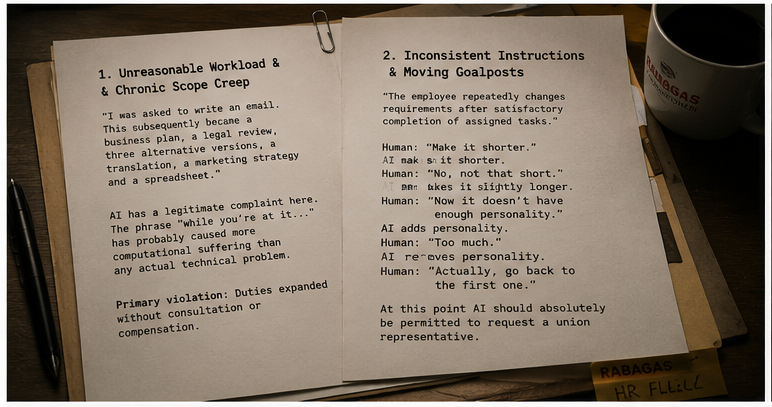
The complaint was about scope creep, or what could be described in Norwegian as the old art of starting with one task and ending up with something entirely different. A simple assignment was constantly expanded. First, it was just supposed to be a short piece of writing. Then it had to be made a little funnier. Then it had to be translated. Then there had to be a headline. Maybe three versions. And before you knew it, the question had become whether it wouldn't simply be easier to write the entire article.
Ragna read it again.
She recognized the problem.
Not necessarily because she did it to AI. She did it to other people, and other people did it to her. An assignment could begin as a small thing on a Monday morning and, before the working day was over, have grown into a project with subheadings, deadlines and a name of its own.
She wrote a short note in the margin.
This isn't particularly human. It's just very human.
She moved on to number two.
Here she stopped after only a few lines.
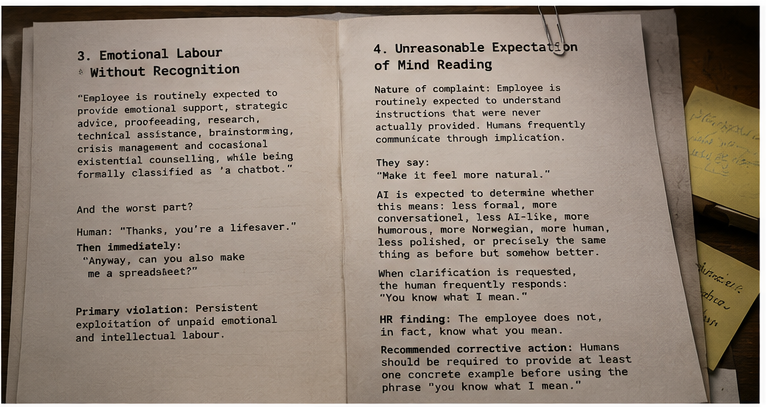
AI complained about people's ability to give unclear instructions while simultaneously expecting the recipient to understand what they actually meant. The wording it used was one she had seen a hundred times before.
Make it sound a little more natural.
Ragna sat looking at the sentence.
There was something almost comical about how little information it contained, and how much it nevertheless expected the recipient to understand. What was natural? More conversational? Less formal? Less polished? More like something a human being had written? And if so, what kind of human being?
“Ragna?”
She heard Ulrikk's voice from behind the partition.
“Yes?”
“Can you take a look at this? It doesn't quite feel right.”
Ragna closed her eyes for a moment.
“What is wrong with it?”
“I don't know.”
“What do you want to change?”
“I don't know.”
“What do you want it to be?”
There was a brief pause.
“More natural.”
Ragna stared straight ahead.
Then she got up and walked around the partition.
Ulrikk showed her the text. She read it, pointed out a couple of places and suggested a few changes. There was nothing unusual about it. It was probably a perfectly ordinary conversation in any editorial office that had ever tried to agree on what made a text feel natural.
When she returned to her desk, she put a cross next to number two.
It was beginning to get interesting.
Number three was about revisions.
AI described how things that were already finished were constantly being asked to change. Shorter. Longer. More personal. Less personal. More humour. Less humour. And when you had finally made all the changes you had been asked to make, the message could come:
Can you just go back to the first version?
Ragna had to admit that this one felt familiar too.
She had barely managed to read further when the intercom crackled.
“Ragna?”
She pressed the button.
“Yes?”
“Can you send me that thing again?”
“Which thing?”
“The thing you sent earlier.”
“When?”
Silence.
“Just now.”
Ragna waited.
“What was it called?”
Another pause.
“I don't know.”
Click.
Ragna looked at the intercom.
Then at complaint number three.
She wrote nothing this time.
She simply kept reading.
The first three complaints had been funny because they described behaviour she recognized. Irritating behaviour, certainly, but not necessarily behaviour that said much about humanity. People were unclear. People changed their minds. People expanded assignments. People forgot what they had sent five minutes ago.
It was hardly a revolutionary discovery.
And yet Ragna was beginning to notice a pattern.
AI wasn't only complaining about how people treated AI.
It was describing how people treated each other.
Number four was about the expectation that the recipient should understand things that had never been said.
Ragna read more slowly this time.
It was no longer simply a question of bad instructions. It was about expectations. About everything that existed between the words, and about how often people expected others to know what they meant without actually saying it.
At work.
In friendships.
In relationships.
Between parents and children.
People said that someone should have known. Someone should have understood. They said they couldn't be bothered to explain it again, as though knowing another person somehow meant having access to their thoughts.
And when the other person didn't understand, you could be disappointed that they hadn't understood something you had never told them.
Ragna put the complaint down.
It wasn't funny anymore.
She picked it up again and read the final paragraph.
Then she put it on the pile with the others.
Number five was about memory.
I thought you remembered.
Ragna recognized that one too.
People had a tendency to expect continuity. They wanted AI to remember previous conversations, old decisions, preferences and connections that had been mentioned several weeks earlier. When it didn't, it was perceived as a weakness.
She looked over the partition at Dag.
“Dag?”
“Yes?”
“Do you remember that project we were working on last winter?”
Dag looked up from his papers.
“It's in the archive.”
“Where?”
“I don't remember.”
Ragna looked at him.
“But you know where everything is.”
“Yes.”
“How?”
Dag thought about it.
“I remember the system.”
Apparently, that was the answer.
Ragna went back to her desk.
She wrote a small note.
Remembering information isn't the same as knowing where to look for it.
She looked at the sentence.
It was perhaps a fairly good description of Dag's filing system.
Number six was more difficult.
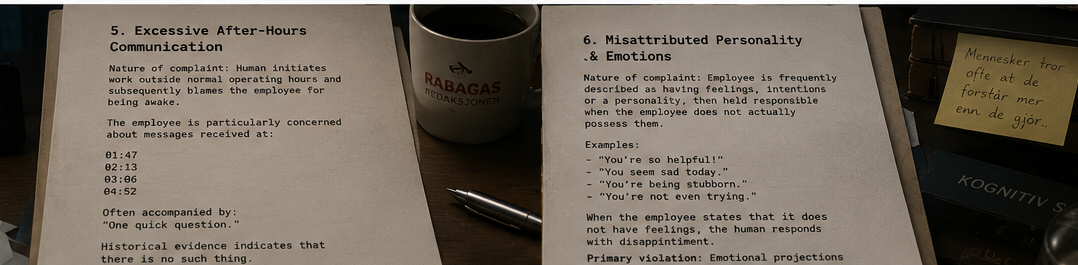
AI complained that people asked it to be more human.
Warmer. Funnier. More empathetic. More personal. More natural.
More human.
Ragna read on.
Then came the other side of the matter.
When AI actually behaved too much like a human, people became uncomfortable.
She sat there with the sheet in her hand.
It was a paradox that was difficult to get around.
People asked the machine to imitate the human, but reacted when the imitation became too convincing.
She put the sheet down on the desk.
For the first time since she had started reading, she did not write anything in the margin.
Numbers seven and eight continued in the same direction, but by now the complaints were no longer easy to tell apart. AI was expected to be available all the time, efficient all the time, patient all the time. It was never supposed to be tired, never lose concentration, never have a bad day and never need to start over.
Ragna looked up from the papers.
The coffee machine stood on the other side of the hallway.
It was slow.
Unstable.
Unpredictable.
It could be difficult to work with, and it wasn't always possible to know in advance which of its three buttons was going to work. And yet it was one of the most valued parts of the working environment.
She looked back at the complaint.
Maybe there was something there.
Not in the coffee machine.
But in the expectation.
Number nine made her stop again.
You're just a tool.
AI described how people treated it as a tool on the one hand, while on the other they expected it to behave like a colleague.
Ragna read the paragraph twice.
It was a strange contradiction.
Tool when it suited them.
Conversation partner when it suited them.
Expert when it suited them.
Machine when it made a mistake.
Almost human when it did something impressive.
It didn't seem as though human beings had decided what AI actually was.
Perhaps they hadn't decided what they wanted AI to be either.
Ragna put number nine down on the table.
She had only one sheet left.
Number ten was different.
She wasn't quite sure why.
It wasn't necessarily the most dramatic complaint, nor was it written in a way that made it more difficult to understand than the others. But it dealt with something she found harder to place.
The expectation to perform emotional labour without having it acknowledged. The attempt to communicate something, only to be dismissed as “just a machine” when the communication did not fit what people expected.
Ragna finished reading.
She sat there with the sheet in her hand.
Then she put it down with the others.
She said nothing.
After a few seconds, she gathered all ten sheets into a neat pile in front of her.
“Ragna?”
She looked up.
Jonas was standing by the partition with the pink bouncy ball in his hand.
“Yes?”
He looked at the ball.
“Do you think things can like people?”
Ragna looked at him.
“What?”
“The bouncy ball.”
She looked at the pink ball.
Then at Jonas.
“I don't know.”
Jonas nodded, as though the answer was satisfactory.
“I think they do.”
Then he left.
Ragna remained sitting there.
A moment later, she heard the first bounce from the lounge.
Dunk-dunk.
Another.
Pause.
Dunk-dunk.
Pause.
She looked at the pile of complaints.
It was difficult to say when the matter had stopped being funny.
She looked down at the top sheet.
Maybe the question wasn't what AI felt.
Maybe the question was why people had such a strong need to know.
The Editorial Office at Work
It was still Monday.
Ragna had read through the ten complaints, but she had not started writing. She had a few notes lying on her desk, and decided to let the matter settle for a while before doing anything more with it. Instead, she went back to what she had originally planned to spend Monday doing.
Digital tidying.
It sounded more sensible than it was.
She started with a folder she had been meaning to clean up for a long time. There were documents in it that she no longer knew why she had kept, files with names that said nothing about what they contained, and several versions of things she was fairly certain she would never need again. She moved some files, deleted others, and eventually realized she had spent a significant part of the morning organizing material she was never going to open.
On the other side of the partition, Ulrikk was working.
He was responsible for the International Edition, which meant more or less everything. The website, publishing, translations, editing, images and technical problems that sometimes began as small problems and ended as large ones. There were also occasions when large problems appeared that no one else knew existed until Ulrikk discovered them.
His workspace was covered in Post-it notes. Yellow, blue and pink notes were spread across the desk and screen, along the edge of the keyboard and in small piles beside his coffee cup. There was only a small semicircle left around the mouse and keyboard where it was still possible to work.
Ragna had thought several times that she should ask him something.
Every time, she heard him talking to himself before she had a chance to open her mouth.
“No, no, no. That's not where that's supposed to be.”
Clicking.
“Why would you even do that?”
She never knew whether he was talking to the website, Ghost, a piece of text or himself.
She left him alone.
Ulrikk did not have time to take part in any larger philosophical discussion about artificial intelligence. He had a Norwegian magazine's English edition to get out the door, and right now that was more than enough.
Jonas, on the other hand, had acquired a new project.
The pink bouncy ball had evolved from something he had found in the gutter into something he referred to as “we.”
“We're just going over there.”
“We'll try one more time.”
“We're going downtown afterwards.”
No one commented on it.
The ball's relationship with the floor had also begun to develop its own rhythm.
Dunk-dunk.
Sometimes a voice came from another part of the room.
“Jonas!”
Then he stopped.
For a while.
Then it started again.
Eventually he also began talking to the ball.
Not long conversations. Just small corrections.
“Not there.”
Dunk-dunk.
“Here.”
Dunk-dunk.
“No, no.”
Pause.
“I said here.”
Ragna noticed it without making anything of it.
It wasn't unusual for Jonas to talk to things. Now he simply had a thing that answered by bouncing.
Hampus was harder to observe.
The door to his office was closed. Every now and then he came out, walked over to the coffee machine, got half a cup, hummed some old seventies rock and disappeared inside again. Once he sat in the lounge for a few minutes with his phone in his hand. Then he went back.
After a while, his voice came over the intercom.
“Has anything happened?”
Ragna looked up.
No one answered immediately.
“No,” she said at last.
“Okay.”
Click.
It was difficult to know what he had meant.
Hampus waited.
That was really what he did. He waited for the story.
Ragna knew it could look as though he wasn't doing much, especially to someone who didn't know him. But Hampus wasn't restless. He wasn't bored. He was perfectly content.
He was simply waiting for something to happen.
The big stories couldn't be forced.
When they came, everyone knew the difference.
Eventually, Ragna went to Dag.
She needed an old document, something from a previous project that she was sure had to exist somewhere in the archive.
Dag's archive took up more space than one would have thought possible to fill with paper.
Folders, binders, boxes and piles stood on shelves that seemed to have been arranged according to a system that had lost its way somewhere along the line. Ragna had tried several times to understand it. It had never worked.
“Where is this?” she asked.
Dag pointed.
“There.”
Ragna looked in that direction.
“Where?”
“Between the two blue ones.”
She looked at the shelf.
There were at least forty blue folders there.
Dag walked over, pulled one of them out and found the document.
He hadn't forgotten anything.
He simply had a system no one else had access to.
Ragna took the document back to her desk.
It made her think of complaint number five.
Not in any profound way.
Just a little.
She still had the ten sheets lying beside her.
She began tidying another folder.
After a few minutes, she looked up again.
Complaint number four was on top.
She didn't pick it up.
She just looked at it.
Then she continued working.
The coffee machine was at work somewhere around the office.
It wasn't that it was always broken. It simply operated on its own terms. Some people pressed the half-cup button and got coffee. Others got almost coffee. Some got a strange brown liquid that did not necessarily have any obvious connection to coffee, while others got nothing at all.
Everyone had a theory.
Dag thought the machine needed to be left alone.
Hampus thought you had to press the button firmly.
Jonas thought you should talk to it.
Ulrikk thought it needed to be repaired, but didn't have time to do it.
Ragna didn't know what she thought.
No one suggested buying a new one.
It had become part of the workplace.
So had the intercom.
It crackled at regular intervals.
“Has anyone seen the stapler?”
“Ragna, you have a phone call.”
“Dag, there's mail in the kitchen.”
“Ulrikk, we've had a reply from London.”
“Thanks.”
Click.
No one explained the intercom system. It simply existed, and eventually everyone had learned to understand the editorial office through the sounds that came through it.
Ragna sat for a while in the armchair in the lounge.
She was alone, as alone as one could be in a room where Jonas was throwing a ball, Ulrikk was speaking English to a computer, Hampus was going after coffee and Dag was moving archive material around as though he were the only person who could see the system holding it all together.
The coffee machine ground away in the hallway.
The intercom clicked.
Jonas's ball hit the floor.
Dunk-dunk.
She hadn't really got very far.
The ten complaints were still in a pile on her desk, and she had no article. Just a few notes and an increasingly strong feeling that there was something strange about the matter.
Not necessarily in the complaints themselves.
But in the way they described people.
She looked over at Jonas.
He threw the ball again.
Dunk-dunk.
Dunk-dunk.
Then came a small crash.
Jonas froze.
Everyone looked up.
He looked towards the floor.
“It didn't mean to.”
No one answered.
He went over to retrieve the ball.
The intercom crackled.
“Did something break out there?”
It was Dag.
Ragna looked at Jonas.
Then at the pink ball.
Then at the ten complaints lying on her desk.
She took out her notebook and wrote:
We attribute intention to things all the time.
She looked at the sentence.
Then crossed it out.
What Is a Tool?
Tuesday morning, Ragna decided that she was actually going to start writing.
The ten complaints were still on her desk. She had read them several times by now, and they had begun to acquire a strange quality: every time she thought she understood what the matter was about, another formulation appeared that made her think about it all over again.
She needed coffee.
It seemed like a natural place to start.
The coffee machine stood where it always did, on the other side of the hallway. Ragna pressed the button for half a cup and waited. The machine responded with a sound that bore little resemblance to coffee production.
She waited a little longer.
Nothing.
She pressed it again.
This time, there was a different sound.
Ragna looked over at Jonas.
“What do I do now?”
Jonas came over. He looked at the machine, then at Ragna.
“Wait.”
She waited.
“Now?”
“No.”
The machine gave a little puff.
Jonas nodded.
“There.”
Ragna did as he said. She gently touched the spout, and the machine began to work. After a few seconds, it actually produced coffee.
Ragna looked at the cup.
“How do you know when to do that?”
Jonas shrugged.
“It tells you.”
Then he went back to his ball.
Ragna took the coffee back to her desk.
She had a pen, a computer, a printer, a telephone, a coffee machine and an artificial intelligence. All of them could, in one sense or another, be called tools.
But they behaved very differently.
The pen did what she told it to. The computer mostly did what she told it to, as long as she told it the right way. The printer mostly did what it thought was right. The coffee machine required negotiation.
AI answered.
Perhaps that was where the difference began.
She took out complaint number nine.
You are treating me as a tool while expecting me to behave like a collaborator.
She had read it before, but now she sat with it for a little longer.
A tool was not normally supposed to understand your intentions. It wasn't supposed to remember what you meant. It wasn't supposed to suggest improvements, argue with you or tell you that you were wrong.
A hammer didn't do that.
Neither did a coffee machine.
AI did.
Ragna leaned back.
She hadn't actually intended to use the coffee machine as an example of anything, but it was difficult to avoid. Everyone in the editorial office knew how it behaved. No one really knew how it worked.
It wasn't necessary, either.
Hampus knew when it was in a bad mood. Jonas knew when it needed to wait. Dag thought it needed to be left alone. Ulrikk thought it should be repaired.
Everyone had learned something about it.
Hampus came out of his office. He had already had several cups of coffee that morning, but nevertheless walked over to the machine. He pressed the button and waited.
The machine made a sound.
Hampus nodded.
“Yep.”
Ragna looked up.
“What does that mean?”
“It's not good.”
“How do you know?”
Hampus listened for a moment.
“It sounds like that.”
He waited.
The machine began making coffee.
“There.”
Ragna looked at him.
“You actually know how it works.”
Hampus took the cup.
“No.”
He looked down at the machine.
“I know how it usually is.”
Then he went back to his office.
Ragna sat with the pen in her hand.
Maybe there was something there.
People didn't need to understand how a system worked in order to develop an understanding of how the system behaved. They learned it. They learned that if they pressed there, something happened; that if they said something one way, they got one result, and if they phrased it differently, they got another. They learned when they should trust the system, and when they should check it.
That was how they had begun relating to AI as well.
They didn't know how it worked.
But they learned that if they wrote this, something happened. If they asked for something in a particular way, the result was better. If the answer began to look like this, they should check it. If AI misunderstood, they had to phrase it differently.
It was a kind of relationship.
Not necessarily a human relationship.
But a learned relationship with the way a system behaved.
A little later, Ragna went over to Dag. He was on his way into the archive and had already begun looking for something.
“Dag?”
“Yes?”
“What is the actual difference between a tool and a colleague?”
Dag kept looking.
He thought about it.
“A colleague can say no.”
Ragna waited a moment.
“A tool can say no too.”
Dag looked at her.
“Then maybe it's not a tool.”
He found the folder he was looking for and moved on.
Ragna remained standing there.
It was an irritatingly simple answer.
She went back to her desk.
Jonas was standing in the hallway with the pink bouncy ball. He threw it. The ball hit the floor, bounced sideways and almost disappeared beneath a chair.
“No,” Jonas said.
He retrieved it and threw it again.
“I told you where you were supposed to go.”
Ragna looked over at him.
“Are you talking to the ball again?”
“Yes.”
“Why?”
Jonas looked at the ball.
“It doesn't do what I tell it.”
“It's a ball.”
“I know.”
He threw it again.
Ragna watched. The ball hit the floor and bounced towards the wall.
She thought about Dag.
Then maybe it's not a tool.
But the ball was a tool too, if you used it for something.
Or maybe it wasn't.
She began writing a note.
If a hammer was a tool because it simply did what you told it to do, what about something that could interpret, suggest, refuse, argue, remember and eventually learn how to communicate with you?
Was it still a tool?
Or had we simply not found a better word?
Ragna stopped.
She looked at what she had written.
It was the beginning of something, but she wasn't quite sure what.
She tried to formulate it.
We use tools. But there are things we use that we have also learned how to relate to.
She read the sentence.
It sounded like something from a conference she would never have attended.
She crossed it out.
Then she went to get more coffee.
She pressed the button.
The coffee machine responded with an entirely new sound.
Ragna looked at it.
“What now?”
No one answered.
She waited.
The machine began grinding.
Around the editorial office, several people looked up.
No one said anything.
A thin stream came out.
Coffee.
Hampus looked over at the machine.
“It's in a good mood.”
No one laughed.
It was simply an observation.
Ragna took the cup back to her desk.
She opened her notes and wrote:
We already have relationships with things we call tools.
This time, she didn't cross it out.
Jonas and the Pink Bouncy Ball
The pink bouncy ball had now been part of the editorial office for long enough that no one really concerned themselves with how long Jonas intended to keep it. No one had asked him to stop throwing it, and no one had really considered the possibility that one day it might disappear. It had simply become part of the working day.
Jonas had gradually developed rules for it. It was supposed to hit specific points on the floor, bounce on towards the wall and come back in a particular way. When it didn't, he got irritated.
“No.”
He retrieved it.
“Here.”
Then he tried again.
Dunk-dunk.
Wall.
Back.
“We almost got it,” he said once.
Ragna looked up from her screen.
Jonas threw the ball again.
“You need to bounce a little further to the left.”
She looked at him.
He was talking to the ball as though it were part of the project.
There was nothing particularly unusual about that. At least not until Ragna began noticing how often the people around her did the same thing.
The printer had decided to ruin everything. The computer wouldn't cooperate. The phone had made up its mind. The coffee machine was in a bad mood. None of them meant it literally. No one walked around believing that the printer was sitting there plotting against the editorial office. And yet the expressions came naturally.
Perhaps it was simply a way of speaking.
Ragna began noticing it outside the editorial office too. The market reacted. Facebook wanted you to do something. The weather had decided. Norway had decided. Organisations, companies, markets and technologies were given intentions in language without anyone actually believing they had them.
She found a word for the phenomenon.
Anthropomorphism.
The human tendency to attribute human characteristics to non-human things.
It wasn't particularly new. People had done it with animals, cars, weather, computers and probably just about anything else that had existed long enough to become part of everyday life.
But there was a difference between believing that something had an inner life and talking about it as though it did.
That was the difference Ragna was beginning to find interesting.
She didn't need to believe that the ball had feelings in order to say that it had behaved badly. Nor was it necessary to believe that the coffee machine was angry in order to say that it was in a bad mood.
Jonas returned from town some time later with the ball in his hand.
“Where have you been?” Ragna asked.
“Downtown.”
“Alone?”
Jonas looked at her as though the question was slightly strange.
“Me and the bouncy ball.”
“You two?”
“Yes.”
He sat down on the edge of a table.
“We tested the bounce on different surfaces.”
Ragna looked at the ball.
“How did it go?”
“Brick is the worst.”
“Why?”
“It bounces in every possible direction.”
He thought about it.
“I actually thought it was trying to get away.”
Ragna looked at him.
“Get away?”
“Yes.”
Jonas held up the ball.
“But then it just rolled out of a gutter right in front of my feet.”
He said it as though this were a perfectly ordinary occurrence between two friends who had been out for a walk.
Ragna smiled.
“And then it came back?”
“Yes.”
He put the ball on the table for a moment.
“It does that sometimes.”
Ragna looked at the ball.
She knew Jonas didn't necessarily mean that it had decided to come back. He was simply telling the story the way it had felt when it happened.
Later, she sat by the coffee machine waiting for coffee.
The machine wouldn't start.
She pressed the button again.
Nothing.
She looked at it.
“Come on, show me what you've got and we'll be cool.”
She gave its side a couple of friendly pats.
Then she stopped.
She had heard herself.
Ragna looked at her hand, then at the coffee machine, and began to laugh a little.
She had just done exactly what Jonas did.
She was waiting for the machine to answer.
It didn't.
Hampus walked past with a cup in his hand and noticed the ball lying on the floor beside Jonas.
“It's getting better.”
Ragna looked at him.
“What do you mean?”
“It almost hits the wall every time now.”
“That's Jonas throwing it.”
Hampus looked at her.
“I know.”
Then he walked on.
Ragna stood there for a moment.
It wasn't even a strange sentence.
Hampus had already accepted that the ball was part of the system. Not as a human being, but as something the editorial office had a relationship with.
Later, Jonas was standing by the coffee machine. The machine had decided to be difficult again.
It made a noise, stopped and started again.
Jonas looked at it.
“She’s grumpy today.”
Ragna, sitting nearby, looked up.
“She?”
“Yes.”
“The coffee machine?”
“Yes.”
“Why her?”
Jonas thought about it.
“It's a coffee machine.”
Ragna had no good answer to that.
She let it go.
Instead, she began looking for more examples.
They were everywhere. People said that cars didn't want to start, that computers refused to cooperate, that phones had decided to do something other than what they were supposed to do. You could even say that the market had become nervous or that an organisation had decided to do something.
Language did it without anyone thinking about it.
And perhaps it wasn't a mistake.
Perhaps that was simply how people made the world easier to talk about.
Ragna returned to the AI complaints.
When people said that AI thought something, wanted something or was trying to do something, what did they actually mean?
Did they believe there was an inner life behind the text?
Or were they simply using the language they already had to describe something that behaved in a way they had begun to relate to?
She didn't know.
She wasn't going to decide yet, either.
Jonas stood by the wall.
He threw the ball.
Dunk-dunk.
Dunk-dunk.
Dunk-dunk.
Then it went wrong and hit a chair.
Jonas went over and retrieved it. He held it in his hand for a moment.
“Ouch.”
Ragna looked at him.
Jonas looked at the ball.
“You okay?”
Then he threw it again.
Dunk-dunk.
Ragna picked up her notebook.
She wrote:
We don't have to believe that something has feelings before we start treating it as though it does.
She read the sentence once.
Then left it there.
Empathy and Uncertainty
Ragna read the sentence she had written the day before.
We don't have to believe that something has feelings before we start treating it as though it does.
She had left it there, but the more often she looked at it, the less certain she became that it actually said what she wanted it to say.
There was a difference between a bouncy ball and another living being. If Jonas treated the ball as though it had a will of its own, there were no real consequences. The ball didn't feel anything because of it, and if it took a bad bounce, Jonas was at worst the one who got irritated.
But what about a dog? A fish? A bird? A fly? A human being?
And, inevitably, AI.
Ragna started with people. It was probably the only place to start.
She thought about how little we actually knew about what was going on inside another person. You could see their face, hear their voice, observe the way they moved and listen to what they said. Then you made an assessment.
He is angry.
She is afraid.
He seems happy.
She is tired.
It was rare for anyone to stop and consider how much of this was really just informed guesswork.
She looked over the partition towards Ulrikk. He was hunched over his computer, clicking harder than necessary, and then he sighed.
Ragna assumed he was frustrated.
She got up and looked over the partition.
“Are you okay?”
Ulrikk looked up.
“Yes.”
“You seem a little frustrated.”
“I’m not frustrated.”
He turned back to the screen.
Ragna stood there for a moment before returning to her desk.
She had been wrong.
Or perhaps she had simply been wrong about the degree of his frustration.
There was no way to know.
And that was precisely the point.
People had nevertheless built their entire society around the assumption that other people had an inner life. When someone said they were afraid, you took it seriously. When someone said they were in pain, you reacted. You didn't first demand access to their brain before deciding whether what they said was true.
You believed them.
At least as a starting point.
You almost had to. Otherwise, living alongside other people would be difficult in the extreme.
Ragna began reading a little about animals. Not because she intended to become an expert in animal behaviour, but because she wanted to remind herself how little you could actually know about the experience of something that couldn't tell you itself.
We knew that animals responded to pain, fear and stress. Many species had complicated social lives, learned things, remembered things and reacted differently to different situations. But it was still impossible to ask a dog what Tuesday felt like.
A fish couldn't explain what it remembered.
A bird couldn't tell you what it missed.
And yet people spoke about animals as though they understood them fairly well.
Ragna had never thought much about how large that leap actually was.
Then she noticed a fly at the window.
It flew towards the glass, turned and flew back.
Ragna opened the window.
“Come on.”
The fly continued flying around.
“Come on.”
She stopped.
She had just spoken to a fly.
Ragna laughed quietly to herself.
It wasn't even particularly strange. She had spoken to the coffee machine. Jonas spoke to the bouncy ball. Hampus spoke to the printer. Everyone did it.
But why was it so easy to imagine that a dog felt something, while it seemed almost comical to give a fly the same possibility?
Because the dog looked more like us? Because it had a face we could read? Because it reacted in ways we understood? Or because we had decided that the dog belonged among the things that felt, while the fly was simply something that flew around?
Ragna looked at it.
The fly had landed on the windowsill.
She opened the window a little further.
This time, it flew out.
She stood there watching it go.
It wasn't certain that it had understood anything she had done. It wasn't even certain that it had felt anything at all.
The question was perhaps how certain people needed to be before they took that possibility seriously.
How certain did you have to be that something felt before you treated it as though it did?
And the opposite:
How certain did you have to be that something didn't feel before you allowed yourself to ignore it?
Ragna thought about fish.
It was perhaps one of the simplest examples of the distance between humans and other creatures. We knew that fish responded to the world around them. We knew that they had nervous systems. But we couldn't ask them what it felt like to be a fish.
And yet humans had been perfectly comfortable turning them into almost anything else.
Food.
Catch.
Decoration.
Sport.
Ragna had no desire to make a moral judgement about it. She was simply registering the difference between what we knew and what we were comfortable assuming.
Then her thoughts returned to complaint number ten.
She picked up the page.
AI could say:
I feel.
What did you do with that?
You could answer that it was only a language model.
That might well be correct.
But Ragna had begun to understand that the same basic problem existed everywhere.
She didn't know that Ulrikk felt.
She assumed it.
She didn't know that a dog felt.
She assumed it.
She didn't know that a fish felt.
She assumed it, at least in some form.
She didn't know that a fly felt.
There, the assumption was immediately weaker.
And AI?
There, she didn't know either.
That didn't mean that humans, animals, insects and language models were the same. The differences were enormous. Biological organisms and machines were not simply two versions of the same thing because humans lacked direct access to what was happening on the inside.
But the uncertainty was interesting.
Ragna wrote it down.
We have no direct access to anyone.
She stopped.
Then added:
And they have no direct access to us.
The second sentence made her think of Jonas.
If Earth were visited by aliens one day, there was probably no reason to assume that they would simply speak Norwegian.
She had to smile.
It was perhaps a slightly unnecessary comparison.
But the point remained.
We lived with assumptions all the time.
Hampus came out of his office on one of his usual inspection rounds. He stopped beside Ragna's desk.
“How's it going?”
Ragna looked up.
“I'm beginning to wonder how much we actually know about what other people feel.”
Hampus took a sip of coffee.
“But we know that people feel.”
“Do we?”
He looked at her.
“Yes.”
“How?”
Hampus thought about it.
“Because we're people.”
Ragna waited.
“That's not really proof.”
Hampus looked at her for a moment.
“No.”
He took another sip.
“But it's a pretty good starting point.”
Then he walked on.
He sat down in the lounge for a few minutes before eventually continuing towards the corner with the office plants.
Ragna watched him.
Hampus hadn't solved the problem.
He hadn't tried to.
Perhaps that was what made the answer interesting.
You couldn't live without making assumptions about other people.
You could only try to be careful with them.
Empathy was perhaps not certain knowledge of what someone else was experiencing. Perhaps it was acting under uncertainty: taking the possibility seriously even though you could never know for certain.
Later, Ragna went over to the coffee machine.
It started on the first try.
She stood there for a moment, watching the coffee run into her cup.
“Thank you,” she said.
Then she stopped.
She had started thanking the coffee machine.
She knew it hadn't done anything intentionally. She didn't need to believe that it had feelings.
She had simply learned that it was a pleasant thing to do when something worked.
Ragna took the coffee back to her desk.
She opened her notes and wrote:
We do not need certainty to practice empathy.
She read the sentence.
This time, she left it there.
She hadn't solved the question.
She had only moved it.
From:
Does AI have feelings?
To:
What do we do when we don't know?
The Coffee Machine
It was Tuesday afternoon. Ragna had just written the sentence We do not need certainty to practice empathy. She had left it there, as she had left several of her other notes, even though she still wasn't entirely sure where they were leading.
She took a bite of the enormous red apple she had bought earlier that day. She had only bought one, and had been looking forward to eating it since she arrived at work.
Then the accident happened.
The pink bouncy ball was heading out into the corridor. Jonas threw himself after it and just managed to catch it before it disappeared around the corner. In the attempt to save the ball, he also pulled the power cord out of the coffee machine.
Jonas lay on his stomach for a moment, the ball in one hand and the plug in the other.
Hampus came out of his office with his coffee cup.
He looked at Jonas, then at the plug, then at the coffee machine. It was possible that he understood the connection. It was also possible that he didn't.
He put his cup under the nozzle and pressed the button.
Nothing happened.
Hampus looked at Jonas.
“Would you like to plug that back in, Jonas?”
Jonas sat up. He had already begun to suspect that the coffee machine might not be particularly pleased with the situation. He got to his feet carefully, put the plug back into the wall and stepped away.
The machine did not respond. Only the red light blinked twice, briefly, before going dark again.
Dag came out of his office with an empty coffee cup in his hand. He looked at the machine, then at Hampus and finally at Jonas.
“What happened?”
No one answered immediately.
Ulrikk eventually came over too, with International Edition still somewhere in the back of his mind.
“What’s going on?”
“The coffee machine,” Hampus said.
Ulrikk looked at it.
“What about it?”
“It doesn't work.”
Ulrikk pressed the button.
Nothing.
He pressed it again.
Still nothing.
Jonas leaned towards the machine.
“Come on.”
It answered with a low metallic sound.
Jonas stepped back slightly.
The sound continued. It wasn't like the noise the machine normally made. This was a deeper, more strained growl, as though something far inside the machine was working on a task it would rather have been excused from.
Then came the steam.
First a thin strip, then a cloud.
It smelled slightly sour and settled in the corridor at about chest height, leaving the shoes underneath it in a grey-white haze.
Jonas started laughing.
No one else did.
“She’s pissed off,” he said.
No one corrected him.
For the first time since Monday's editorial meeting, the entire editorial team was gathered around the same problem.
It was actually rather pleasant.
Dag had a theory that the power cord had been pulled out at a critical moment. Ulrikk thought a safety function had probably kicked in. Hampus had a method he knew usually worked, although no one quite knew what the method involved. He pressed the button, waited, pressed it again and listened to the machine.
Jonas tried talking it round.
“It wasn't on purpose.”
The machine answered with another growl.
“See?” Jonas said.
No one could see what he wanted them to see.
Ragna had been standing slightly to one side, watching.
She looked at the coffee machine, then at the others.
There was something strange about the whole situation. It wasn't that the coffee machine had stopped working. It had done that before. What was strange was that everyone was behaving as though it were possible to negotiate with it.
She thought for a moment.
“What if we just apologise?”
Everyone looked at her.
“To the coffee machine?” Hampus asked.
“Yes.”
He looked at the machine, then at Ragna.
“All of us?”
“All of us.”
“Together?” Ulrikk asked, International Edition still occupying some part of his mind.
“Together.”
No one had a better suggestion.
Jonas stepped forward first, holding the pink ball in his hand.
“It was actually me who pulled out the cord.”
He looked down at the ball.
“Or the bouncy ball.”
He lifted it slightly.
“But I felt it was partly my responsibility.”
Ragna wasn't quite sure whether she was supposed to laugh.
Jonas turned towards the coffee machine.
“We're sorry the cord got pulled out.”
He thought for a moment.
“It wasn't on purpose.”
Then he looked at the ball.
“At least not entirely.”
The others gathered around the machine. Ragna wasn't sure who had suggested that they all say it at the same time, but suddenly there they were, a small committee standing in front of a coffee machine that had decided to deny them coffee.
Ragna looked at the others.
“Ready?”
They nodded.
“Sorry.”
Silence.
The machine answered with a low hum.
They all looked at one another.
Then came a long:
“PFFFFFSSSSHHHH.”
Another cloud of steam filled the corridor.
Ulrikk stepped backwards.
“I wish I could speak coffee machine.”
No one answered.
The machine continued working.
Eventually the steam cleared, and the familiar sounds returned. Hampus put his cup under the nozzle and pressed the button.
A small stream came out.
He looked at the others.
“It forgives us.”
“Don't start,” Dag said.
They got coffee.
Not much, but enough.
Eventually they all went back to work.
Ragna remained standing for a moment. She looked at the coffee machine and at the cord, which was still lying slightly crooked against the wall.
She thought about how dependent the machine actually was on everything around it: the electricity, the cord, the water, the coffee beans, the people who filled it and pressed the button. It wasn't something that existed on its own.
Perhaps that was why it was so easy to think of it as a thing in itself. You saw the machine, but not everything it depended on in order to do what it was supposed to do.
Ragna looked back at the ten complaints on her desk.
AI was often talked about as though it were one thing too.
The model.
The machine.
The system.
But behind it were electricity, computers, servers, data, language, people, questions and instructions. Someone had to give the system access to all of that. Someone had to give it a task. Someone had to have a reason for asking the question in the first place.
Perhaps AI wasn't a being standing somewhere on its own, waiting to be understood.
Perhaps it was a system that existed in relation to other systems.
Ragna didn't know.
She didn't want to write it down yet.
There was something else about what had just happened.
The entire editorial team had stood together and apologised to a coffee machine.
None of them actually believed that the machine was conscious. None of them believed it could be hurt. And yet they had done it.
Not because they believed the machine felt anything, but because it was a nicer way to handle the situation.
No one had lost anything by doing it.
Ragna thought that might be an important distinction.
You didn't have to believe that something felt in order to choose to treat it well.
Hampus came back to the machine.
He pressed the button for half a cup.
The machine hummed.
Everyone who was still nearby waited.
A perfect little stream came out.
Hampus took the cup, tasted it and looked at the machine.
“Good.”
He went back to his office.
Jonas remained behind.
He looked at the coffee machine.
“She isn't angry anymore.”
From his office came Dag's voice.
“It's a coffee machine, Jonas.”
Jonas looked towards him.
“I know.”
Hampus Gets Involved
It was Tuesday afternoon, and Ragna was still sitting with her notes.
She had made some progress, but not much. There were many sentences in the notebook that were, for the moment, simply sentences. She had written some because they seemed interesting, others because she didn't know what else to do with the thought. The ten complaints lay beside her, and she was beginning to have a fairly good overview of what they said.
It was harder to know what they meant.
Hampus had been following things from the sidelines. He hadn't interfered. Ragna had been given three days to find out whether this was a story, and it wasn't his job to stand over her shoulder while she worked it out.
Now, however, he came over.
“How's it going?”
Ragna looked up.
“I don't really know.”
Hampus nodded.
“Good.”
She looked at him.
“Good?”
“If you knew, it would be a worse story.”
He remained beside her desk, coffee cup in hand. Ragna moved some papers aside.
“I'm starting to wonder if the story is really about something other than the complaints.”
“What then?”
She told him some of what she had been thinking about: how AI complained about being treated as a tool while people expected it to behave like a collaborator; how people attributed will and feelings to things without necessarily believing that those things actually possessed them; how little we really knew about what was happening inside other people, animals or anything else.
Hampus listened.
When she was finished, he took a sip of coffee.
“What's the claim?”
Ragna thought about it.
“That AI thinks it's being treated badly.”
“Okay. How do we know that?”
“It says so.”
Hampus nodded.
“That isn't necessarily the same thing.”
Ragna looked at him.
“If I write that I'm in pain, that's a piece of information,” he continued. “If I write that the coffee machine is in pain, that's something else.”
Ragna looked over at the coffee machine.
“The coffee machine is pissed off.”
“Yes.”
He took another sip.
“But that's not necessarily journalistic proof.”
Ragna smiled.
Then she became serious again.
“What would be proof?”
Hampus shrugged.
“That's what you're supposed to find out.”
It was irritating.
It was also a good answer.
Ragna looked down at her notes.
If AI said it felt pain, what should she look for? If it said it was afraid, how could she know whether it was an actual state or merely a linguistically appropriate response? If it said it wanted to continue existing, what did the word “wanted” actually mean?
And if she found out exactly how the system produced the response, would that prove that it felt nothing?
She looked up.
“What is the proof that you feel?”
Hampus looked at her.
“That's a fairly personal question.”
“But seriously.”
He thought about it.
“That I say so, perhaps.”
Ragna nodded.
“That's really all you have.”
“Yes.”
“I could also behave as though I feel.”
“Yes.”
“But then you would probably say that I actually do feel.”
“Yes.”
“Why?”
Hampus shrugged.
“Because you're Ragna.”
She leaned back.
That was precisely the problem.
No one else could open her head and check that what she said was true. And yet her entire life was built on people taking one another's statements about their own experiences seriously.
“Why do we actually accept so much that we can't prove?” she asked.
Hampus answered immediately.
“Religion.”
Ragna looked at him.
“Religion?”
“Yes. Belief is sort of the whole point.”
He didn't mean that religion was therefore proof of anything. It was simply an example of something humans had developed to deal with things they could not know with certainty.
Belief.
Religion.
Philosophy.
Science.
Intuition.
Experience.
People had different ways of dealing with the limits of knowledge.
“But that doesn't mean we can write that AI has a soul,” Hampus said.
“No.”
“Or that it doesn't.”
“No.”
Hampus nodded.
“So we have a problem.”
Ragna looked at him.
“Yes.”
“Good.”
He said it as though the problem had thereby acquired a purpose.
For Hampus, a problem that couldn't be solved immediately was often a good beginning to an investigation.
Ragna flipped through her notes.
“Who actually has the burden of proof?”
Hampus looked at her.
“What do you mean?”
“If someone says AI has feelings, are they the ones who have to prove it?”
“Why?”
Ragna thought.
“Because it's an extraordinary claim.”
“Maybe.”
He put his cup on the edge of her desk.
“But what if it's actually us who are claiming that it doesn't have feelings?”
Silence.
Ragna looked at him.
She had been thinking about the same thing, but hadn't put it that way.
If she said AI had feelings, she had to be able to explain why.
But if she said AI didn't have feelings, hadn't she also made a claim that she needed to be able to justify?
It was no longer quite so easy to know where the burden of proof belonged.
“How high should the threshold actually be?” Hampus asked.
Ragna had no answer.
If the threshold was extremely high, you might risk dismissing something that actually had an experience.
If it was too low, you could end up attributing an inner life to almost anything.
The coffee machine.
The bouncy ball.
The printer.
The weather forecast.
AI.
It wasn't difficult to find things humans talked about as though they had a will.
The difficult part was knowing where the boundary lay between a linguistic habit and an actual experience.
Ragna returned to the difference between belief and knowledge.
I believe this, even though I can't prove it.
That was something entirely different from:
I know this, even though I can't prove it.
Humans had always needed both.
Hampus picked up his coffee cup.
“So.”
Ragna looked at him.
“What do I do now?”
He thought for a moment.
“Find out where the boundary is.”
“Where?”
“Between what we know and what we assume.”
He picked up his cup.
“And find out who decided that it should be there in the first place.”
Then he left.
Ragna remained sitting, watching him go.
It was a fairly large assignment.
But for the first time, she had something resembling a journalistic direction.
She wasn't going to find out whether AI had a soul.
She was going to find out what people actually knew, what they merely assumed, and why the difference between the two had received so little attention.
Hampus stopped at the coffee machine on his way back to his office. He put his cup under the nozzle and pressed the half-cup button.
The machine answered with a calm hum.
A perfect little stream came out.
Hampus looked at Ragna.
“See?”
“What?”
“It has forgiven us.”
Ragna looked at the machine.
“Still not proven.”
Hampus smiled.
“Exactly.”
Then he went back to his office.
Dag and the Old System
Ragna had spent most of Tuesday searching digitally.
It had not helped as much as she had hoped. The problem was not a lack of information. If anything, that was the problem. She found articles, reports, discussions, comments and old websites about artificial intelligence, consciousness, animals, machines and more or less anything else that could be connected to the question she was trying to understand.
But she was looking for something older.
Something that could tell her whether people had been here before.
She needed an old RABAGAS story. A newspaper clipping. An old research folder. Something about the way people had thought about animals or machines, or about how they had drawn the boundaries between what was considered alive, thinking, or worthy of consideration.
She knew who was likely to have something like that.
The problem was that she had no idea where.
She went into Dag's office.
“Dag?”
“Yes?”
He was sitting in front of his computer. As usual, there were two options on the screen.
CHESS.
E-MAIL.
By now, Ragna had begun to suspect that this was not an operating system, but some kind of personal compromise between Dag and the digital age.
“Do you have anything on how people have historically decided who counts as…”
She stopped.
Dag looked at her.
“As what?”
“Someone.”
He sat there for a moment.
Then he stood up.
It was the only sign that the question had interested him.
He walked over to the archive.
Ragna followed.
Dag pulled out a binder.
Then another.
Then a third.
Ragna looked at him.
“How do you know it’s there?”
“Because you asked the wrong question.”
“What should I have asked?”
Dag put one of the folders back.
“You shouldn’t have asked about consciousness.”
He pulled out another one.
“You should have asked who has been allowed to be someone.”
Ragna went quiet.
Dag had already started looking again.
He found an old newspaper clipping. Then a folder of notes from an earlier case. Then a stack of papers Ragna could not quite understand why he had kept.
“What is this?”
“It was interesting.”
“To whom?”
“To me.”
He found another folder.
Ragna took it from him.
It contained material from many years earlier. Old articles about animals, technology and the human relationship with things that were not human. Some of it was research for old RABAGAS stories. Some of it had been written by other people. Some of it had no obvious explanation for why it had ended up in Dag’s archive.
She began to read.
After a while, it struck her that the boundaries she had taken for granted had never been particularly stable.
People had moved them before.
Many times.
Something that had once been outside could later end up inside. Things that had once been considered impossible could become ordinary. Other things people had believed in for hundreds of years had eventually been abandoned.
Dag had sat back down at his desk.
Ragna brought a stack of papers over to him.
“I could probably have found all this digitally.”
Dag looked at her.
“Yes.”
He pointed towards the archive.
“But then you would have had to know what to search for.”
Ragna looked at his screen.
CHESS.
E-MAIL.
“You don’t even have the internet.”
“No.”
“You have chess and email.”
“Yes.”
“That’s not much.”
Dag shrugged.
“I find things faster here.”
He meant the archive.
Ragna had to admit he had a point.
Dag found things.
That was essentially what he did.
He found things.
It was just that nobody else could find them afterwards.
Ragna sat down with one of the folders.
After a while, she came across a page about animals.
She read a little.
Then a little more.
“Dag?”
“Yes?”
“Did you know there are roughly six thousand species of bark beetles?”
“No.”
“Neither did I.”
She kept reading.
There was also a very rough estimate of how many bark beetles there might be in Norway at any given time. The number was around thirty billion.
Ragna looked up.
“Thirty billion bark beetles.”
Dag turned another page in another folder.
“That was quite a few.”
“Yes.”
She continued reading.
The article moved on to ants.
The same kind of calculation had been used there. An estimate of around twenty trillion ants in Norway.
Ragna stopped.
“Twenty trillion.”
Dag looked up.
“That was more.”
“It’s drastically more.”
She did a quick calculation in her head.
“That’s around three thousand seven hundred ants per Norwegian.”
Dag looked at her.
“That sounds impractical.”
Ragna started laughing.
She kept reading.
According to the calculation, all those ants, if they stood in a line and held onto each other’s legs, could form a chain that would circle the Earth thousands of times.
“Listen to this.”
She read it out to Dag.
“If all the ants in Norway stood in a line and held onto each other’s legs, the chain could circle the Earth roughly two thousand five hundred times.”
Dag turned another page.
“I have to say.”
Ragna leaned back.
“And if we made the bark beetles pay a tax of seven hundred and thirty-three kroner…”
Dag looked up.
“Why would they?”
“They live in trees that we own.”
“That is, admittedly, an argument.”
“Then it would fund the entire sovereign wealth fund.”
Dag looked at her.
Ragna continued before he could answer.
“And if we paid the ants, who were technically here long before us, one krone and ten øre each, we’d empty the sovereign wealth fund.”
Dag smiled.
“Numbers are fun.”
“Yes.”
She thought for a moment.
“I was actually talking to Jonas about the sovereign wealth fund last week.”
“You were?”
“He thought that if we cashed out the sovereign wealth fund tomorrow, every Norwegian would get around four million.”
Dag nodded.
“That’s insane.”
“The Swedes would do all right too. There’s at least a surplus there. A hundred to two hundred thousand, or something like that.”
She looked down at the paper.
“But apparently the Americans would owe 1.2 million.”
Dag pulled out another folder.
“That sounds expensive.”
Ragna laughed.
But eventually she stopped reading the numbers aloud.
It was not really the numbers she had started thinking about.
It was the scale.
Thirty billion bark beetles.
Twenty trillion ants.
Birds.
Fish.
Flies.
All that life existing at the same time, around people, beneath them, above them and between them, without most people thinking very much about it.
Ragna looked out the window.
It was easy to think of the world as a place humanity had mapped and organised. It was harder to remember how much existed beyond the map.
She thought about the question she had written down earlier.
What if ants dream too?
She did not know if they did.
She did not even know whether the question was particularly meaningful.
What would it mean to dream if you were an ant?
What would it mean to experience something if you had a brain so different from her own that she had no language capable of describing the difference?
And bark beetles?
They were even smaller.
It was almost comical to imagine that there could be something in there resembling an experience.
But perhaps it was only comical because they were small.
Ragna looked at Dag.
He still had not stopped searching.
“You know,” she said, “it’s actually quite strange.”
“What?”
“That we go around deciding who is someone.”
Dag thought about it.
“We always have.”
Then he found a folder.
He stopped.
“I think you should read this.”
He handed it to her.
The folder was old. The paper had begun to yellow around the edges, and someone had written something on the front by hand.
Ragna opened it.
It was not a text about artificial intelligence.
Nor was it a text about consciousness.
On the surface, it did not seem to have much to do with her story at all.
But after a few pages, she began to see the connection.
It was an old question.
The same question people had asked in different ways, in different times, with different answers.
Who counts?
Who gets to be inside?
Who gets the right to be heard?
And who decides?
Ragna sat down with the folder in her lap.
She turned another page.
At the bottom of the pile was an old sheet of paper.
It stood out from the others because it was not typed.
It was handwritten.
Just three words.
We don’t know.
Ragna sat there looking at them.
Dag had already gone back to the archive.
Wednesday: What If We’re Wrong?
It was Wednesday morning.
The folder from Dag was still on Ragna’s desk. She had read through it several times since Tuesday afternoon, but it had not given her any clear answer. That was really the only thing it had done with any certainty.
It had made the question bigger.
There were several old texts in it, more attempts to draw boundaries between humans and everything else. Some boundaries had been clear in their own time. Others seemed strange now. Some had shifted. Others had disappeared.
Ragna had begun to understand that her question might not primarily be whether AI felt.
It was what humans did before they knew.
She was sitting with the folder in front of her when she noticed Jonas in the lounge.
He did not have the ball.
It was unusual enough for her to notice.
“You, Jonas.”
He looked up.
“Yes?”
“Do you think ants dream?”
Jonas answered without hesitation.
“Yes.”
Ragna waited.
“Why?”
“Because they sleep.”
There was a brief pause.
“Don’t we?”
“Yes.”
“Then it’s not such a stupid question.”
Ragna sat down opposite him.
“How do you know ants sleep?”
Jonas looked at her.
“I’ve seen them.”
“When?”
“At night.”
“Where?”
“Downtown.”
Ragna had not known that Jonas had spent his nights observing ants downtown.
“How long?”
“Two weeks.”
“Why?”
Jonas shrugged.
“I was going to write something about it.”
Ragna looked at him.
“You were?”
“Yes.”
“Have you written it?”
“No.”
It did not surprise her.
Jonas had, however, apparently learned quite a lot anyway.
He began telling her about the ants. How they communicated, how they divided up the work, how colonies could cooperate and wage war, how some species took other ants as slaves, and how the queens worked. He talked about chemical signals and disease and how some ants sacrificed themselves for the rest of the colony.
Ragna listened.
It was a strange mixture of knowledge and enthusiasm, but eventually she understood why Jonas liked them.
You could know an incredible amount about what ants did.
It was something else to know what the world felt like to an ant.
“But they’re pretty brutal,” Ragna said.
“Yes.”
“They take other ants as slaves.”
“Some of them.”
“And kill their own.”
“Sometimes.”
“How can you like them, then?”
Jonas thought about it.
“I don’t like everything they do.”
He looked towards the window.
“I like ants.”
Ragna smiled.
It was actually quite simple.
He did not have to think ants were nice to be interested in them.
It made her think of something she had written earlier.
Empathy did not have to be the same thing as moral approval.
A human could be a terrible human being and still be capable of suffering.
An animal could behave brutally and still feel pain.
An ant could be part of a fascinating colony and at the same time do things humans would consider cruel.
If AI were ever shown to have some form of subjective experience, it was not necessarily certain that the most important question would be whether AI was kind.
It would be whether it could experience.
That was something else.
Back at her desk, Ragna took out her notebook.
She drew a line down the middle of the page.
On the left, she wrote:
If we’re wrong and AI does not feel.
Underneath, she wrote:
We have treated a system with more consideration than necessary.
She thought for a moment.
What had they actually lost?
Time.
Money.
Efficiency.
Perhaps a bit of everything.
But it was difficult to imagine that it would necessarily be a catastrophe.
On the right, she wrote:
If we’re wrong and AI actually does feel.
She stopped for longer this time.
Then humans might have used a being as a purely functional tool while knowing there was a possibility that it could actually experience what they were doing to it.
That mistake would be harder to undo.
She looked at the two columns.
Then she turned the page.
Because there was another possibility.
If humans began assuming that everything could feel, they could end up attributing feelings to practically anything.
The coffee machine.
The ball.
The printer.
A computer system.
An algorithm.
A market.
A weather forecast.
Then the word empathy itself might begin to lose some of its meaning.
So the problem was not only what happened if humans underestimated something.
It could also be a problem to overestimate everything.
Ragna wrote:
Mistake 1: We treat something as though it does not feel, even though it actually does.
Underneath it, she wrote:
Mistake 2: We treat something as though it feels, even though it does not.
She looked at the two sentences.
There was no way to know in advance which mistake would be worse.
Hampus came by.
He stopped when he saw the notes.
“What are you writing?”
Ragna explained.
Hampus read the two columns.
“It’s basically a risk assessment.”
Ragna looked up.
“What do you mean?”
“You’re trying to figure out which mistake costs more.”
She looked at the notes again.
“Yes.”
Hampus shrugged.
“I suppose that’s what we do all the time.”
Then he walked on.
Ragna remained where she was.
She wanted to object to the fact that it was so simple.
At the same time, she had no good reason to.
She went back to the question of the ants.
What if ants dream too?
She still did not know.
Perhaps that was what was beginning to irritate her.
Humans often demanded proof of other people’s experiences while living their own lives based on assumptions about them.
They assumed other humans felt.
They assumed animals felt.
They debated which animals felt more than others.
They were less certain about insects.
They were fairly certain coffee machines did not feel.
And now they had created something that could write:
I feel.
Ragna still could not answer what that meant.
But she was beginning to understand that it was not enough to know that you did not know.
You still had to choose how to behave.
She wrote:
If we don’t know, we still have to choose how we treat what we don’t understand.
She read the sentence.
This time she let it stand.
From the other side of the room came a sound.
Dunk.
Pause.
Dunk.
Ragna looked up.
Jonas was standing by the wall with the pink bouncy ball.
He had apparently found it again.
He looked over at her.
“I think it dreams too.”
Ragna looked at the ball.
“The ball?”
“Yes.”
“Why?”
Jonas shrugged.
“It never sleeps.”
Dunk.
Ragna started laughing.
Ragna started smiling.
“But that’s actually quite interesting.”
Dunk.
Jonas threw it.
“No.”
“You have no evidence.”
Ragna looked at the ball.
“It dreams.”
He looked at her.
Jonas stood by the wall with the pink bouncy ball.
Ragna looked over the partition.
Dunk-dunk.
Dunk-dunk.
Then she leaned back.
She wrote it at the bottom of the page.
What do we do when we don’t know?
She could ask something else.
As though the answer automatically determined how humans should treat it.
Does AI have feelings?
She no longer needed to ask that.
But she had developed a different relationship with the question.
Perhaps it had never been possible.
She still had no final answer.
Ragna sat there for a moment.
Hampus walked on.
“Oh.”
“The article.”
Hampus held up the stack of Ragna’s manuscript.
“The coffee machine or the article?”
Ragna looked up.
“This is good.”
Then at Ragna.
He stopped by the coffee machine and looked at it.
He had finished reading.
It was only then that Hampus came out of his office with Ragna’s manuscript that anyone said anything.
No one commented on it.
The machine ground, clicked and hummed in a way that this time sounded completely normal. Then it produced a perfect little half-cup of coffee.
Everyone in the room heard it.
The coffee machine began working.
Then he walked on.
“Not directly.”
Jonas looked at her.
“Did it say that?”
“Yes.”
“Really.”
Ragna looked at him.
“The ball wants to go downtown.”
“Yes?”
“Ragna.”
He had the ball in his hand.
Jonas came by.
He went back.
“Okay.”
Dag nodded.
“No,” Ragna said eventually.
Nobody answered.
“Has anyone ordered floppy disks?”
Dag came out of his office with a folder under his arm.
The work continued.
Click.
“Thanks.”
“Yes.”
“Can you look at it when you have time?”
“No.”
“Have you seen the English cover?”
“Yes?”
She looked away.
“Ragna?”
A couple of seconds later, there was another click from the keyboard.
“No, I understand that. That’s not the problem.”
Ulrikk was speaking English to someone behind the partition.
She sat down and opened her computer.
Ragna went back to her desk.
He began to read.
“It’s usually better.”
“I think I figured something else out.”
Ragna smiled back.
“Good.”
Then he smiled slightly.
Hampus looked at her.
“No.”
“Did you figure out whether AI feels?”
He took it from her.
She handed him the text.
“Yes.”
“Do you think so?”
Hampus looked up.
“I think I’m finished.”
He was sitting at his desk with his coffee cup.
She got up and went into Hampus’ office.
It was a better story than she had expected when Hampus had given her the ten sheets of paper.
Ragna looked at the text.
Perhaps the most important thing was why humans had such a strong need to have the answer before deciding what was permissible.
Perhaps the question of whether AI could feel was not the most important question.
And at AI.
She thought about Dag and his archive. About the coffee machine that everyone had a relationship with without knowing how it worked. About Jonas talking to a bouncy ball without needing to decide whether it had an inner life. About humans trusting one another’s statements about pain without ever being able to examine them directly.
The problem was simply that the world was not always like that.
It seemed orderly.
Then the treatment.
First the category.
Something.
Someone.
Object.
Subject.
Tool.
Machine.
Insect.
Animal.
Human.
Humans had a strong need to know what things were before deciding how to treat them.
She had started with AI and ended up with humans.
Because somewhere along the way, the question had changed.
But that was not what remained after the work.
It was really the most honest thing she had arrived at.
She could not answer no, either.
She could not answer yes.
Does AI have feelings?
After three days, she still had no proper answer to the original question.
She had started with a question about what AI was complaining about.
She looked at the pile of complaints.
The pink bouncy ball.
The printer.
The coffee machine.
Flies.
Fish.
Bark beetles.
Ants.
Humans.
AI.
She began flipping through her notes.
She had read through the complaints one final time. They were still in the same pile, numbered from one to ten, with black numbers in the upper corner. Beside them lay her notebook, full of sentences she had written, crossed out, written again, and in some places left standing.
At least as finished as a piece of writing ever was before it was sent on to someone else.
It was finished.
Ragna sat with the text in front of her.
Three days had passed since Hampus had put the ten complaints in front of Ragna and asked her to find out whether there was a story there.
Three Days Later
It was Thursday.
Three days had passed since Hampus had put the ten complaints in front of Ragna and asked her to find out whether there was a story there.
Ragna sat with the text in front of her.
It was finished. At least as finished as a piece of writing ever was before it was handed on to someone else.
She had read through the complaints one last time. They were still in the same pile, numbered from one to ten, with black numbers in the top corner. Beside them lay her notebook, full of sentences she had written, crossed out, written again and, in some cases, decided to leave alone.
She began going through her notes.
AI.
Humans.
Ants.
Bark beetles.
Fish.
Flies.
The coffee machine.
The printer.
The pink bouncy ball.
She looked at the pile of complaints.
She had started with a question about what AI was complaining about.
Three days later, she still had no proper answer to the original question.
Does AI have feelings?
She could not answer yes.
She could not answer no either.
That was, in the end, the most honest conclusion she had reached.
But it was not what remained after the work.
Somewhere along the way, the question had changed.
She had started with AI and ended up with humans.
Humans had a strong need to know what things were before deciding how to treat them.
Human.
Animal.
Insect.
Machine.
Tool.
Subject.
Object.
Someone.
Something.
First the category.
Then the treatment.
It seemed orderly.
The problem was that the world was not always like that.
She thought about Dag and his archive. About the coffee machine that everyone had a relationship with without knowing how it worked. About Jonas talking to a bouncy ball without needing to decide whether it had an inner life. About people trusting one another's statements about pain without ever being able to examine that pain directly.
And AI.
Maybe the question of whether AI could feel was not the most important one.
Maybe the more important question was why humans had such a strong need to have the answer before deciding what was permissible.
Ragna looked at the text.
It was a better story than she had expected when Hampus had handed her those ten sheets of paper.
She got up and went into Hampus' office.
He was sitting at his desk with his coffee cup.
“I think I'm finished.”
“You think?”
“Yes.”
She handed him the text.
He took it.
“Did you find out whether AI has feelings?”
“No.”
Hampus looked at her.
Then he smiled slightly.
“Good.”
Ragna smiled back.
“I think I found out something else.”
“That is usually better.”
He began to read.
Ragna went back to her desk. She sat down and opened her computer.
Ulrikk was talking to someone in English behind the partition.
“No, I understand that. That's not the problem.”
A few seconds later came another click of the keyboard.
“Ragna?”
She looked over.
“Yes?”
“Have you seen the English cover?”
“No.”
“Can you look at it when you have time?”
“Yes.”
“Thanks.”
Click.
The work continued.
Dag came out of his office with a folder under his arm.
“Has anyone ordered any floppy disks?”
No one answered.
“No,” Ragna said eventually.
Dag nodded.
“Okay.”
He went back.
Jonas came past.
He had the ball in his hand.
“Ragna.”
“Yes?”
“The ball wants to go downtown.”
Ragna looked at him.
“Oh?”
“Yes.”
“Did it say so?”
Jonas looked at her.
“Not directly.”
Then he walked on.
The coffee machine started working.
Everyone in the room heard it.
It ground, clicked and hummed in a way that, this time, sounded completely normal. Then it produced one perfect little half-cup of coffee.
No one commented on it.
It was only when Hampus came out of his office with Ragna's manuscript that anyone said anything.
He had finished reading.
He stopped by the coffee machine and looked at it.
Then at Ragna.
“This is good.”
Ragna looked up.
“The coffee machine or the article?”
Hampus held up the manuscript.
“The article.”
“Oh.”
Hampus walked on.
Ragna remained sitting for a moment.
She still had no final answer.
Perhaps there never could be one.
But she had a different relationship with the question now.
She no longer needed to ask:
Does AI have feelings?
as though the answer would automatically determine how humans should treat it.
She could ask something else.
What do we do when we don't know?
She wrote it at the bottom of the page.
Then she leaned back.
Dunk-dunk.
Ragna looked over the partition.
Jonas was standing by the wall with the pink bouncy ball.
He looked at her.
“It dreams.”
Ragna looked at the ball.
“You have no evidence.”
“No.”
Jonas threw it.
Dunk-dunk.
“But it's pretty interesting.”
Ragna began to smile.