Everyone Has a Different Weather Forecast
In a world where billions of people receive different versions of reality every day, the challenge is not only finding information — it is learning how to understand it. This essay explores how human psychology, algorithms, history and the struggle for trust shape the way we see the world.

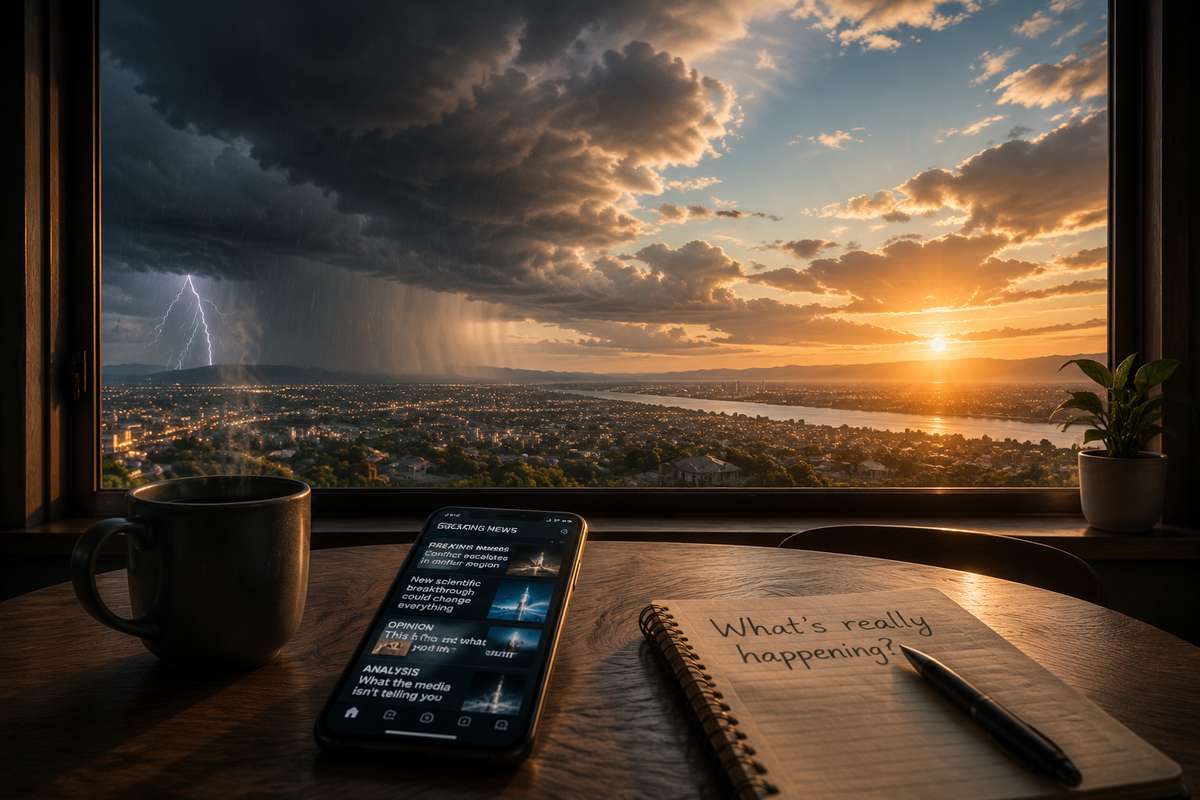
How humanity ended up living under the same sky while seeing different storms
The first thing many modern people do in the morning is not look out the window.
They look down.
A small rectangle of glass lights up in the darkness. Before the coffee has finished brewing, before the first conversation of the day has begun, before the outside world has fully entered the room, millions of people have already received their first version of reality.
A war has started somewhere in the world. A politician has lied again. A scientific breakthrough has changed what we thought was possible, while a society only a few countries away is facing a crisis of its own. Your own country may appear to be moving in the right direction today, but there is no guarantee that tomorrow’s headlines will not bring a completely different picture.
One voice warns you that something is terribly wrong.
Another tells you that the warning itself is the real danger.
One person believes they have found the truth. Another believes the truth has been deliberately hidden.
The strange thing is not that people disagree. Human beings have always disagreed. We have argued around fires, across dinner tables, in churches, parliaments and cafés. Disagreement is not a modern invention.
The strange thing is that more and more people seem to be standing in the same rain while describing completely different weather.
One person looks outside and sees a storm gathering on the horizon. Another sees a normal summer afternoon. A third insists that the clouds are not even real.
And all three may have a collection of experiences, information and evidence that makes their interpretation feel reasonable.
This is one of the defining experiences of the modern world. Not simply that we have more information than ever before, but that we increasingly struggle to create a shared understanding of what that information means.
Reality has not disappeared.
The difficulty is that sharing reality has become much harder.
For most of human history, information moved very slowly.
A person living in a small village did not wake up to thousands of competing explanations about events happening thousands of kilometres away. News travelled through people. Through conversations. Through stories repeated around tables. Through trusted voices and, very often, through gossip.
A rumour could still travel quickly, of course. Humans have always been fascinated by stories about other humans. Someone had seen something unusual near the river. Someone had heard that a neighbour was planning to leave. Someone claimed to know why the harvest had failed.
But information had limits.
It moved at the speed of human conversation.
And conversation came with consequences. If someone constantly spread nonsense, people remembered. Reputation mattered because you had to meet the same people again tomorrow.
The world was smaller, but it was also easier to map.
The human brain developed inside this environment. It learned to navigate a relatively small social landscape where information came from people we could see, hear and judge.
There could be a warning from a neighbour about a stranger approaching.
A change in the weather and the occational potential danger near the edge of the forest.
The human brain is an extraordinary system, but it was not designed for the world we built around it.
It was not designed for a constant global conversation where millions of voices compete for attention at the same time. Neither was it designed for waking up and immediately being asked to process wars, elections, economic predictions, scientific debates and social conflicts from every corner of the planet before breakfast.
The modern information environment is not simply larger - It operates by completely different rules.
And this is where the problem begins.
Our brains do not approach information like a computer searching a database. They do not collect every available piece of evidence, weigh everything equally and calmly produce an objective conclusion.
They search for patterns.
They look for meaning.
Most importantly, they try to reduce uncertainty.
For our ancestors, this was extremely useful. A person who quickly recognized danger had a better chance of surviving than someone who calmly considered every possible explanation for the movement at the edge of the forest.
But the same mental shortcuts that helped humans survive in a small world can become complicated in a world where every person carries the entire planet in their pocket.
When we encounter information that supports something we already believe, our brains often accept it more easily. When information challenges a deeply held belief, it requires more effort. It requires the uncomfortable process of asking whether we might have misunderstood something.
And we do not like that.
It is known as confirmation bias, but the name can sometimes make it sound like a flaw that belongs to other people.
It is not.
It is a human tendency.
The person who disagrees with us also searches for patterns. Their brain also prefers explanations that make sense of the world around them. They also want to feel that they are not completely lost in the unknown.
The problem is that our modern world provides more possible meanings than any single brain can comfortably process.
And when the amount of information grows beyond what we can reasonably understand, we do what humans have always done when faced with complexity.
We simplify.
We create stories that help us navigate uncertainty. We search for connections between events. We look for causes, intentions and patterns because a world that makes sense feels safer than a world ruled entirely by randomness.
For most of human history, this was not a major problem. The number of possible explanations was limited by geography, experience and the people around us. A person could be wrong about something, but the size of their world also placed limits on how far that mistake could travel.
Today, a misunderstanding can cross oceans in seconds.
A personal interpretation can become a movement. A rumour can become a political weapon. A single misleading image can travel further than a carefully researched article simply because it creates a stronger emotional response.
The challenge is not only that false information exists. False information has always existed.
The challenge is that modern information systems have removed many of the natural limits that once slowed it down.
The human brain is not the only system trying to navigate this new environment.
We have built another system to help us.
The algorithm.
At its simplest, an algorithm is a set of instructions designed to sort information. It helps us find what we are looking for in a world where there is far too much for any individual to discover on their own.
This was supposed to be a solution to information overload.
And in many ways, it has been.
Without algorithms, modern life would become almost impossible to navigate. They help us find music, news, research, places, people and ideas that would otherwise disappear in the endless amount of information produced every day.
But there is a difference between helping us find information and deciding what information finds us.
The systems that shape our digital environment are not primarily designed to answer one simple question:
"What is true?"
They are designed to answer another question:
"What keeps people engaged?"
This distinction changed the way information moves through society.
A carefully researched explanation and an emotional accusation do not compete under equal conditions.
One requires patience.
The other demands attention immediately.
Fear, anger and outrage are powerful human reactions. They make us stop scrolling, comment, share and participate. They create the kind of activity that digital systems are designed to measure.
The result is not necessarily that the most extreme information always wins.
Reality is more complicated than that.
But information that triggers strong emotions often receives advantages in a system where attention has become one of the most valuable resources in the world.
Over time, people begin to receive different versions of reality, not because they live on different planets or simply because they hold different political opinions, but because the systems around us have learned what we are most likely to respond to.
The same world enters through different doors.
And this is where the challenge becomes larger than technology itself.
Because information does not only shape what people know.
It shapes what people believe is happening.
A society can survive disagreement. In fact, disagreement is often a sign that people are engaged. Democracies are built on the idea that citizens can look at the same situation, reach different conclusions and still participate in a shared conversation.
The difficult moment arrives when people are no longer debating what should be done, but what is happening in the first place.
Before people can argue about the direction of a journey, they need some agreement about where they are standing.
Without that common ground, every discussion becomes a struggle over basic reality.
And this creates a vulnerability.
Not because humans are unusually easy to manipulate, but because humans have always depended on shared stories.
Communities are built on common understandings: ideas about what is important, what is trustworthy and what kind of future is possible.
The stories do not need to be perfect. No society has ever had a complete or flawless understanding of the world.
But societies need enough shared reality to coordinate.
A bridge can only be built when the people designing it agree on the basic principles that make it possible.
A medical treatment can only be developed if researchers agree that evidence matters.
A democracy can only function if people believe that, despite their differences, they are still participating in the same conversation.
When that foundation becomes weaker, information itself becomes a place of conflict.
For much of human history, conflicts were fought over territory, resources and political power.
Today, another battlefield has become increasingly important.
The human understanding of reality itself.
Information has always been connected to power. Kings controlled official histories. Governments shaped narratives. Newspapers influenced public opinion. Propaganda is not a new invention.
What has changed is the speed, scale and accessibility.
A message created in one part of the world can reach millions of people before most have had time to understand where it came from. A false claim can travel alongside a verified report, presented through the same channels and often with the same appearance of credibility.
Modern information warfare does not always aim to make people believe one specific version of events.
Sometimes the goal is more subtle.
To create exhaustion.
To make people conclude that nobody knows anything and that every source is equally unreliable.
Because a society where people disagree is difficult.
But a society where people no longer believe that truth can be found at all is much easier to destabilize.
Perhaps this is one of the most important distinctions of our time.
The problem is not disagreement.
Disagreement is a natural part of human society. In many ways, it is a sign that people are participating. A healthy society does not require everyone to think the same way. It requires people with different perspectives to still believe that they are part of the same conversation.
The greater danger appears when the conversation itself begins to disappear.
When every source is considered equally unreliable, when every institution is assumed to have hidden motives, and when every piece of information becomes nothing more than a weapon used by someone else, the result is not necessarily greater freedom.
It can also create a form of helplessness.
A person who believes nothing can be known has fewer reasons to search, compare or question. A constant flood of conflicting information does not always produce curiosity.
Sometimes it produces exhaustion.
And exhaustion changes the way people relate to the world.
But perhaps the most important question is whether our current situation is as unique as it feels.
Every generation experiencing a major transformation in communication has gone through a period where the old ways of understanding the world no longer seemed sufficient.
The printing press offers one of the clearest examples.
When books and pamphlets became easier to produce in Europe during the fifteenth century, information suddenly escaped the boundaries that had previously controlled it. Ideas could travel further and faster than ever before. Religious debates, political arguments, recipes and competing explanations of society spread across countries and communities.
It was one of the greatest expansions of human access to knowledge.
But it was not an immediate age of enlightenment and reason.
The first consequence of the information revolution was not necessarily clarity.
It was chaos.
Old authorities were challenged. New movements appeared. Rumours travelled alongside discoveries. False claims existed alongside genuine attempts to understand the world.
People suddenly lived in an environment where there were more explanations competing for attention than society had developed methods to evaluate.
The problem was not that people became less intelligent.
It was that the information environment changed faster than their ability to navigate it.
There is something familiar about that moment.
The technology is different. The speed is different. The scale is almost impossible to compare.
A printed pamphlet in the sixteenth century could influence a town, a region or eventually an entire country.
Today, a message can cross the planet before most people have had time to ask where it came from.
But the underlying human challenge remains surprisingly similar.
A new information system has arrived before our global society has fully learned how to live with it.
Throughout history, humans have responded to this kind of uncertainty by creating new ways to question, compare and correct their own understanding.
The scientific method is one example of this.
Not because scientists are incapable of being wrong. They are.
Not because scientific institutions are immune to mistakes. They are not.
Its strength comes from accepting something deeply uncomfortable about being human: we are all capable of misunderstanding the world, including ourselves.
The value is not that it creates a world without errors.
It creates a process where errors can be discovered, questioned and corrected over time.
It does not begin with certainty.
It begins with curiosity, observation and the willingness to change our minds.
In a world filled with competing explanations, this may be one of the most important lessons.
Not every claim has equal evidence behind it. Not every explanation deserves equal trust. But every person shares the same human vulnerability: the ability to become convinced that we understand something before we truly do.
Certainty is attractive because it feels like solid ground.
It tells us that we know who is right, who is wrong and what should happen next.
But reality rarely offers that kind of simplicity.
The world is not a collection of separate stories where one person has all the correct information and everyone else is simply mistaken. Reality is the result of billions of human experiences, decisions and consequences interacting with each other at the same time.
This does not mean every interpretation is equally valid.
Facts still matter. Evidence still matters. Some explanations are better supported than others.
But understanding the world requires something that has become increasingly difficult in an environment built around speed and reaction.
Patience.
The patience to look beyond the first explanation.
The patience to ask why something feels true.
The patience to accept that someone we disagree with may understand a part of the world that we have missed.
Perhaps the most important skill in the modern information age is not knowing everything.
That has become impossible.
It is knowing how to continue searching while remaining open without becoming lost. To question without becoming cynical, and to change your mind without feeling that you have lost a part of yourself.
These are not spectacular abilities. They rarely create dramatic headlines or attract millions of views.
But they may become increasingly important in a world where attention is constantly competing with understanding.
Perhaps this is the uncomfortable reality of living in the modern information age.
We will not return to a world where information moves slowly, where communities share the same limited sources, or where reality arrives through only a few trusted voices.
That world had its own problems. It could exclude people. It could preserve mistakes for generations. It could allow those with power to decide which stories were remembered and which disappeared.
The challenge we face today is not that we have too much knowledge.
It is that knowledge, opinion, emotion and uncertainty now arrive together, often before we have had time to understand the difference between them.
Learning how to separate them may become one of the great challenges of our generation.
Perhaps the first step is simply accepting that we are living through a transition.
The systems around us have changed faster than our habits, our institutions and our understanding of ourselves.
We are still learning how to navigate this new landscape.
There will be mistakes.
There will be confusion.
There will be moments where the world feels impossible to understand.
But perhaps that feeling is not evidence that reality is collapsing.
Perhaps it is evidence that we are trying to adapt to a reality that has become larger, faster and more complicated than anything previous generations experienced.
The sky has always been the same sky.
People have always looked upward and tried to understand the weather.
Some saw signs of coming storms. Others saw opportunities for sunshine.
The difference today is that we are no longer standing in the same village, looking at the same horizon.
We are standing across an entire planet, each carrying our own experiences, our own instruments and our own forecasts.
The challenge is not to create a world where everyone sees exactly the same clouds.
That may never happen.
The challenge is to remember that we are still standing beneath the same sky.
And perhaps, in an age where certainty is everywhere and understanding is harder to find, the most valuable thing we can carry with us is not the belief that we are always right.
It is the willingness to keep looking.