Light Bulbs and Privacy
Buying a light bulb used to require a shop and a few coins. Today it may require cookies, newsletters, analytics consent and yet another password. Somewhere along the way, shopping became an exercise in digital identity.

It all started because a light bulb died.
Nothing dramatic.
No explosion.
No sparks.
It simply did what light bulbs have been doing ever since Edison decided it might be nice to see things after sunset.
It stopped working.
So I did what people of my generation have been trained to do:
I went online to buy a new one.
It turned out to be a surprisingly naïve plan.
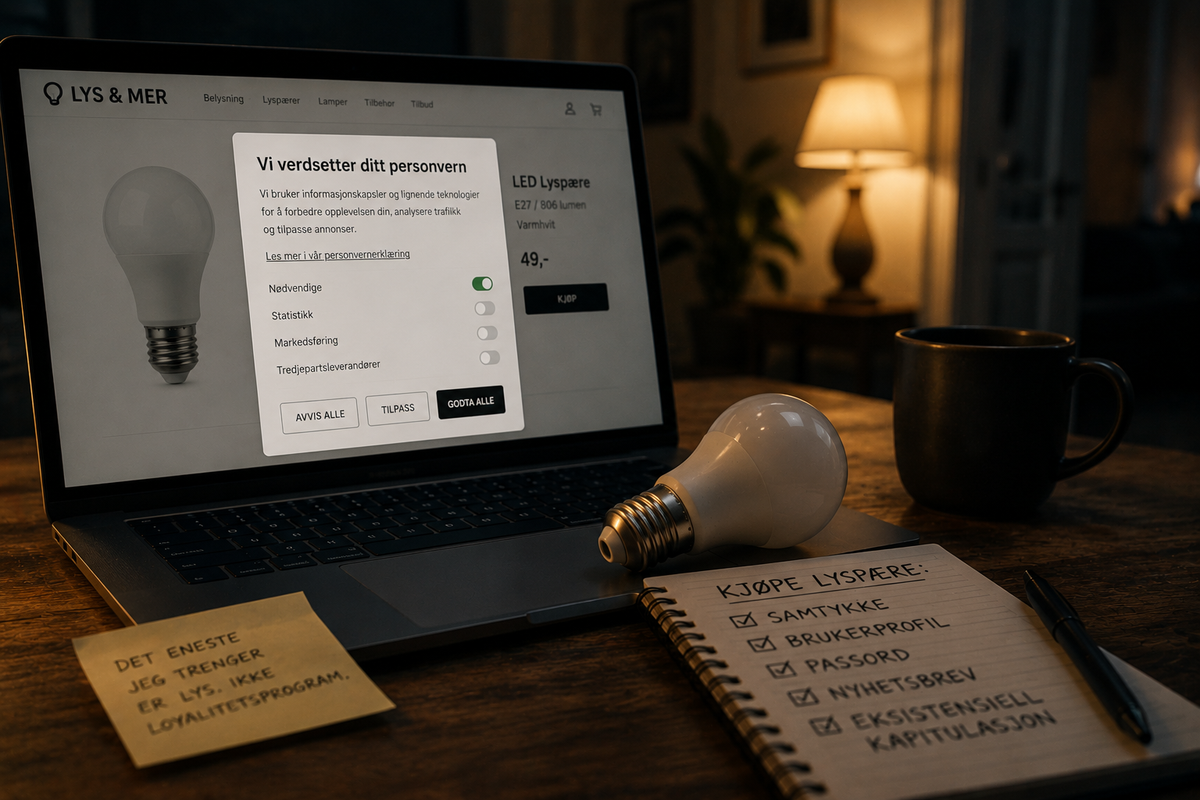
I opened an online shop. Before I even caught sight of a single light bulb, I was greeted by a question about cookies.
"We value your privacy."
It's an interesting choice of words.
I've never met anyone who demonstrated how much they valued something by putting a window in front of your face and refusing to let you continue until you'd clicked one of five different buttons.
I didn't want to share personal information.
I wanted a light bulb.
Yet I still had to make decisions about analytics, marketing partners, third-party providers and personalised advertising, as though buying a replacement bulb could somehow have geopolitical consequences.
After clicking "Reject All" in three different places, I was finally allowed to see the product.
Then came the next obstacle.
"Create an account to complete your purchase."
An account.
For a light bulb.
I'm not adopting a child.
I'm not applying for a mortgage.
I'm buying a small glass object containing a filament and an expected lifespan of about five years.
Yet the website wanted my name, email address, a password and permission to send me newsletters.
This is usually the point where I begin wondering whether the internet is really just one enormous machine for collecting personal data, and the products are merely a convenient excuse.
Once upon a time, you walked into a shop and said,
"I need a light bulb."
The assistant replied,
"Here's a light bulb."
And that was the end of the story.
Nobody asked whether I'd like personalised offers on lighting products.
Nobody wondered whether I'd be interested in receiving a monthly newsletter featuring exciting developments from the light bulb industry.
Today I can't even buy a lamp for the hallway without first establishing a digital identity.
By now I have so many user accounts that I'm beginning to suspect there are websites out there that know me better than some of my relatives.
I have accounts with streaming services, newspapers, parking apps, ticket companies, online retailers and probably one that sells gardening equipment—even though I don't have a garden.
And every time I visit another website, I have to make another decision about cookies.
I accept more cookies in a week than I eat in a year.
Nobody reads these texts.
We click our way through them with the same weary resignation that people once signed documents they didn't understand.
I'm no longer sure I've consented to anything.
I think I've simply surrendered.
Eventually, I bought the light bulb.
Admittedly, I first had to create an account and invent a password with twelve characters, one capital letter, one special character and a symbol that probably represents an extinct Phoenician god.
So now I own a new light bulb.
And a new online account.
I'm just not sure which one will last longer.