Modern Humans Are Just Passwords and Receipts
Modern life is less about living than remembering passwords, collecting receipts, and proving to machines that we are who they already know we are. A humorous essay about the quiet absurdities of the digital age.

I don't think we were built for this.
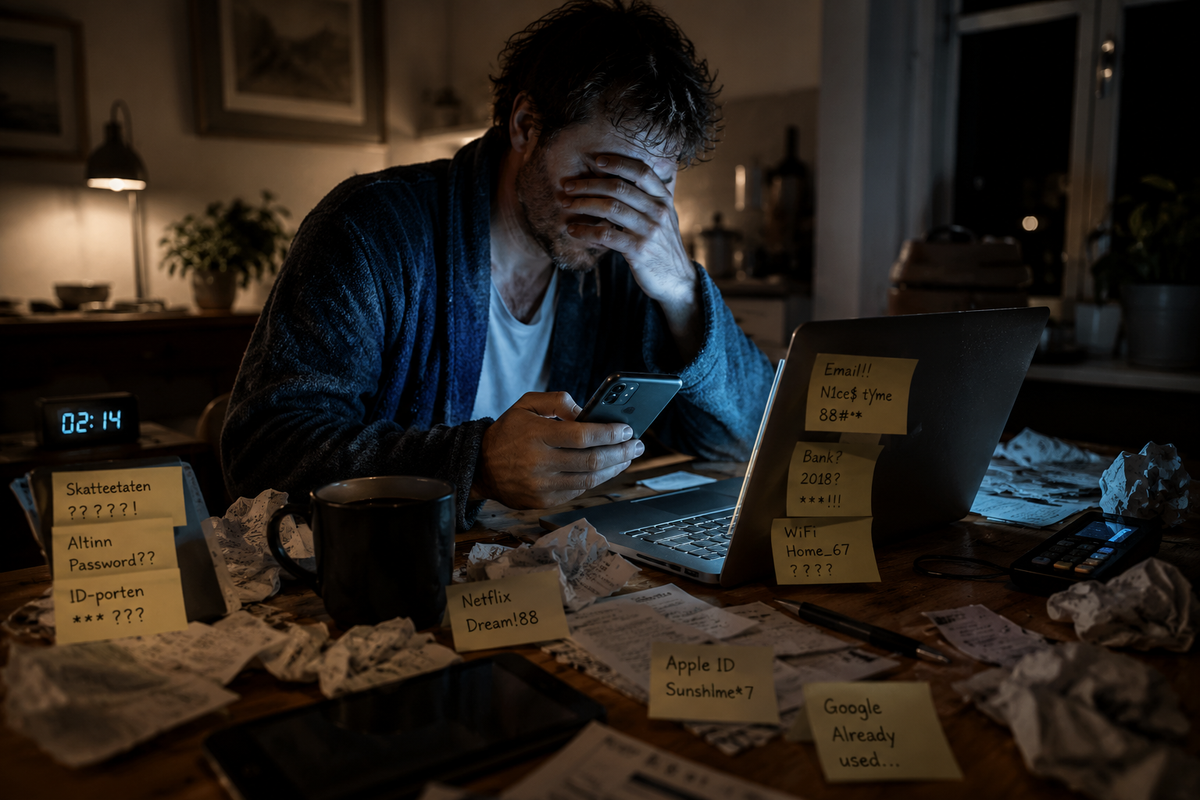
I don't think evolution spent millions of years developing nervous systems, language and opposable thumbs just so that one day we'd find ourselves sitting in our underwear at 2:14 a.m., desperately trying to remember whether the password for our tax account ended with an exclamation mark or a question mark.
And yet...
Here we are.
Modern humans exist primarily as a series of logins.
You're no longer an individual.
You're a temporarily authenticated user session.
I have a complicated relationship with passwords.
Not because I don't understand the concept.
But because society apparently expects me to possess the memory of a chess grandmaster combined with the security clearance of a nuclear submarine commander.
There was a time when passwords could be simple.
Your dog's name.
Your favourite band.
A random word.
Now every password must include:
one capital letter,
one symbol,
one number,
an unresolved emotional issue,
a childhood trauma,
and at least ten characters written in blood beneath a full moon.
And naturally, it can't resemble any of the previous thirty-eight passwords you've already used.
The most arrogant thing modern technology does, however, is pretending it's helping.
Your phone cheerfully announces:
"We've saved your password."
Then two years pass.
You try logging in from a new device.
Suddenly your phone develops complete amnesia.
"Sorry. We don't recognize you anymore."
There you sit.
A digital refugee inside your own life.
Several times a year my entire existence comes to a complete halt because I'm missing one crucial code.
Partly because I still cling to ageing electronics that are periodically replaced by slightly less ancient electronics.
Partly because the human brain apparently performs a factory reset after three weeks abroad.
I can come home from a trip and suddenly have no idea how to exist administratively.
How do I log into my electricity provider?
Where did I put my digital ID?
What's the Wi-Fi password again?
Did I ever have a password for this?
Have I ever really been in control of anything?
Then comes identity verification.
This is where technology stops being inconvenient and becomes personally hostile.
First you enter your password.
Then you receive a verification code.
Then you approve the login.
Then you take a selfie.
I can tolerate a lot.
But the moment a computer asks me to smile in order to prove that I'm human, I begin to worry ever so slightly about the future of civilisation.
And what happens if the selfie gets rejected?
You do it again.
"Your face doesn't match your face."
Well.
Thank you for that.
It's remarkable how quickly a fully grown adult can regress into an angry primate shouting at a smartphone.
But perhaps receipts are even sadder than passwords.
Passwords are at least about access.
Receipts are about guilt.
Every month I tell myself:
"This time I'm going to keep every receipt and finally get my finances organized."
Three days later...
There are crumpled pieces of paper scattered through jacket pockets, backpacks and jeans like tiny financial crime scenes from a budget that died young.
And yet I almost always say yes when the cashier asks whether I'd like the receipt.
Not because I need it.
But because I'm somehow convinced that if I leave without it, a security guard will immediately arrest me over a forgotten bag of gummy candy hiding at the bottom of my backpack.
Modern humans live in a permanent state of administrative paranoia.
Perhaps the strangest thing of all is how many new problems technology has created while solving the old ones.
Yes.
Things are faster now.
Yes.
We no longer carry little security tokens.
Yes.
You can scan your passport with your phone.
But hold on.
Why can we scan passports with our phones?
I recently checked in for a trip simply by holding my passport against my mobile phone, as though I was trying to pay for myself.
Nobody thought this was remotely strange.
We casually walk around carrying pocket-sized machines capable of reading our identities...
...and society collectively responds:
"Convenient."
Nobody asks any more questions.
It's as if humanity silently agreed not to think too hard about any of it.
Then there are the notifications.
Those endless little digital woodpeckers pecking away at your attention all day long.
First you get a reminder about a meeting.
Then a reminder reminding you about the reminder.
Then a notification explaining that you haven't responded to the reminder.
Then an email informing you that another notification is on its way.
At some point it begins to feel as though half of adult life consists of confirming that you still exist.
Click HERE to continue.
I'm beginning to understand why some people disappear into the woods.
Not because they hate society.
But because they simply can't face another round of two-factor authentication.
Of course, there are people who seem perfectly comfortable inside modern systems.
These people usually work for the systems.
They navigate government websites with a resting heart rate of forty and somehow know the difference between PDFs, authentication apps and digital tax portals without breaking a sweat.
I don't entirely trust them.
There's something faintly supernatural about people who say:
"It's actually quite simple."
No.
If something requires six logins, a facial scan and a verification code sent by text message to a phone that no longer supports software updates...
...then it isn't simple.
It's merely well-disguised administrative violence.
Maybe that's why modern people always seem so exhausted.
Not because of wars.
Not because of work.
Not because of existential dread.
But because every single day we have to prove who we are...
...to machines that already know everything about us.