
Modern Loneliness
We have hundreds of online connections, yet many of us don't know who to call when the washing machine breaks down or a wardrobe needs carrying downstairs. Perhaps modern loneliness isn't about being alone—it's about lacking a safety net.

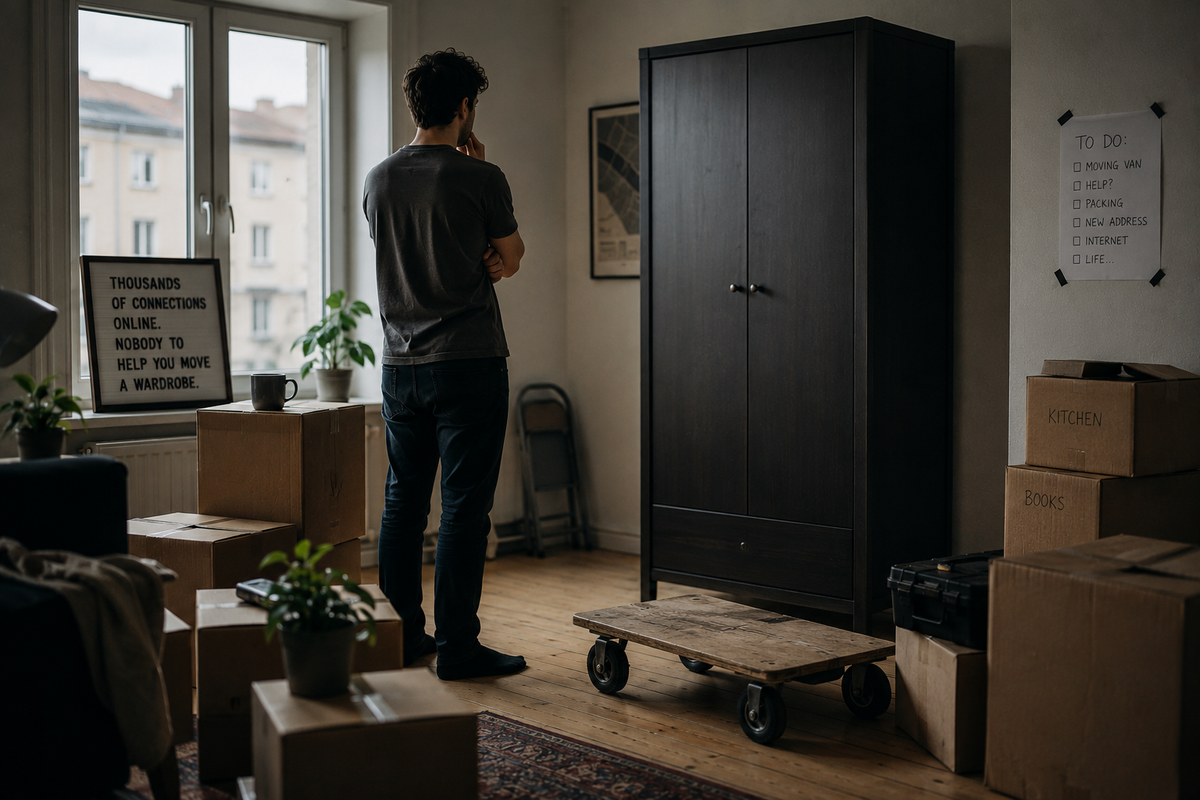
When You Need Help Carrying a Wardrobe
We have a thousand friends online and nobody who can drive a van.
By Jonas Steinarsen
I don't think modern loneliness is necessarily about sitting alone on a Saturday night.
I think it's about standing in a flat with a wardrobe that needs carrying down three flights of stairs and not knowing who to call.
It's a strange realisation. You may have hundreds of people on Facebook. You follow people on Instagram. You're in group chats, Discord servers and have a phone full of contacts. In many ways, you're more socially connected than any generation before you.
And yet you can find yourself in the middle of a house move—or a small personal crisis—and realise you're actually quite alone.
Because what is a network?
Is it the number of people who like a photo of you online?
Or is it the people who turn up when your washing machine breaks down, when you need somewhere to sleep, or when a wardrobe has to be carried down a staircase?
I think more and more of us are discovering that the difference between those two things is greater than we'd like to admit.
Connected, But Not Necessarily Bound Together
We live in an age where we can talk to people on the other side of the world in seconds. We can send messages, share photos and comment on each other's lives in real time.
But there's another kind of closeness that can't be digitised.
Practical closeness.
The kind that means having someone you can ask for help.
Someone who can collect you from the train station.
Someone who can feed the cat.
Someone who can lend you a drill.
Someone who can help you move house.
These are the relationships that rarely appear on social media, yet often determine how secure life feels.
And I think many young adults are poorer in exactly this way than we'd like to believe.
We've Become a Society of Small Islands
People move away to study.
They move for work.
They move for love.
Then they move again.
And again.
Eventually, many of us find ourselves in a new city with a handful of acquaintances, a few pleasant colleagues and a family living several hours away.
We know people.
But we're not necessarily woven into each other's lives.
There's a difference between knowing someone and being able to call them and say:
"Hi... I know this is a bit of an odd question, but could you help me carry a wardrobe?"
Asking for help requires something more than friendliness.
It requires trust.
It requires closeness.
It requires feeling that you're allowed to be an inconvenience.
Men Are Often Especially Bad at This
There are many things men learn to say.
"I'm fine."
"I've got it."
"Don't worry about it."
There are also many things men never learn to say.
Like:
"I need help."
I think many men carry around a strange belief that independence is the same thing as strength.
That you're supposed to cope on your own.
Sort things out.
Solve your own problems.
Never become a burden.
The result is that many men build lives that work perfectly well—as long as everything goes according to plan.
But life rarely goes according to plan.
Sometimes you have to move.
Lose your job.
Become ill.
Go through a relationship breakdown.
That's when you suddenly discover how important a support network really is.
And how painful it is not to have one.
Society Assumes We Have Help
One of the strange things about adult life is how many systems quietly assume that you have people around you.
Moving house?
Well, surely you know someone with a van.
Need somewhere to stay between rental contracts?
Surely you can stay with someone.
Need to collect a piece of furniture?
Surely you know someone with a trailer.
Lost your job?
Surely you've got a bit of support back home.
It's as though society has been built around an invisible assumption:
That everyone has a practical safety net.
But many people don't.
Not because they're unsociable.
Not because they're unfriendly.
But because modern life has made our networks smaller, more scattered and more fragile.
Loneliness Isn't the Absence of People
I think modern loneliness is something much more concrete.
It's the feeling that everything rests on your shoulders alone.
If you become ill, you have to deal with it.
If you're moving house, you have to deal with it.
If something goes wrong, you have to deal with it.
It's a kind of loneliness that isn't necessarily about lacking company.
It's about lacking a safety net.
And perhaps that's why so many young adults seem exhausted.
Not because we're weak.
Not because we lack initiative.
But because we're living lives that require ever more coordination, while more and more of us are carrying the responsibility alone.
I'm beginning to understand that adulthood isn't primarily about money.
It's about people.
About who you can call when the washing machine breaks down, when you have to move house, or when life suddenly falls apart.
And if there's nobody you can call, you discover something else:
You have to manage absolutely everything on your own.