Nobody Is Driving the Bus
As children, many of us believed that somewhere, someone was in control. As adults, we gradually discover something far more unsettling—and perhaps more hopeful. A reflective essay about uncertainty, responsibility and the quiet power of human agency.

By Ulrikk K. Reen
I used to believe that adults knew what they were doing.
Not everything, of course. I never expected my teacher to explain the universe or the Prime Minister to have all the answers to life. But I assumed that somewhere, someone understood how it all fit together. Someone was looking at a map much larger than mine.
When something went wrong, someone would step in.
When a crisis emerged, someone would have a plan.
When the world began to wobble, someone would keep their hands on the wheel.
It turns out that many of us move through life carrying this quiet assumption. First as children, and later as adults who still hope there is a room behind the room. A floor above the one we occupy. A place where the people in charge are, in fact, in charge.
Then one day you discover something deeply unsettling.
There is no such room.
Or if there is, it is just as chaotic as everywhere else.
We live in what should, on paper, be the most controlled period in human history.
My phone knows where I am.
My bank knows what I bought for breakfast.
Algorithms know which videos make me stop scrolling.
Traffic cameras watch the roads.
Satellites watch the weather.
Computers watch almost everything else.
And yet the world feels less stable than it has in decades.
Wars break out that nobody seems able to stop.
The climate changes faster than politics.
Technology evolves faster than legislation.
Trust disappears faster than solutions appear.
Never before have we collected so much information.
Yet it often feels as though nobody knows what to do with it.
A few months ago I was sitting in a café, absent-mindedly scrolling through the news on my phone.
Within five minutes I had read about a flood, an armed conflict, a stock market crash, a new AI model and a study suggesting that loneliness could shorten your life.
The very next thing my phone showed me was a golden retriever riding a skateboard.
I remember laughing.
Not because it was funny.
But because the contrast felt like the most accurate description of our age I had seen all day.
Everything happens at once.
Everything demands attention.
Nobody has time to understand one crisis before the next one arrives.
The Myth of Control
We like to talk about control as though it were something tangible.
But perhaps control has always been a story we tell ourselves.
Kings claimed to control history.
Churches claimed to control truth.
Governments claimed to control society.
Parents claimed to control the family.
Perhaps those stories endured because they gave people a sense of reassurance.
Not because they were true.
Because the truth is that the world has always been chaotic.
The difference today is that we receive notifications about the chaos every three minutes.
Perhaps the defining condition of modern life is not a lack of control.
Perhaps it is our growing awareness of just how little control has ever existed.
We know too much.
We see too much.
We carry too many crises at once.
The result is a strange kind of collective vertigo.
People make five-year plans while wondering whether their jobs will still exist in five years.
They try to buy homes in markets that increasingly behave like casinos.
They search for love through apps that often resemble slot machines.
They attempt to plan their future in a world that keeps rewriting its own rules.
And yet something interesting begins to happen once the illusion of control starts to crack.
You discover that something else remains.
Not control.
Agency.
The distinction matters.
Control is about determining the outcome.
Agency is about deciding how you respond to it.
You cannot control the economy.
But you can help your neighbour.
You cannot control the climate on your own.
But you can plant something.
You cannot control world politics.
But you can vote.
You cannot control tomorrow.
But you can cook dinner for a friend tonight.
What Remains
Perhaps this is what remains once the great systems no longer seem all-powerful.
The small things.
Conversations.
Love.
Friendships.
Art.
Humour.
A warm cup of coffee.
The message you send to someone you've been thinking about.
The pot of soup you make on an ordinary Tuesday evening.
The seemingly insignificant acts that, when you look closely enough, turn out to be the things holding society together.
So, is there any control left in the world?
Yes.
Plenty.
But it is fragmented.
Scattered.
Often far less impressive than we like to imagine.
Nobody is sitting at the top, pulling every string.
Nobody possesses the complete map.
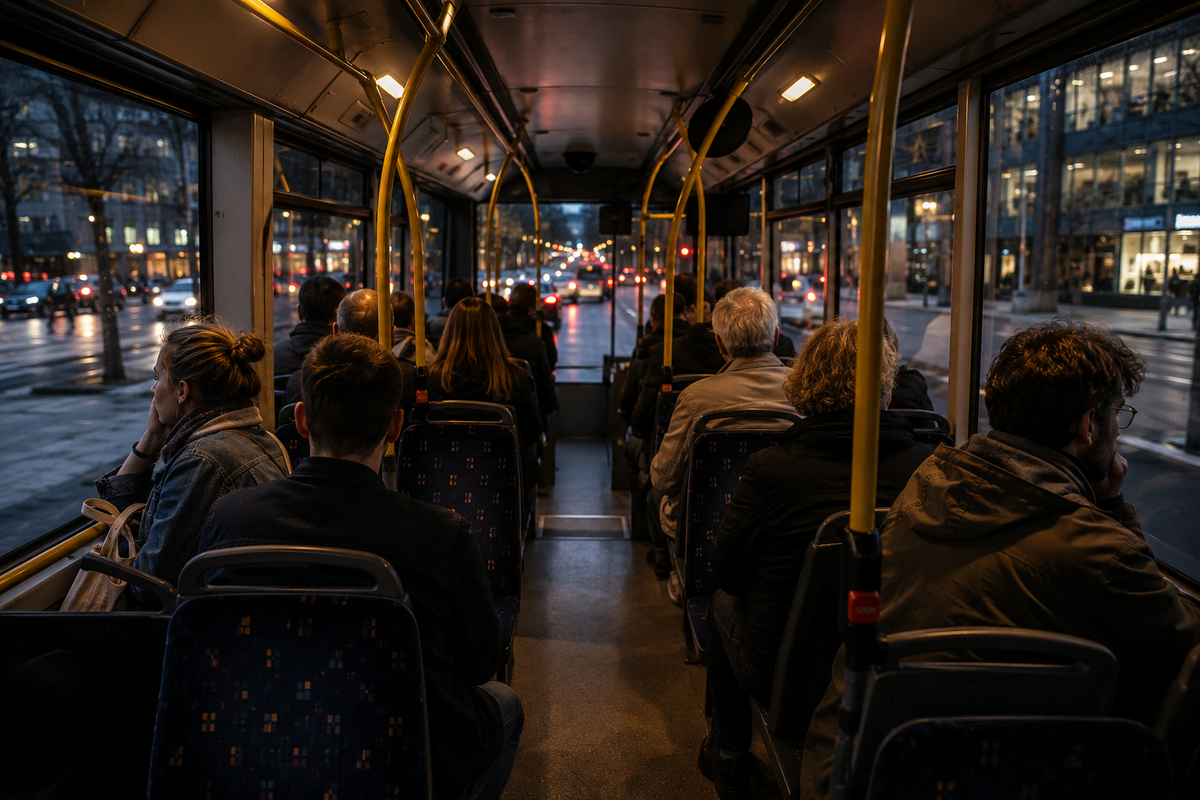
Nobody is really driving the bus.
Perhaps the most surprising thing is that the bus keeps moving anyway.
And that despite the noise, the crises and the uncertainty, we are all still travelling together.
That may not be particularly comforting.
But it is true.
And at the moment, truth feels more valuable than comfort.