One Year of Words
Jack Mikkel Revheim is writing a book without a title, a deadline for publication, or a clear ending. RABAGAS Magazine meets the author halfway through a year-long experiment in creativity, chaos, and documenting life.

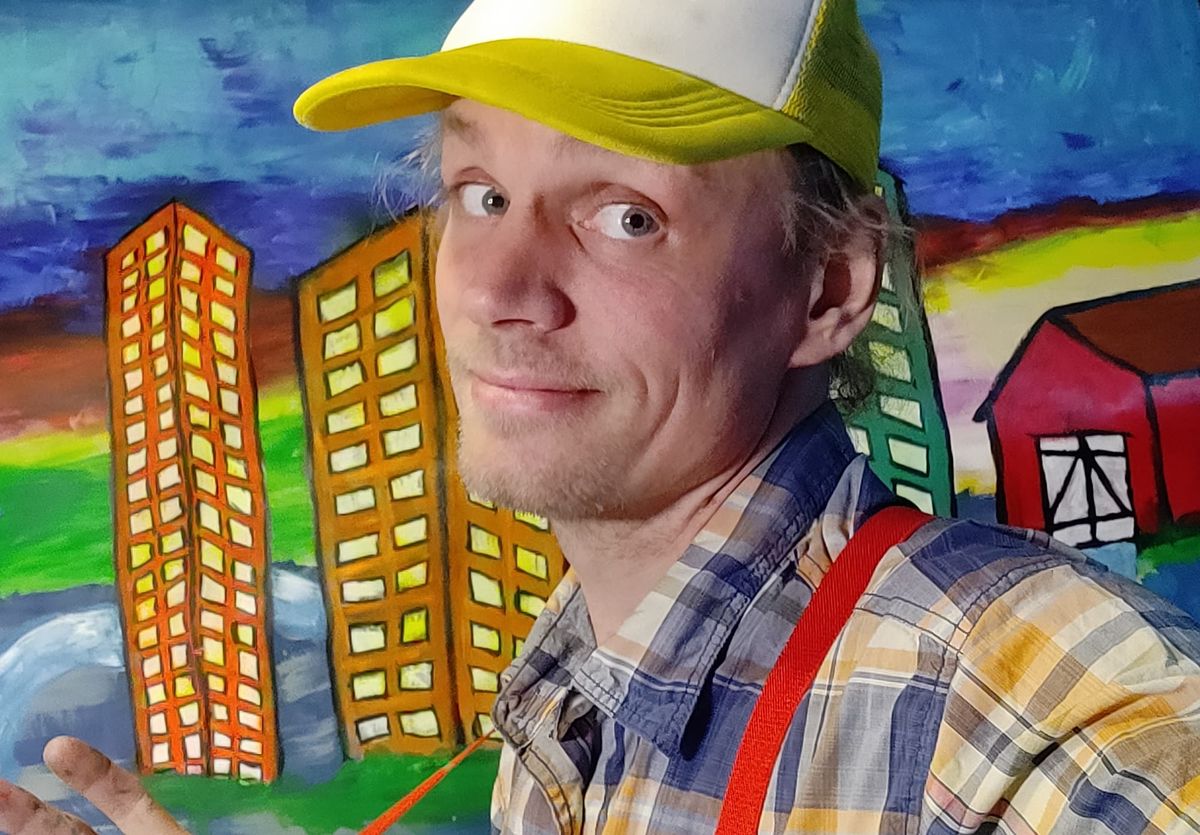
by Hampus Fickelton
Some stories are about people who have already arrived. Others are about people still trying to find the road. This is one of those stories.
The book that nobody knows the name of yet will not be finished until November 10, 2026.
RABAGAS Magazine has been fortunate enough to borrow some of the raw material that is slowly, but steadily, taking shape — even though these pages will appear in print long before the actual book ever does.
Join us as we visit the author at home in this piece of field report.
Jack Mikkel Revheim has been travelling to gather material for a new chapter of the book. Along the way, he meets Hampus Fickelton, co-editor of RABAGAS Magazine and a man with an almost unhealthy enthusiasm for everything related to investigative field journalism.
Unfortunately, I did not get to enjoy the luxury of being the observer this time. I had been assigned an interview for RABAGAS Magazine — and those assignments are not exactly the kind you turn down.
The interview was with the relatively new writer Jack Mikkel Revheim, a man who has not actually published a book yet. He is also my friend, and someone I know extremely well.
Which, naturally, meant we agreed to do the only reasonable thing.
We just went ahead with the interview.
That day, I meet him in an apartment on Suttestadvegen in Lillehammer.
He has borrowed it from a close friend while she has gone off to protest against the rule of law and the Kingdom of Norway. The battles had taken place in the windy and slightly icy streets of Bodø.
The latest telegram from the north had reported serious damage. She had broken her arm in two places after a physical confrontation with an overconfident electric scooter.
The incident resulted in ten hours at the hospital and a taxi bill they refused to reimburse because she apparently spoke the wrong dialect.
Jack Mikkel opens the door, gives me a hug, and says:
“Luckily, she won’t be back for another two days. We should be able to finish before then.”
I am not entirely convinced.
I give him a sideways look.
Knowing Jack Mikkel Revheim as I do, I am not sure there is any realistic amount of time that would be enough to fully cover the person sitting in front of me. Even with a month, I suspect I would only have reached the introduction.
But I decide to give it a chance.
“Let’s start with the most obvious question,” I say, managing to hold Jack’s attention long enough to ask:
— What are you doing here? Why aren’t we meeting at your place?
“It has a nice view here, doesn’t it?” Jack replies, trying to disarm the question with humour.
It is a good attempt.
But he does not get away that easily.
“The view is probably nice at your place too. As far as I know, you just moved somewhere new. To a farm, didn’t you?”
“It doesn’t really feel like home there,” he says. “So I don’t really want to be there.”
Besides, he has to move again anyway.
Within four weeks.
Of course, at Jack’s place, the move had already escalated into complete overload. He had barely managed to get out of bed for two weeks. Meeting here was simply easier.
I did not say anything.
Driving all the way to Nedre Svatsum would have added forty minutes of extra travel time each way.
Although, there is always a small satisfaction in being able to add some respectable mileage to the magazine’s travel log.
I ask him about transportation.
“You still haven’t got your driver’s license?”
“Nope,” he says, happily.
I see very little of the depression he described from the previous two weeks.
“There are two buses and the journey takes one hour and seventeen minutes. It’s actually possible to do it once in the morning and once in the evening. And they often have what we call taxi-for-bus services here — taxis that take over when running the bus route is no longer practical.”
“And now you’re going to write a book?”
“Working on a book,” he corrects me.
“Do you have a publication date?”
“No.”
He says it completely calmly, as if spending a year of your life on a project without a release date, a title, or any real guarantee that it will ever become anything at all is the most natural thing in the world.
“But you’re writing for one year? How did this project come about?”
Jack leans back slightly before answering.
“November 10 is my fortieth birthday. I’m not particularly interested in celebrating it, but I feel like I owe myself some kind of accounting. Or at least a plan for the future.”
He shrugs slightly.
“Besides, I wanted to try to describe what life is like as an adult — a person approaching forty — without really having much to show for it.”
The project was born during the Christmas holidays.
Everything he writes between January 1 and the day he turns forty can potentially become part of the book. The editing will only begin after the milestone itself has passed.
“This is just the production phase right now,” he says. “Raw, unfiltered, and completely unedited.”
He estimates that the project is roughly halfway completed.
“And are you actually getting anything written?”
“Oh yes. Absolutely. But it’s difficult to keep the momentum going every single day, so it comes in waves.”
Still, Revheim believes he is on track.
He recently spent a couple of weeks travelling, and during those fourteen days he wrote more than fifty pages.
Those travel letters are the pieces that eventually found their way into this magazine.
Eventually, coffee arrives on the table.
It has taken some time. I see him appear from the kitchen three separate times with the kettle in his hand before it actually happens. Apparently, he is also in a talking mood, because there is no shortage of entertainment while I wait.
“What is your driving force?” I ask once we are both sitting there with a mug in our hands.
“It’s not every day that I have some particular motivation,” he says, looking at me seriously.
“But when I find a project I truly care about, that’s different. Then it’s full speed ahead and no brakes until either it’s finished or it grows into something bigger than itself. But if I don’t care about something, you can forget it. I get these mental barriers, and I can’t lift a finger.”
“So you’re basically a project worker?” I suggest.
“I’m just incredibly tired of working on things that aren’t my own. I’ve probably had forty jobs, and I’ve been fired from every single one that wasn’t project-based.”
“Why do you always get fired then?”
“When I’ve learned all the systems, I get bored pretty quickly. And then I either become creative or destructive just to fill the empty space. If I see something that could be improved, I tend to fix it too quickly — without necessarily checking with my boss first.”
“So that’s where things usually go wrong?”
He blows on his coffee, as if it needs a little more time before it is worth drinking.
“Yes. Or… not always ‘go wrong’. It’s more that the system I’m in eventually stops being compatible with the way I think. And then I start fixing things I was never actually responsible for fixing.”
I nod, but let the answer sit there for a moment.
“But that has to affect other people, doesn’t it?”
He shrugs, almost slightly frustrated by the question.
“Of course it does. But it also affects me to pretend I don’t see it. That’s what people don’t understand. I can’t just stand there and watch something not work when the solution is obvious.”
“And that’s where you become destructive?”
He smiles briefly, without humour.
“That’s what they call it. I just call it… rapid iteration.”
I laugh a little, but he does not let it become a joke.
“The problem is the speed,” he continues. “I skip the middle steps. I don’t always ask. I just do. And technically, it often works. At least from a practical perspective. But socially… it’s not always equally popular.”
For a moment, the room goes quiet.
The kitchen clock suddenly seems much louder than it should.
“Have you ever thought that maybe you’re just… not built for ordinary jobs?” I ask.
He looks down into his cup.
“Yes. But it’s a pretty depressing answer. Because it means the alternatives are either adapting myself to something I don’t fit into, or creating something of my own that doesn’t really fit into anything either.”
He takes a sip of coffee.
“So I’m trying to figure out which one is worse.”
I decide to change the subject.
“Why do you want to write this book?”
“Because I don’t really have anything better to do. And I have this secret dream of being able to make a living as a writer. I’ve been writing for as long as I can remember. Ever since I cracked the code and learned the entire alphabet, I’ve been fascinated by text as a way of communicating.”
He pauses.
“It’s probably one of the few things I can actually imagine myself doing in the future. But I find it difficult, with ADHD and everything. Have you seen the list of things you’re supposed to send with a submission or a manuscript to a publisher? Formats, rules, guidelines, all the lines you’re expected to stay inside. It doesn’t really work for me when all I want to do is create.”
He pushes the mug slightly back and forth across the table.
“I understand the system. I really do. I understand why they need systems. But it clashes a bit with the way I function. I get ideas all the time. And not just small ideas either. Entire… structures.”
He looks down at the table.
“And then you’re supposed to somehow squeeze it into a form that doesn’t allow anything to exist outside the lines.”
He looks up again, a little more directly now.
“And ADHD doesn’t exactly make it easier. It’s not a lack of ideas. It’s a lack of brakes. Or filters. I can jump from one thing to something completely different within two minutes if the new thing is more interesting. And that’s obviously not how ‘submitting a book to a publisher’ is supposed to work.”
He runs a hand through his hair, slightly restless.
“But I think that’s exactly why I want to write a book. Because it’s the one place where having chaos in your head actually makes sense. In a way, you’re allowed to be like that in there. You don’t have to clean everything up before you’re allowed to exist.”
He shrugs.
“And it’s probably a little naive too. I know that. But I’ve been thinking that if I’m already difficult to place in the workplace, I might as well try to be difficult to place in book form as well.”
He laughs slightly, but it is not really laughter — more like an exhale looking for somewhere to land.
“That’s the strange thing about it,” he says. “You’re supposed to write something alive, but deliver it as if it’s dead. Everything has to be the right format, the right length, the right… everything. And if you miss one thing, the answer is simply: ‘No, thank you.’”
“BUT HOW ARE YOU ACTUALLY DOING?”
I ask the question because, from the outside, the situation sounds quite dramatic. Doctor’s appointments. Close follow-up. A life being carefully monitored.
“It depends on when you ask me,” Jack says after a small pause.
Another pause.
Then:
“Do you actually believe in the future?”
No hesitation.
None.
No grand expectations for himself. Or humanity.
“But that might just be today talking.”
The psychologist wanted me to explain why I am not particularly enthusiastic about large social gatherings.
It is difficult to explain that part of it comes from the fact that I take up a lot of space wherever I go. I am not exactly someone who can quietly disappear from a room unnoticed, even if I wanted to.
And there is not necessarily anything wrong with that.
But strong energies are quickly picked up by other people — for better and for worse.
I would like to be better at the internal social battle, but I am not ashamed to admit that I often calculate how much energy it will actually cost me to keep my head up in certain situations.
Usually, the calculation ends up being far more expensive than I am willing to pay.
I have probably become a little strange. Difficult. A person carrying too much anxiety to properly handle a modern society in 2026.
Unfortunately, it is also expensive to move around in the physical world, which makes it difficult to start untangling some of these problems.
I notice that he is becoming restless.
Not in any dramatic way.
Just small things.
He gets up a little too quickly when his coffee cup is empty. Stands by the window without really looking outside. Sits down again before remembering that he was actually going to get something from the kitchen.
I start to suspect that his body operates with a different battery percentage than the rest of us.
“Have you ever considered just disappearing completely?” I ask. “Not dramatically. Just… logistically.”
Jack laughs quietly through his nose.
“Yes. Far too often. I actually have an open invitation to a bed at the local psychiatric unit if things start moving in that direction.”
He says it in the same way other people might mention that they have a dentist appointment next Tuesday.
I become quiet for a moment.
He notices and shrugs.
“It’s actually quite practical. Almost like a customer loyalty program for anxious people.”
I laugh.
Unfortunately.
“How much of your life fits into a backpack right now?”
“Everything I need. Otherwise, I just have a huge, eclectic collection of stuff I don’t really need.”
“How many places do you feel you can show up unannounced without people getting stressed?”
“None.”
The answer comes faster than most of the others.
Fortunately, he does not seem particularly hurt by it.
Just factual.
Like a man who has already surveyed the terrain.
“Have you ever actually felt at home somewhere?”
“Never.”
He scratches his beard slightly.
“I think maybe I’ve lived too much inside my own head to really manage that part.”
The room goes quiet again.
Not an uncomfortable silence.
More the kind of silence that appears when both people understand there is probably a much bigger answer somewhere in the room — but neither of them has the energy to open that particular door right now.
So I do the only professional thing a journalist can do in a situation like that.
I change the subject a little too quickly.
“You seem like someone who is always on the way somewhere else.”
“I feel like I’m going to die if I stop moving.”
He says it without the slightest hint of irony.
It is probably the first time during the entire interview.
I start to understand that much of his energy is not necessarily enthusiasm.
It might just as easily be escape.
“Are you lonely, or are you just alone a lot?”
“Both. But I make sure I get some kind of human connection when I have the energy and when it’s possible.”
“You talk like someone who has already given up a little. Have you?”
“Yes. Of course.”
Not even a pause.
“I get that feeling more and more often. How long is a person supposed to keep fighting? I often feel like the world is hopeless and life is meaningless.”
I look at him for a while before answering.
“That was surprisingly not very uplifting.”
“You asked.”
It is difficult to argue with that.
He gets up again and starts looking for something. I am not entirely sure what.
He finds a lighter, looks at it, and puts it back down without a comment.
“What are you most jealous of when it comes to other people?”
“Clothes, maybe. I’ve never really had particularly cool clothes.”
I stare at him for a moment.
“That is the most down-to-earth thing you’ve said in two hours.”
“Thanks.”
“What is the most adult thing you do during a normal week?”
“Shave.”
“And the least adult thing?”
“Try to be a little mischievous every day.”
He smiles a little now.
It strikes me that he seems most comfortable when he is allowed to be slightly impossible to take completely seriously.
As if humour works as a shock absorber against everything else.
“How much of your life is controlled by impulses?”
“Most of it, haha.”
“That explains surprisingly much.”
“It explains my entire economy.”
I ask him what happens when his mind starts running away from him.
He thinks a little longer this time.
“If I’m lucky enough to catch it happening, I eat something, find a bed, and sleep until the next day.”
“And if you don’t catch it?”
“Then I usually start five new projects and destroy my sleep schedule for three weeks.”
I write down: structured catastrophe.
Jack leans across the table to read.
“That is not going in the magazine.”
“Too late.”
“Have you become better at being a person over the years, or just better at hiding the chaos?”
“Practice makes perfect. I’ve learned a lot about how you’re supposed to function in society. But the person inside me is still the same as it has always been.”
He pauses for a moment before continuing.
“Maybe that’s the problem.”
I notice that somewhere along the way, the interview has started to change character.
It is less about the book now.
More about how a person tries to keep himself running long enough to finish something before the system collapses again.
“If someone followed you with a camera for a year, what do you think would surprise them the most?”
“How much free time they would suddenly have when I start working seventy-six hours on a single project. Or when I sleep for three days because I’m depressed or because I’m exhausted from being happy.”
“Exhausted from being happy?”
“It takes a surprising amount of energy.”
He says it as if it is the most normal side effect in the world.
“What is the most self-destructive side of you that people around you don’t notice immediately?”
He answers almost before I finish the question.
“Darkness.”
No smile this time either.
Just the one word.
Darkness.
I let it go.
“What makes you calm? Is there anything?”
“Nothing legal.”
He starts laughing before I even have time to react.
“No, I’m kidding. Or… well, maybe not entirely. But that’s probably not something we need to explore in a culture magazine with a limited legal budget.”
It is the first time in a while that he seems genuinely energized.
As if he prefers to make jokes about things before they are left alone long enough to become too heavy.
“Do you feel intelligent, or just overactive?”
“I am an intelligent man. I figured that out fairly early.”
Unfortunately, he delivers the line with complete seriousness.
I cannot decide whether that makes it funnier or worse.
“When you look back at your life so far — what is the pattern?”
He thinks for a long time.
Actually so long that I start to believe he might skip the question.
Then, suddenly, he points at me.
“My limit is three.”
“Three what?”
“The first time I say something, I’m polite. If people don’t understand, I’m happy to explain it again, a little more clearly. But if I have to say it a third time, I explode.”
He shrugs.
“It has created a surprising amount of administration in my life.”
I laugh so loudly that he starts laughing too.
And right there, suddenly, he seems much lighter.
Not healthier.
Just lighter.
As if, for a few seconds, he does not have to carry the weight of holding his entire self together at once.
There is always something slightly strange about an interview ending.
Not the conversation itself.
That part usually takes care of itself. People talk surprisingly much when you simply show up with coffee breath, a recorder, and a press card that looks reasonably convincing from a distance.
It is the moment afterwards that feels strange.
The moment when you suddenly have to return to normal human behaviour again.
Jack Mikkel Revheim sat quietly for a few seconds after I turned off the recorder.
It might have been the first time all day.
Then he looked over at me and asked:
“Did we actually get anything useful out of that?”
As if we had not just spent several hours dismantling his entire nervous system in the kitchen of a borrowed apartment in Lillehammer.
I told him there would probably be a magazine article out of it.
He seemed genuinely surprised.
Several times during the interview, I found myself thinking that Jack is the kind of person who appears to be either:
A) trying to find himself
or
B) actively trying not to be found.
Possibly both at the same time.
Jack talks like someone who has spent far too much time alone inside his own thoughts. Not necessarily because he wants to be alone, but because he seems unable to stay still long enough to build something permanent around himself.
It is as if the entire person is held together by temporary solutions that have lasted a little too long.
Temporary homes. Temporary projects. Temporary plans.
Temporary versions of himself.
Even the book seems to exist in a strange space somewhere between documentation, self-therapy, and pure defiance.
And yet. There is something genuinely alive there.
Because behind all the irony, all the detours, and all the jokes about psychiatry, welfare systems, and destructive impulses, there is also a person who seems genuinely afraid of becoming hard.
Or cynical.
Or cruel.
That surprised me a little.
I actually think Jack spends a surprising amount of energy trying to be a good person in a world he seems increasingly tired of existing in.
Even though his methods sometimes resemble a behavioral pattern developed by someone who drank six energy drinks and read philosophy at exactly the wrong time of night.
At one point during the interview, he said:
“I feel like I’m going to die if I stop moving.”
And I think that might be the most honest sentence in the entire interview.
Not because I believe he means it literally.
But because his entire life seems built around movement.
New places.
New projects.
New people.
New ideas.
A new direction before the old one has had time to become real.
It is difficult to say whether that is a survival strategy or simply his personality at this point.
Maybe there is no longer any difference.
When I was about to leave, he had lost his lighter again.
We spent several minutes looking for it before he found it in the refrigerator.
Neither of us really asked any follow-up questions about how it ended up there.
It did not feel necessary.
On the way back, I thought about something he had said earlier that day.
That everything he needs fits into a backpack.
It sounds quite free when you say it quickly.
I am not sure it feels equally free when you actually have to live inside it.
But I think he will finish the book.
Not because he necessarily believes it will save him.
But because some people seem to write for the same reason other people scream for help, pray to God, or set out alone on a long journey across the ocean.
To prove that they are still here.
And honestly.
I think this book will do exactly that.