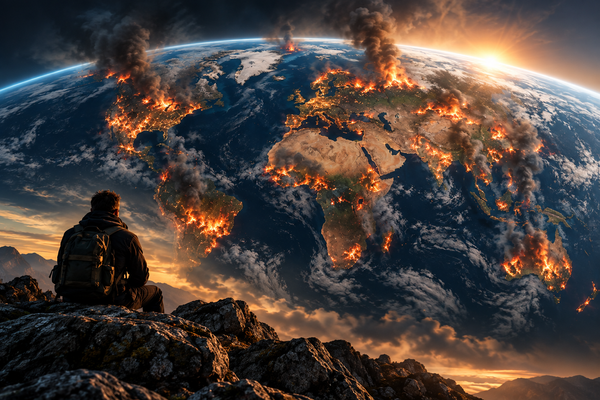
Roads Not Taken
History remembers the roads humanity took. Roads Not Taken asks what happened to the ones that disappeared before we even realized they were there.


By Hampus Fickelton
The Road We See
Imagine standing in New York in 1882.
Electric light is becoming real. Not a curiosity in a laboratory, not a demonstration for people who have been invited to look at the future, but something that is beginning to appear in the actual city. On September 4, the Pearl Street Station begins operating in Lower Manhattan. Edison's system is designed as more than a lamp. It is a complete electrical system: generation, distribution, meters, wiring, switches and everything else necessary to make electric light work for paying customers. At first there are only a few hundred lamps. Within a year there are more than five hundred customers using more than ten thousand lamps.
There is something almost comforting about looking back at this now. We know how this story ends. We know that electricity will become one of the foundations of modern life. We know what a power grid looks like. We know that alternating current will eventually become the dominant system for electricity transmission and distribution. We know that Niagara Falls will be generating electricity for Buffalo fourteen years later. We know that the people standing in the middle of this argument will eventually be reduced to two names in a schoolbook.
Edison. Tesla.
It is a remarkably neat story, once it has happened. It was considerably less neat while it was happening.
The version we have inherited is usually called the War of the Currents. Edison is placed on one side with direct current. George Westinghouse and Nikola Tesla are placed on the other with alternating current. It makes for an excellent story because it gives us what stories like: two people, two ideas, one winner. History rarely remains that tidy when you start looking at it. Edison was not defending an absurd technology because he was too stubborn to recognize the future. His direct-current system worked. He had built an entire commercial system around it, with customers, factories, equipment, capital and infrastructure. Pearl Street was not a failed experiment. It was a functioning business.
And alternating current was not simply Tesla's invention arriving fully formed from somewhere in the future. Westinghouse was already working on alternating-current systems before he obtained the rights to Tesla's polyphase AC patents in 1888. Tesla's work became enormously important, particularly through the polyphase system and induction motor, but the technological road was being built by considerably more people than the two names we now remember. This matters because the future was not waiting somewhere ahead of them. The future was being negotiated.
In 1888, Westinghouse published The Alternating System, a contemporary document making the case for alternating current and explaining the equipment and distribution system behind it. The booklet reads less like a historical artefact than an advertisement for a future that, at the time, still had to be sold. It describes generators, converters, secondary mains, meters and other parts of a complete system. We can hold that document in our hands today and already know what happened. The people reading it could not. For them, the future was still an argument.
There were technical arguments. There were economic arguments. There were questions about distance and cost. Direct current had limits when electricity needed to travel over long distances, while alternating current could be transformed between different voltages much more easily. That difference mattered enormously once electricity had to travel farther than the immediate neighbourhood around a generating station. There were also less noble arguments. Edison and his allies attacked alternating current as dangerous, including highly public demonstrations intended to associate AC with electrocution. The electrical battle was not conducted exclusively in laboratories and engineering journals; it also involved money, patents, publicity and control of a rapidly developing market.
And eventually the balance shifted. In 1893, Westinghouse won the contract to illuminate the World's Columbian Exposition in Chicago. General Electric had bid $554,000 for a direct-current system. Westinghouse offered to do it with alternating current for $399,000. That same year, Westinghouse won the contract for the Niagara Falls project. In November 1896, Buffalo was receiving alternating current generated at Niagara Falls. By then, even General Electric had moved toward AC.
Looking backward, the sequence is wonderfully clean.
1882: Edison.
1888: Westinghouse and Tesla.
1893: Chicago.
1896: Niagara Falls.
Then AC.
The road appears almost embarrassingly obvious.
Except it wasn't obvious. Nobody standing at Pearl Street in 1882 could see the whole road. They could see a city beginning to electrify itself. They could see competing engineers and companies. They could see technical problems and commercial opportunities. They could make decisions about the next year, perhaps the next decade. What they could not see was the history book. They could not see which inventions would become footnotes, which companies would disappear, which systems would become standards or which technical compromises would eventually become so ordinary that nobody would think of them as compromises anymore.
That is one of the peculiar tricks of hindsight. Once we know what happened, everything that happened before it begins to look like a sequence leading toward it. The winner gives the story its shape. The surviving technology gives the story its logic. The infrastructure built around it gives the story its appearance of inevitability. And the roads that disappeared along the way become increasingly difficult to see.
That does not mean the road we took was wrong. It does not even mean that another road would have been better. Alternating current had genuine advantages for long-distance transmission. Direct current was not simply defeated by a clever publicity campaign. Technical capability, economics, infrastructure and institutional choices all mattered. The point is smaller, and perhaps more troublesome: we know who won because we are standing at the end of the race.
The people who lived through the race did not have that luxury. They had to choose without knowing. And that changes the way history looks, because perhaps history is not a single road running cleanly from past to present. Perhaps it is a landscape full of forks. Some roads are abandoned because they lead nowhere. Some are abandoned because another road is better. Some disappear because the people who maintained them disappear. Some become too expensive to travel. Some are deliberately closed. And some simply stop being interesting enough for anyone to keep walking.
We mostly remember the road that remained. We build the map from what survived. Perhaps the first thing we should be suspicious of is the map itself.
People Were Not Stupid
There is a peculiar arrogance in the way we sometimes imagine the past. We tend to picture the people who lived hundreds or thousands of years ago as occupying an earlier version of ourselves: less informed, less technically capable, surrounded by fewer tools and therefore somehow closer to being stupid. This is not entirely unreasonable. They did not have antibiotics, satellites, semiconductor physics, global telecommunications or Wikipedia. But that is not quite the same thing as being less intelligent. The human brain did not have two thousand years to become fundamentally different. The library did.
What changed enormously was not necessarily the human capacity to understand the world, but the amount of information humanity could accumulate, preserve, reproduce and pass on. And even that accumulation has never been as straightforward as we like to imagine. Knowledge does not simply pile itself neatly on top of earlier knowledge. It branches, disappears, gets replaced, becomes unnecessary, survives in one place while disappearing in another. Sometimes we inherit the result of an old piece of knowledge without inheriting the knowledge itself.
Take purple. Not the colour. The knowledge.
For thousands of years, people around the Mediterranean produced an extraordinarily valuable purple dye from marine molluscs of the Murex family. Archaeological evidence places production in the second millennium BCE, and what is striking is how much specialized knowledge was involved. This was not a matter of crushing a shell and discovering that purple happened to come out. It required the right animals, the right parts of them, the extraction of their secretions, controlled processing and exposure to sunlight. Archaeological sites containing enormous quantities of crushed shells and specialized production equipment tell us that this was not some isolated trick known to one unusually inventive person. It was an industry. People knew how to do this, people taught other people how to do it, and people made a living from knowing how to do it. And then, eventually, the knowledge disappeared.
Not the colour. The colour survived. What disappeared was the system of knowledge required to make it. Modern researchers have had to reconstruct aspects of the process through chemistry, historical sources and experimentation. A civilization can remember that something existed while forgetting how to make it. We can inherit the product and lose the recipe. That is a strange thing to contemplate, particularly when we remember that the people who possessed the original knowledge probably did not think of themselves as the guardians of an ancient secret. To them, it was simply something they knew how to do.
And purple is hardly unique. In ninth-century Baghdad, the Banū Mūsā brothers wrote The Book of Ingenious Devices, describing roughly a hundred mechanical devices. Their work included automatic valves, fountains, vessels that regulated liquid levels and other mechanisms in which the behaviour of a machine could control what happened next. It is tempting to look at such devices and say, Look how advanced they were. I think that misses the more interesting part. The brothers were not visitors from the future. They were people living in their own time, using the materials, mathematics and practical knowledge available to them, and applying considerable intelligence to problems that interested them. They knew things. They also wrote things down.
And yet most of their other known works have not survived. We know of a much larger body of writing because later references tell us that it existed, but only a small part of it remains. That creates a strange asymmetry. We can study the book that survived. We can marvel at the machines described in it. But we cannot read the books that disappeared. We don't even know what questions some of those books might have answered. The surviving work gives us a window into what was possible for its authors, but it is also a reminder that the window is not the whole building.
This is where the idea of lost knowledge becomes more interesting than a collection of historical curiosities. The problem is not simply that an old machine might have been clever. The problem is that knowledge exists inside systems. A person may know how to shape a material. Another may know how to measure it. A third may know which mistake ruins the process. A fourth may know when the result is wrong just by looking at it. The written instructions, if there are any, may contain only part of this. The rest lives in practice, in apprenticeship, in memory, in habits and, ultimately, in people. And people disappear.
Perhaps the most extraordinary example is sitting on the bottom of the Mediterranean. The Antikythera mechanism was made roughly two thousand years ago. It is a complex geared device capable of representing astronomical cycles and calendar phenomena, and its sophistication is not particularly interesting because ancient people were somehow secretly modern. It is interesting because we don't know the whole story around it.
We have the object. We can reconstruct what parts of it did. We can study its inscriptions. We can compare it with mathematical and astronomical knowledge from the ancient world. But we do not possess the workshop manual. We do not have the complete series of machines that preceded it. We do not have a catalogue of the machines that followed it. We do not have a neat technological family tree leading from its first crude prototype to its finished form. We have a fragment, a remarkably sophisticated fragment, and then a great deal of darkness around it.
That is perhaps more revealing than the mechanism itself.
We tend to imagine invention as a ladder. Someone builds something simple. Someone improves it. Someone improves it again. Eventually, after enough improvements, we arrive at the thing we recognize as advanced. But the Antikythera mechanism does not fit comfortably into that picture. It is like finding a cathedral in the middle of a forest and discovering that the road leading to it has disappeared. The building tells us that somebody knew how to build it. It does not tell us everything they knew.
And that distinction matters because when a technology survives, we tend to assume that the knowledge behind it survived too. It doesn't have to. The object may outlive the people. The manuscript may outlive the institution. The technique may outlive the language in which it was taught. A workshop may disappear while the thing it produced survives in a museum. And sometimes even the memory that the knowledge existed can disappear.
This changes how we should think about the history of human knowledge. We often imagine knowledge as a growing pile: one generation adds something, the next generation adds something else, and the pile gets higher. There is truth in that. But knowledge also branches. It gets abandoned. It becomes unnecessary. It gets hidden. It becomes uneconomical. It becomes impossible to reproduce. And sometimes an entire branch disappears while the trunk keeps growing.
We are therefore not looking at the history of everything humanity has known. We are looking at the history of what survived well enough to become visible to us. That is a very different thing. It should make us a little more careful about calling the past primitive. People hundreds of years ago did not know what we know. People two thousand years ago did not know what we know. But they knew things we do not. They solved problems we have never encountered. They developed materials, processes, observations and techniques that made sense inside their particular world. Some of that knowledge became part of ours. Some of it was replaced. Some of it was forgotten. And some of it may have disappeared so completely that we no longer have the faintest idea that there is something missing.
That last possibility is the one I find hardest to get away from. Because if we find a lost machine, we can be amazed by it. If we find an ancient recipe, we can reconstruct it. If we find a manuscript, we can read it. These discoveries are possible precisely because something survived long enough to become visible. But what happens when there is nothing left to find? What happens when a piece of knowledge disappears without a machine, manuscript or building waiting somewhere to tell us that it was ever there?
How much can disappear while leaving us only a fragment?
And perhaps even more importantly:
How much can disappear without leaving us a fragment at all?
How a Road Disappears
We tend to speak about lost knowledge as if someone misplaced it. An ancient book was lost, a city burned, a civilization collapsed, a technology was forgotten. It makes disappearance sound almost accidental, as though knowledge were an object that could simply fall behind a cupboard. But knowledge is not really an object. It is a chain. Someone learns something from someone else. They practise it. They teach it. Someone else improves it. An institution preserves it. A profession gives people a reason to continue learning it. A market gives them a reason to continue practising it. Break enough links in that chain and the knowledge can disappear without anyone ever deciding that it should.
Sometimes the people disappear first. The collapse of the Bronze Age is an extreme example of what happens when a complex world stops functioning as a connected system. Across the eastern Mediterranean, political structures, trade networks and administrative systems were disrupted or destroyed. In the Greek world, the Linear B writing system disappeared along with the administrative culture that had used it. Nobody had to gather up the tablets and announce that writing was no longer necessary. The people who needed that particular system disappeared, and so did the system. For centuries afterwards, the Greek world did not use Linear B. You can lose knowledge without destroying a single book.
Sometimes, however, the chain breaks for a different reason. Sometimes knowledge is deliberately kept small. Greek fire is perhaps the most famous example. The Byzantine Empire possessed an incendiary weapon whose exact composition remains uncertain, but what matters for our purposes is that the technology was treated as a closely guarded military secret. That makes perfect sense. If your enemies know how you make your weapon, it is no longer much of a secret. But secrecy creates an interesting problem: the fewer people who know something, the fewer people there are who can pass it on. A secret can therefore become both protected and fragile. The same wall that keeps knowledge out can eventually keep knowledge in so tightly that, when the people who possess it disappear, there is nobody left outside the wall who can reconstruct it. This is not necessarily how Greek fire was lost, and we should be careful about turning an incomplete historical record into a neat explanation. But the mechanism is real.
And not all chains are broken by war. Some are broken by success. A new technology arrives. It works better. It becomes cheaper. People stop teaching the old method because they no longer need it. The apprentices go somewhere else. The tools are no longer manufactured. The suppliers disappear. The last person who knows how to do the job retires. Nothing dramatic happens. No library burns. No army arrives. Nobody declares the knowledge forbidden. People simply stop needing it, and eventually nobody knows how to do it anymore.
The same thing can happen economically. A method can remain perfectly functional and still disappear because nobody can make a living from it. A craft becomes too expensive. A process requires too much labour. A material becomes difficult to obtain. A competitor produces the same result more cheaply. Customers stop paying for the old method. Again, nobody has necessarily destroyed anything. The market simply stops paying people to remember. And once remembering something no longer pays, the chain of transmission becomes much harder to maintain.
Then there is competition. This is where a road can disappear even while the road itself remains perfectly intact. Imagine two technologies that solve roughly the same problem. One becomes slightly cheaper. More manufacturers adopt it. More workers learn it. More spare parts become available. More customers buy it because everyone else is buying it. Schools begin teaching it. Governments begin standardizing around it. Infrastructure is built for it. The competing technology has not necessarily become worse. But it has become harder to use. That distinction matters. A road can lose because it is inferior. It can also lose because the world around it has stopped being built for travellers using that road.
Eventually the difference becomes almost impossible to see. The winning technology looks natural. The losing technology looks strange. The winner looks like progress. The loser looks like a dead end. But sometimes what we are looking at is not the difference between a good idea and a bad one. We are looking at the difference between a road that kept receiving investment and one that didn't.
And these mechanisms rarely operate alone. A technology becomes less profitable. Fewer people learn it. The number of specialists falls. Production becomes more expensive. The remaining specialists become harder to replace. Customers move toward the competing system. Manufacturers follow the customers. Schools follow the manufacturers. Governments follow the infrastructure. Eventually, the original technology is no longer merely unpopular. It has become difficult to reproduce. At that point, the knowledge surrounding it begins to disappear too.
This is one of the strangest things about technological history. We often imagine that an invention either survives or dies. But what actually survives is usually a much larger ecosystem. A machine needs parts. Parts need manufacturers. Manufacturers need skilled workers. Workers need training. Training needs institutions. Institutions need money. Money follows demand. Demand follows the infrastructure that already exists. And suddenly the question of whether a technology survives is no longer simply a question of whether the technology works. It is a question of whether an entire world continues to support the people who know how to use it.
This is how a road disappears. Not necessarily with a barrier. Not necessarily with an explosion. Sometimes it simply becomes more expensive to walk. Then fewer people walk it. Then the signs disappear. Then the bridge isn't repaired. Then nobody remembers why there was a bridge in the first place. And eventually, if someone discovers the remains centuries later, they may look at the abandoned road and assume that nobody ever needed it.
Perhaps that is the mistake we make with knowledge. We see the things that survived and ask why they survived. We see the things that disappeared and ask why they failed. But those are not always the same question. Sometimes a road disappears because it was a bad road. Sometimes it disappears because another road was better. Sometimes it disappears because nobody maintained it. And sometimes someone had very good reasons for making sure people travelled somewhere else.
Which leaves us with a more difficult question than how knowledge disappears.
Who Chooses the Road?
In 1900, the automobile had not yet decided what it was. There were gasoline cars, certainly. There were electric cars. There were steam-powered cars. There were manufacturers experimenting with different arrangements of engines, batteries, controls and bodies, and there were customers trying to work out whether this strange new machine was actually going to become useful or remain an expensive curiosity.
Looking back, this is difficult to imagine. The modern automobile seems so completely defined that we tend to project its present form backwards. We picture the early car and see an unfinished version of what we already know: four wheels, an internal-combustion engine, a steering wheel, a transmission, a fuel tank. We know what the machine became, so we instinctively imagine that it was always heading in that direction.
It wasn't.
At the beginning of the twentieth century, there were several plausible futures. Electric cars had some very practical advantages. They were quiet. They did not produce exhaust fumes where they were being driven. They were relatively simple to operate, particularly compared with some early gasoline automobiles, and they were well suited to short trips in cities. There was no engine to warm up and no manual crank to wrestle with before setting off. Gasoline cars had their own problems. Their engines were noisy and dirty. Starting them could be physically demanding. Fuel distribution was still developing, and the machinery was complicated enough that owning one required a degree of mechanical tolerance that would eventually become difficult to imagine. Steam cars were not ridiculous either. Steam propulsion had an established industrial history and could produce considerable power. It simply came with its own problems: water, fuel, boilers and the time required to get everything ready.
Nobody standing in 1900 had the luxury of knowing which set of disadvantages would eventually matter least.
The electric car did not disappear because somebody proved that it was incapable of being a car.
That distinction is important. We tend to tell technological history as though inventions compete against one another directly. Put three machines on a table, compare their specifications and let the best one win. Real technologies rarely get such a fair fight. They compete inside an environment. An electric car is useful if you can charge it. A gasoline car is useful if you can find fuel. Both are more useful if there are roads worth driving on. Both are easier to own if there are mechanics who understand them, manufacturers producing spare parts and somebody willing to invest in infrastructure. The technology is therefore only part of the technology.
In the early years of motoring, that surrounding world was still being built. Electricity was spreading through cities, but an electrical grid capable of supporting widespread charging was not waiting on every street corner. Batteries were expensive and heavy, and their limitations mattered particularly once people wanted to travel beyond the short urban journeys for which electric cars were well suited. Gasoline, meanwhile, was becoming easier to obtain. Oil production was expanding. Fuel distribution developed alongside the growing automobile market. Manufacturers became better at producing internal-combustion engines, and perhaps most importantly, the cost of producing gasoline cars began to fall dramatically.
Henry Ford's use of mass production transformed the economics of the automobile. A car no longer had to be an expensive machine assembled for a relatively small number of wealthy customers. It could become a mass-market product. That changed the question. A technology that is slightly better for a particular use can lose to a technology that can be manufactured, distributed and supported at an entirely different scale.
Then, in 1912, the gasoline automobile received a remarkably small technological improvement with remarkably large consequences.
The electric starter.
It is easy to underestimate what this meant because we have never known a world in which starting a car was a separate physical task requiring considerable effort. But the hand crank was one of the unpleasant realities of early gasoline motoring. The electric starter removed much of that inconvenience. And with that, one of the electric car's practical advantages became less significant.
This is one of the recurring patterns in technological history. A technology does not necessarily have to be defeated directly. Sometimes its advantages simply disappear one by one. Electric cars were quiet, and gasoline engines became easier to start. Electric cars were clean at the point of use, while gasoline became increasingly available. Electric cars were convenient for short journeys, while gasoline cars became capable of much longer journeys. Electric cars could be charged where electricity existed, while gasoline cars could increasingly be refuelled where fuel was sold. None of these developments, considered individually, had to destroy the electric car. Together, they changed the environment in which the electric car had to compete.
And then something even more powerful happened.
The successful technology began to receive more of the infrastructure that made it successful. More gasoline cars meant more demand for gasoline. More demand made fuel distribution more worthwhile. More fuel infrastructure made gasoline cars more useful. More useful cars increased demand for cars. Manufacturers had more reason to invest in gasoline technology because there were more customers for it. Mechanics had more reason to learn how gasoline engines worked because more customers owned them. Suppliers had more reason to manufacture parts. Investors had more reason to fund infrastructure. The cycle reinforced itself.
This is where a technology can begin to acquire something that has nothing to do with the machine itself.
Momentum.
Not momentum in the physical sense, but the accumulated weight of everything that has already been built around it. A manufacturer does not choose a technology in isolation. It chooses the technology for which suppliers already exist. A customer does not buy a vehicle in isolation. They buy the vehicle they can refuel, repair and resell. A mechanic does not learn every engine ever invented. They learn the engines people bring into their workshop. An investor does not necessarily fund the technology with the greatest theoretical potential. They fund the technology for which there appears to be a market. A government does not build every possible infrastructure simultaneously. It builds infrastructure according to political priorities, economic expectations and the systems already developing around it.
Each decision can be entirely rational. That is what makes the result so interesting.
Nobody has to be stupid. Nobody has to be corrupt. Nobody has to sit in a dark room deciding that electric cars must disappear.
The world can simply become increasingly organized around one possibility.
Research into the early history of electric vehicles has suggested just how important this surrounding infrastructure could have been. One study examining the period found that earlier expansion of the electricity grid could have substantially altered the trajectory of electric vehicles. That does not mean electricity was secretly destined to power all cars, or that gasoline won through some grand deception. It means that technological outcomes depend partly on what exists around the technology when the competition takes place.
The car that wins is therefore not necessarily the car that wins the specification sheet. It can be the car that finds itself in the more favourable ecosystem. And once that happens, the ecosystem begins to grow around the winner.
This is the point where a choice becomes difficult to undo. Imagine, for a moment, that you wanted to reverse it. Suppose you decided that electric cars deserved another chance. You would not simply have to build a better electric car. You would need batteries, factories, charging infrastructure, electrical generation, distribution networks, mechanics, training, spare parts, investment, standards and consumers willing to buy the cars before all of those things existed. You would have to build a world.
Meanwhile, the gasoline automobile already had one.
That is what technological lock-in can look like. It does not necessarily mean that somebody locked the door. It means that somebody built a staircase on the other side.
The interesting thing is that the same mechanism can work with almost anything. Once enough people use a particular system, more people have a reason to use it. Once enough infrastructure exists for that system, competing systems become more expensive. Once enough expertise exists around it, alternatives appear less practical. Once enough money has been invested, changing direction becomes politically difficult. Once enough generations have grown up inside the system, the system stops looking like a choice.
It begins to look like reality.
And this is where the language of progress can become misleading. We often describe history as though technologies emerge, compete and the best one survives. Sometimes that is exactly what happens. But sometimes the process is less like a competition and more like a path gradually becoming easier to walk because more and more of the world is built beside it.
The winner does not merely survive. The winner builds the road.
That does not make the winner illegitimate. It does not mean the alternative was better. It does not even mean that anyone made the wrong decision. It means that the consequences of a technological decision become larger than the original decision itself. A choice made by a manufacturer becomes a supply chain. A supply chain becomes an industry. An industry becomes infrastructure. Infrastructure becomes a standard. The standard becomes an expectation. And eventually, the original choice becomes so deeply embedded that asking whether another choice might have been possible sounds almost absurd.
This is where power enters the story. Patents can determine who is allowed to manufacture something. Governments can subsidize some technologies and regulate others. Industries can lobby for rules that favour their existing systems. Military requirements can direct enormous amounts of research and investment. Companies can consolidate markets. Standards can make certain technologies compatible with everything else while leaving alternatives isolated.
Sometimes these forces are deliberate. Sometimes they are not. Sometimes they are entirely reasonable responses to circumstances. And sometimes they have consequences that nobody intended.
That distinction matters because it is tempting, when looking for roads not taken, to assume that every missing road must have been suppressed by somebody. History rarely gives us such a satisfying explanation. Sometimes the road disappeared because it was genuinely worse. Sometimes it disappeared because the world changed. Sometimes it disappeared because another technology solved the same problem more effectively. Sometimes it disappeared because nobody could make money from maintaining it. Sometimes it disappeared because institutions preferred something else. And sometimes, yes, power mattered.
The difficult part is determining which is which.
The early electric car therefore does not give us a simple lesson about what humanity should have done. It gives us something more useful. It shows us how quickly a possibility can move from available to impractical, and from impractical to unthinkable, without any single moment in which somebody declares that the possibility no longer exists.
The alternative does not necessarily die. It can simply stop being fed. And when that happens for long enough, the surviving road begins to look like the only road that ever existed.
That may be the most effective form of selection of all. Not destroying an alternative. Not banning it. Not proving it wrong. Simply making the world increasingly inconvenient for anyone who wants to travel it. And once an alternative becomes sufficiently inconvenient, nobody has to notice when it disappears.
Which leaves us with a problem far larger than the history of the automobile. We can find the roads that disappeared when something remains of them: a patent, a prototype, a factory, a photograph, a newspaper article, a machine buried underground. But what happens when there is nothing left? What happens when the alternative disappears so completely that we no longer know what we should be looking for?
That is where the map becomes most difficult to read.
The Roads We Cannot See
There is a limit to how far we can follow a lost road. If a machine survives, we can examine it. If a manuscript survives, we can read it. If a building survives, we can measure it. If someone left behind a description of a technique, we can at least begin looking for evidence that it worked. History gives us fragments, and from those fragments we try to reconstruct the world that produced them. But there is a problem with that method: everything we find has already survived.
The purple dye that tells us something about ancient chemistry survived. The book of the Banū Mūsā brothers survived. The Antikythera mechanism survived. The patents, machines and photographs that allow us to reconstruct technological history survived. They are all witnesses who made it through. The problem is that we don't know how many witnesses never made it to the courtroom. A manuscript can burn, a workshop can disappear, a language can die, a profession can become unnecessary. A person can take a technique to the grave without ever writing it down. A machine can be dismantled for parts. An experiment can fail and never be recorded. An idea can be rejected so completely that nobody bothers to preserve the argument for it. Sometimes there may not even have been an object to preserve; a technique may have existed entirely in the hands of people who knew how to do something. Once the last person stops doing it, there may be nothing left that looks like evidence.
This creates a peculiar problem for anyone trying to understand the history of human knowledge. We can search an archive for a missing document. We can excavate a site looking for a missing machine. We can compare manuscripts looking for a missing passage. But how do we search for something when we do not know that it existed? You cannot put “things humanity once knew but has completely forgotten” into a search engine and wait for the results. There is no catalogue for the invisible. We can only investigate what has left enough of a trace for us to recognize that there is something to investigate in the first place.
That means the surviving record may contain a bias that is almost impossible to escape. We know about the things that survived because they survived. We know about the things that left traces because they left traces. The things that left nothing behind are not merely absent from the historical record; they may be absent from our questions. If we find a lost technology, we can say that we did not know it existed, but we can only say that because we eventually found it. There may be other things for which we will never have that moment. We may never know that there was something to find.
This is where the idea of a lost road becomes different from the idea of a lost invention. An invention can sometimes be recovered. A possibility cannot. If someone discovers an ancient method for producing a material, we can test it. If we discover a forgotten mechanical principle, we can build it again. But if an entire alternative way of solving a problem disappeared before anyone recorded it, we cannot reconstruct the road from the destination. There is no destination. There is no signpost. There may not even be a footprint.
It would be tempting to turn that uncertainty into a romantic story about everything humanity has supposedly lost. We should resist that temptation. Some roads deserved to end. Some technologies were dangerous. Some ideas were simply wrong. Some systems were too expensive, too inefficient or too impractical to survive. Some alternatives were abandoned because humanity found something genuinely better. The fact that a road disappeared does not make it a road we should have taken.
That is not the argument.
The argument is that survival is not proof of inevitability.
The road we took may have been the best road available. It may even have been the only road that could have carried us this far. We simply cannot know that from the fact that we are standing here. We are standing at the end of one particular sequence of choices, containing the technologies that survived, the institutions that endured, the standards that became normal and the knowledge that was successfully transmitted from one generation to the next. It is an extraordinary achievement. But it is not the whole map.
Perhaps that is the most humbling thing about human knowledge. We like to think of knowledge as something humanity possesses: a library gets larger, a database gets bigger, a scientific field accumulates discoveries, a civilization learns more than the one before it. In many ways, that is true. But knowledge is also fragile. It can be concentrated in one person, depend on one institution, become economically useless, be hidden, be replaced or simply stop being taught. Humanity does not only accumulate knowledge. Humanity edits itself.
Every generation inherits an enormous collection of things it knows how to do and an equally enormous collection of things it no longer thinks about doing. Most of those choices are invisible. We do not wake up in the morning and decide which ancient technologies to forget. We simply use what exists. We build on what is available. We teach what is useful. We invest in what appears promising. We improve the systems we have inherited. Slowly, without anyone needing to announce it, the possibility space becomes narrower.
Perhaps that is unavoidable. A species cannot pursue every possibility simultaneously. We have finite time, finite resources and finite attention. Choosing one road necessarily means not spending those resources on another. There is nothing inherently wrong with that. The problem begins when we confuse not choosing a possibility with proving that the possibility was never important.
History is very good at telling us what happened. It is much worse at telling us what could have happened.
Perhaps that is why the past can sometimes appear so much more orderly than the present. We know the ending. We know which technologies survived, which cities grew, which industries became enormous and which ideas became ordinary. We can draw a line backwards through all of them and call the line history. But the people who lived it did not have that line. They had uncertainty. They had competing possibilities, inventions that might succeed and inventions that might fail, and roads leading in different directions. They had no idea which one would eventually be called progress.
Neither do we.
That may be the final reason to care about the roads not taken. Not because we should turn around. Not because the past was better. Not because every forgotten idea deserves to be resurrected. But because we are still standing at crossroads. We are still building infrastructure, creating standards, deciding what gets funded, taught, manufactured and remembered. We are still making some possibilities easier and others harder. If history has taught us anything, perhaps it is that a road can disappear long before anyone notices that it is gone.
We do not need to turn back. We do not need to resurrect every abandoned idea or pretend that the past contained answers to all our problems. We might simply need to become slightly better at noticing the possibilities around us while they are still possibilities. The future will eventually become history too, and the people who live there will know which roads survived. They will know which technologies became ordinary and which alternatives disappeared. They may even look back at our choices and wonder why the road we took seemed so obvious to us.
We know where the road we are on leads because we are standing on it. We do not know where the others would have gone. Some would have led nowhere. Some would have led somewhere worse. Some might have led somewhere better. We will probably never know. Perhaps the greatest knowledge humanity has lost is not how to do something, but the knowledge that something else was possible.
And perhaps that leaves us with one final question
Not about the roads behind us, but about the ones disappearing now.