Running From Myself
A train north, a kebab wrapped like a work of art, and a mind running faster than the world around it. An honest essay about hypomania, movement, and the strange comfort of never quite knowing where you'll spend the night.

There was something liberating about not having to be anywhere. A luxury disguised as idleness. My body was running at full throttle while my calendar was completely empty—a dangerous, but often productive, combination. The hypomania wasn't a monster today. It was more like an overexcited dog tugging at the leash, desperate to greet absolutely everything.
I gave it a little more slack.
The city was muffled by snow, as if someone had turned down the volume on reality.
The sounds grew softer, the edges gentler. I walked with the little blue suitcase in my hand and realized I had become a different version of myself. One who looked as though he had a plan—or at least a destination.
It's remarkable how little it takes to fool both other people and yourself.
I sat down on the concrete ledge outside the apartment building and drank my beer slowly, as though it were an act with intrinsic value. Almost ceremonial. The cold tugged at the can, and the taste was just sad enough and just satisfying enough.
It tasted like a pause. Like a comma, not a full stop.
I thought about all the projects blinking away back home, like airplanes circling above Bennmoveien in a holding pattern.
Texts. Ideas. Half-finished systems. Notes convinced they were more important than they really were.
Everything was connected.
It really was, even if I couldn't quite explain how.
The common thread was there.
It just looked more like a ball of yarn.
And I like yarn.
Yarn means possibility.
When I got to my feet again, it wasn't because I was heading anywhere in particular. Just onward. That's often enough. Some chapters don't begin with a destination, but with movement. With a man, a backpack, a little blue suitcase, and a body that still refuses to call it a day.
The cultural center was a kind of in-between place. Somewhere for people who were on their way to something else, or who had once been somebody. The chairs stood in neat rows, as though waiting for better times, while the scent of coffee and dust lingered low in the room.
I sat there for a while, letting my thoughts do whatever they pleased, like children on a playground without supervision. Then the theatre came back to mind—the sold-out performance arriving like a mental break-in.
I could probably have done it.
Sneaked in.
Looked serious.
But three hours in a dark room with one person demanding my full attention until ten o'clock was more than my brain could honestly promise today. Hypomania is generous, but it isn't patient. And I needed to rest if I wanted to get anything out of tomorrow's appointment with my psychiatrist.
After asking four different staff members about tickets, and calling the theatre's box office only to be greeted by the old ISDN screech I thought had died a decade ago, I zipped up my outer layer and clenched my teeth against the cold.
Back out on the street, I found a hole-in-the-wall serving anything involving gyro meat, and my body made the decision before my mind had a chance to object.
Spicy.
Everything on it.
Wrapped, not boxed.
The man behind the counter lit up, the way people do when they're given the chance to do something they're genuinely good at. I made room inside the little blue suitcase as though I were preparing an altar.
"Now you can have your food," he said suddenly, presenting it with both hands.
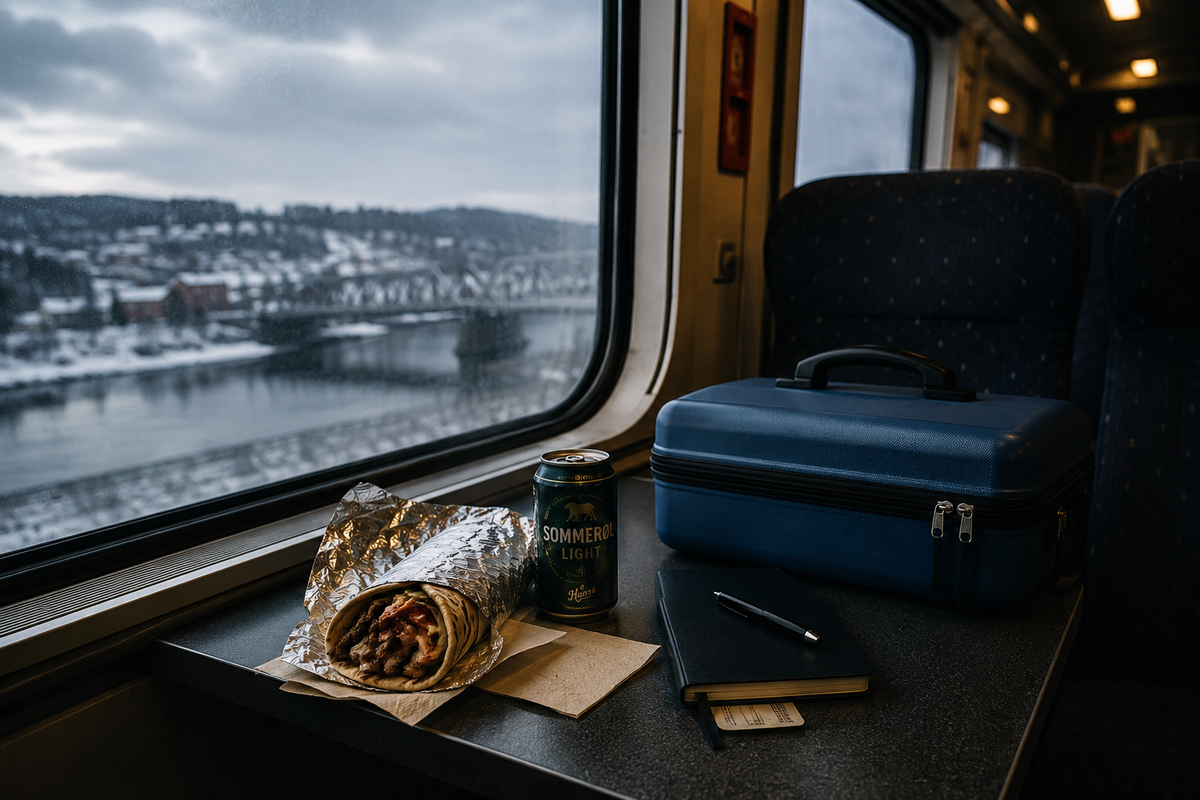
The double layer of foil was tight and flawless, as though someone had actually taken pride in wrapping it. Even the napkin was the thicker kind. A small detail, but it mattered.
I accepted it with matching solemnity, lifted the kebab like a fragile relic, and lowered it gently into the suitcase.
The zippers met with a small, satisfying click.
"It even looked good from the outside," I said. "I'm looking forward to eating it."
His smile widened, almost delighted, and for a moment I considered staying. Eating with him. Giving him the audience he deserved.
But the tracks were calling. The iron horse was waiting. My ticket north—178 kroner—had already been bought. Departure: 3:52 p.m. The day had already begun leaning in that direction.
Where I was actually going to spend the night was anyone's guess, though the odds seemed to favor Lillehammer.
Sometimes it's enough to know where you're not meant to stay.
The train takes care of the rest.
For readers who may be wondering what exactly is unfolding here, I should explain that periods of hypomania have followed me throughout my life. I'm not hypomanic every day, but it happens often enough that I eventually learned how to manage the symptoms on my own.
Hypomania is like borrowing an engine that was built for an airplane and bolting it onto an otherwise ordinary human body.
Everything moves faster.
My thoughts sprint ahead and wave back at me. Words line up, waiting their turn. Sleep starts to feel like an elective course I've already passed.
It's not madness.
Not quite.
I don't lose touch with reality.
I just seem to get better reception than usual.
The colours are brighter, the connections more obvious, and I'm often left with the frustrating conviction that everything fits together, even when I can't fully explain why.
It feels efficient.
I become efficient.
Quite often, I feel like a genius.
Sometimes, invincible.
The problem is the pace. Hypomania isn't a quiet force. It's restless. It wants projects—preferably several, preferably all at once. It has little interest in breaks and an uneasy relationship with the concept of a circadian rhythm.
My body does its best to keep up, but it rarely gets a vote.
Sooner or later, the bill arrives. And it comes without a trace of humour or any fond memories of the dazzling carnival I'd just been wandering through.
From the outside, hypomania can look like abundance. I seem sociable, productive, creative, switched on. People often like me in this state.
They see the energy, not the wear and tear.
"I don't lose touch with reality. I just seem to get better reception than usual."
The inside is more complicated. It's like living in a room where the lights are always just a little too bright and every sound just a little too loud. I become hypersensitive to loud noises, tight clothing, and electrical hum. Lawnmowers might as well be angle grinders screaming beside my ear. I swear I can hear which electrical outlets have a faulty ground.
That's why I rarely spend time in electricity-heavy environments like kitchens or offices while everything is running.
For some people, hypomania is a warning sign. For others, it's a tool that demands enormous respect. It can build remarkable things, but it cannot last.
It's a weather system, not a climate.
When it finally passes, the silence reveals just how loud it really was.
The train was exactly as empty as I'd hoped. The grey-haired man in a second-hand fleece was the only one who reacted when I unfolded the kebab. Just the slightest twitch of the nose—more reflex than protest.
I barely noticed, because the moment the foil gave way, every suspicion I'd had was confirmed.
This wasn't just a kebab.
This was craftsmanship.
It was tight, perfectly even, almost beautiful. Not a wrinkle anywhere. Wrapped with a precision that had survived a march through the winter streets of Hamar.
The flavour kept unfolding, layer after layer, as though someone had composed it. After finishing two-thirds of it, I had to surrender.
Serious business.
Self-respect, wrapped in flatbread.
The woman who seemed convinced she was in a bad mood got off at the first stop, and suddenly I had the carriage to myself.
Almost.
A teenager was sprawled out at the far end, slumped there like a discarded coat.
I celebrated the silence with a gluten-free light summer beer.
The cheapest one per litre.
There's something honest about that choice.
Outside, the day slowly disappeared as the train worked its way north. Darkness clung to Lillehammer like something that didn't quite want to let go, but had no choice. The sounds grew fewer, the thoughts slower, as though speed travelled in both directions.
The PA system blared out the final stop.
Terminus.
Once.
Twice.
Three times.
The teenager didn't react.
So I gently nudged him with the little blue suitcase.
He needed exactly three seconds to conduct a full mental reconnaissance—mapping the world, himself, and the situation—before nodding politely at the suitcase and thanking it.
There's something beautiful about that kind of trust. A stranger. A train that's finished being a train. And a little blue suitcase that, once again, has made itself useful.
The opposite of hypomania is rarely dramatic. Sometimes I slip into hypomania without fully realizing it, and when it leaves, it may slam a few doors on the way out.
Depression doesn't burst through the front door.
It simply places a hand on your shoulder and asks you to sit down.
It's not darkness in the cinematic sense.
It's more like a low-pressure system.
Where hypomania promises coherence, its counterpart delivers friction. My thoughts don't slow down—they become stuck. Like drawers that refuse to close all the way.
My body is awake, but without desire. Sleep suddenly isn't a choice, yet it isn't available on demand either. There's a weary clarity to it. A sobriety that can be brutal.
It's not just sadness.
It's the absence of momentum.
The projects that yesterday fit together into a brilliant system now lie scattered like loose parts without an instruction manual. Not broken.
Just inaccessible.
Even the things that normally bring me joy begin to feel like work.
Laughter demands an explanation.
Initiative requires negotiation.
From the outside, it can look like calm. You're less intense. More restrained. Less demanding. People often assume this is the healthy version of you.
The inside knows better.
This isn't balance.
It's inertia.
A kind of inner winter where everything is still there, but nothing grows.
And yet this state has a strange kind of value. It's honest. It forces priorities to the surface. It reveals which ideas can survive stillness—and which only ever lived because they were moving.
Hypomania builds.
Its counterpart sorts.
One shouts.
The other whispers.
And somewhere between them are brief moments of something resembling stability.
That's the part people rarely understand, because it isn't cinematic enough.
No flames.
No storm.
Just a ladder that's gone missing.
When I'm at my lowest, it doesn't feel like falling. It feels like waking up and discovering you're already in the root cellar—and that someone has thoughtfully removed the exit.
It's cool down there.
Not freezing.
Just constant.
The light is dim, and your eyes never quite adjust. You can stand upright. You can walk around. But every step reminds you that this isn't a place meant for living.
The most deceptive part is that I still function.
I buy groceries.
I answer people.
I show up.
From the outside, it looks like slowness. Maybe a touch of melancholy. Maybe just an adult who's finally stopped making such a fuss.
Inside, though, I'm constantly rationing energy. Everything is measured against whether it's worth the calories. Joy becomes a luxury. Hope, a speculative investment.
Time behaves strangely down there. It moves too quickly and too slowly at the same time. Years can disappear without distinct chapters, dissolving into one long sequence of days that resemble each other just enough to blur together.
You become surprisingly good at living without expectations. Not because you've grown wise, but because hoping hurts more.
And then there's the shame.
The quiet kind.
Not shame for being ill, but for remembering that you were once a person overflowing with energy. You remember hypomania as though it belonged to a previous body.
One you used to live in.
Now you're down here, knowing you could climb if the ladder ever returned—but also knowing you can't fetch it yourself.
Still, root cellars are old rooms.
They were built for storage.
To keep something alive through the winter.
And perhaps that's the most important part.
Even at my lowest, I'm not empty.
There's a difference.
Nothing rots down there.
It waits.
For light.
For movement.
For someone—perhaps another version of yourself—to put the ladder back where it belongs.