
Since Zero Years Old
A weekend in Hamar and Stange with a friend I have known since birth — old conversations, new music, a cat with a red string, and the quiet kind of friendship that never needed any work.

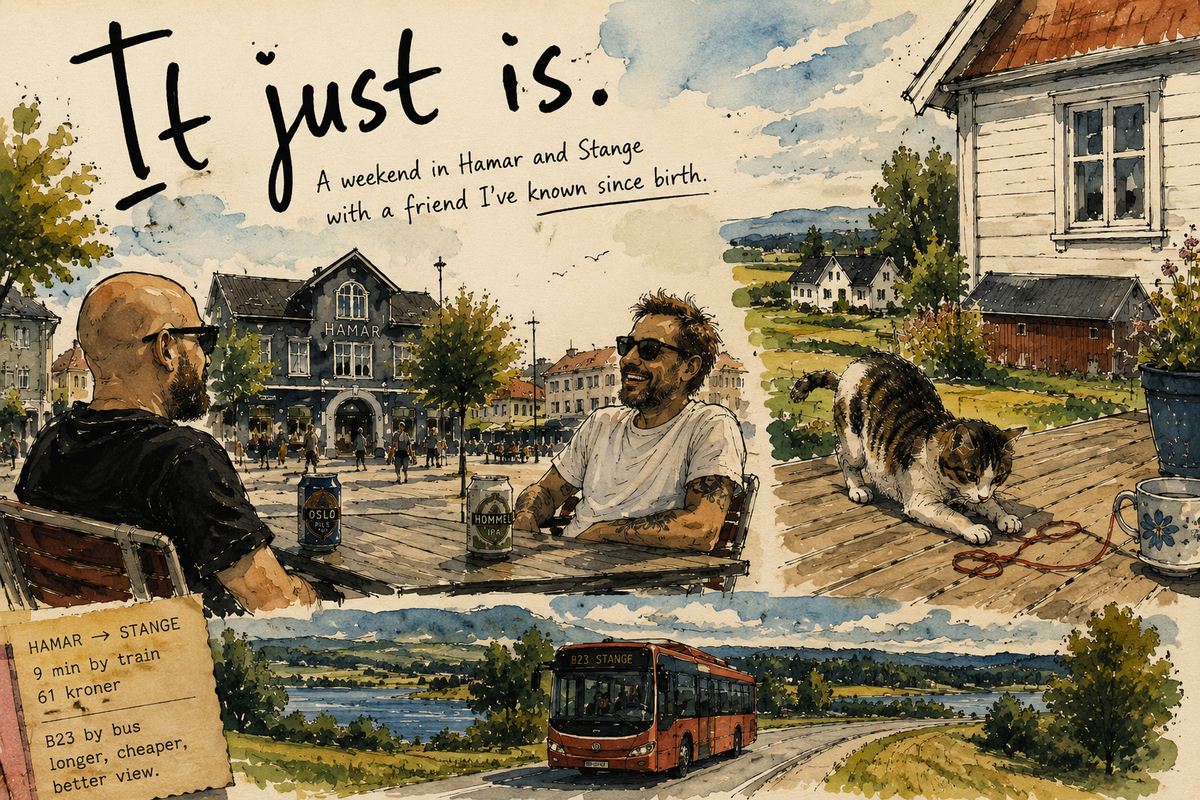
I step off the train in Hamar.
Again.
It is warm enough that I really should have been wearing shorts, but I packed as if I still don’t completely trust the weather. I have an appointment with Christer Karlsson — one of my few close friends — to meet up.
He is, as usual, at work.
I send him a simple message with an equally simple suggestion: if he is going to be stuck there for a while anyway, I can have a beer while I wait.
I get permission.
He is not finished yet.
So I do exactly what I suggested and sit down at Stortorget in Hamar — the thousand-year-old town square — with a beer from a brewery in the capital.
People pass by in a slow stream.
The day has that kind of calmness that makes everything feel a little more permanent than it actually is.
I am meeting a man who is a couple of months older than me.
I have known him since shortly after birth.
Outside my own family, he is the person I have known the longest in my life — and the same goes the other way around.
Christer.
When he is not doing that, he makes music on his phone — a hobby he has thrown himself into over the past few months with a level of genuine seriousness I have not really seen from him before.
We do not meet that often.
Maybe a couple of times a month. Sometimes less.
It has not always been like that. There have been long periods — years, even — when we have not seen each other.
And yet, it rarely feels like a break when we meet again.
More like a continuation.
As if the conversation was never really finished the last time we saw each other.
And I am still wearing far too many clothes.
Then Christer appears.
Wearing a T-shirt.
And shorts.
He is grinning like sunshine itself as he walks across the square with his bag hanging over his shoulder. He has clearly welcomed summer with open arms, much to the annoyance of those of us who still dress as if June cannot entirely be trusted.
A layer of clouds drifts across the sky.
If we are unlucky, there might be a few drops of rain.
We greet each other and wander, stroll, and slowly make our way through the city before deciding to head east for a while.
Christer has an envelope he needs to deliver before the working week can officially be declared over.
We talk about life since the last time we met.
It could probably have been better for both of us.
Like me, Christer is also looking for somewhere to live.
The difference is that he has a mother nearby with room for a son temporarily living on a sofa.
I do not have that option.
As we approach his final work obligation of the day, I spot a table and some steel chairs fixed permanently into the ground.
Admittedly, they are right next to the road, surrounded by traffic and people passing by.
But they are more than good enough.
I claim the spot while Christer takes care of his final task of the week.
When he returns, he is happy and satisfied.
Ready to show me the last ten songs he has spent his time creating.
I have already heard roughly half of them through modern telecommunications over the past few weeks and offer my usual feedback.
We open a beer each from the plastic bag he brought from Mega and sit down.
Around us, traffic rushes through Hamar on this Friday afternoon.
Christer is calm.
A little stressed, maybe.
But present.
He looks at you when you speak to him.
Mostly, we talk nonsense and small things.
And right there, at that exact moment, it is completely perfect.
So we sit there for about an hour.
Completely on display for the weekend traffic.
Christer is the son of Kenneth and Tove, both of whom I got to know early in my childhood.
He is also the grandson of Aage Samuelsen, and he has a poster-sized letter signed by Cowboy-Laila hanging framed on his living room wall.
We first met in Skien.
In Telemark.
At zero years old.
Our mothers were friends, and the world was a slightly smaller place back then.
Eventually, we get up and continue walking.
We stop by the shopping centre to borrow the toilet.
Besides, it turns out we are hungry.
So we treat ourselves to an entire baguette and split the whole thing in half.
The baguette disappears quickly, and we make our way towards the railway station and Hamar’s central hub for public transportation.
We are taking a bus later, but we still have some time.
So we enter a corner building next to the shopping centre and take the elevator up to the roof.
Up there, we stand for a while looking out over the city.
The trees hide the traffic below, and the view gives us time for another conversation.
A chance to actually listen to each other.
The bus leaves at twenty-five past.
We arrive two minutes before departure.
A small group of other passengers joins us in the queue.
Then Christer scams me through the ticket system.
He walks up to the driver, points back at me, and says:
“Just go ahead.”
Then he only pays for himself.
Earlier that day, I had checked that the train to Stange would have cost 61 kroner for a nine-minute journey.
Now we are sitting on the bus.
It costs 41 kroner, split between the two of us, but takes considerably longer.
And the view is beautiful from here as well.
Norway is a beautiful country in many ways, and the road between Hamar and Stange is one of them.
At least on a summer day in June, seen through the window of regional bus B23.
During the journey, Christer tells jokes.
He makes rhymes out of the stops we pass, turns them into little verses, and usually ends with a small tune and a laugh.
We get off at Stange bus station.
It consists of a huge gravel area, roughly the size of a football field, covered with hundreds — maybe thousands — of small, round puddles.
The driver drops us off at the edge of this minefield.
There is not another person in sight.
The landscape is flat, and the wind is considerably stronger than it was before we got on the bus.
We do not have far to go.
Just straight up the hill.
It has become a little colder, and now I am glad I did not put on shorts.
Even Christer, the summer guy who confidently walked across Hamar wearing exactly that, admits that maybe he should have brought an extra layer.
But it is not far.
Soon we are standing in front of a two-story building with four apartments.
We are going to the first one.
We are going home to Tove.
Christer’s mother.
Tove is one of my mother’s old friends.
It was through her that I met Christer in the first place.
I have not seen her in twenty years.
And there she is, lying on the sofa, grinning from ear to ear.
It is a genuinely happy reunion.
It becomes one of those moments where adults, who have lived a little life since they last saw each other, simply allow themselves to be honest with one another.
Tove is in good spirits.
I eventually realize that she had taken a little nap on the sofa before we arrived, which seems entirely reasonable for a Friday evening.
We talk about a little bit of everything.
About this and that, here and there — the way Tove and I have always talked.
The conversation finds its rhythm immediately, and it feels exactly as a reunion should feel.
After a while, Tove settles in for a little more Friday evening rest.
Christer and I take a beer each out onto the terrace.
Out there on the terrace, he puts on his new music.
And asks if I know anyone with a master’s degree in Holocaust denial.
I do not.
So it feels good to simply sink into the sofa outside.
In front of us is a view of a barn and a row of detached houses.
Christer and I are good at exactly that.
We can spend time together in silence.
Even though he talks the entire time.
He still notices when I start struggling a little with all the impressions.
So he turns the volume down when he realizes the music is hitting my nervous system the wrong way.
It is one of those small things that happen between people who have known each other almost their entire lives.
No grand gesture.
Just a small adjustment.
A consideration.
Eventually, the air gets colder.
Besides, the beer cans are empty.
So we go inside.
Christer and I sleep on the sofa in the living room, with our feet facing each other.
There is just enough space.
And that is enough.
Not before we have borrowed some ice cream from the little freezer that jumps every time you open it, and talked a little about the old days.
The next morning, I wake up with the sun.
My body has decided that it is rested, and that is honestly quite convenient.
Christer is still lying there, snoring loudly enough for the neighbours to hear.
Zelda, on the other hand, appears to have assessed the situation and concluded that I can be trusted.
Now it is time for brushing, petting, and attention.
Eventually, Christer wakes up properly and is ready for a new day.
Things are going reasonably okay on all sides.
Then Christer walks over to the freezer and gives it a little push.
Underneath it, just out of Zelda’s reach, lies a small red piece of string.
Her favourite toy.
“That is all she needs,” Christer says. “Everything she needs in the entire world.”
Zelda rolls onto her back and plays with the string using all four paws.
Then she picks it up in her mouth and carries it over to Tove.
She drops it on the floor in front of her.
Now it is Tove’s job to throw it across the room.
Zelda runs after it.
Plays for a while.
And comes back with it.
Then she places the red string down in front of Tove again.
Seven minutes before the agreed time, Tove’s ride arrives outside.
We get a good hug, and then she is out the door.
Christer and I stay behind.
He starts making eggs for breakfast.
Christer has a culinary education behind him, so naturally the eggs turn out exactly the way they should.
We eat.
And after the food has done some of its work, he gives the app on his phone one final attempt.
Over the last twenty-four hours, he has been going back and forth with customer service.
Apparently, they have not entirely understood what he was trying to explain.
But then it happens.
He gets in.
He can work again.
As dependent on making music as he is, he disappears almost immediately into another world.
He adjusts something here, moves an octave there, and listens carefully before making another small change.
I drink a cup of coffee and feel completely content with life.
He invites me into his process and is just as engaged as he always is when it comes to music.
“Listen to this!”
He pushes the phone up in front of my face and turns up the volume.
Out comes one of his latest creations.
And it is genuinely not bad.
The first memory we have together, he tells me, is from Bleia.
A playground.
He knows this because there is a picture of us somewhere in an old photo album.
Evidence that we actually knew each other before we could walk, write, or explain ourselves.
The surprising thing about becoming an adult, he says, is that he has never really felt like one.
He is forty years old, but on the inside, he is still, in many ways, the same person.
The internal experience of himself has not changed very much.
It is just the body, the years, and the surroundings that have moved on.
Music, on the other hand, is something new.
That is why he likes it so much.
He cannot play instruments in the traditional sense, but he can create music.
He can build sounds, experiment with genres, and put together something that did not exist before.
It comes naturally to him.
Maybe that is why he disappears so completely into it when the app on his phone finally starts working again.
He worries too.
About life.
About family.
About sleep.
But he tries to meet it all with a kind of philosophy borrowed from The Jungle Book:
Take life as it comes.
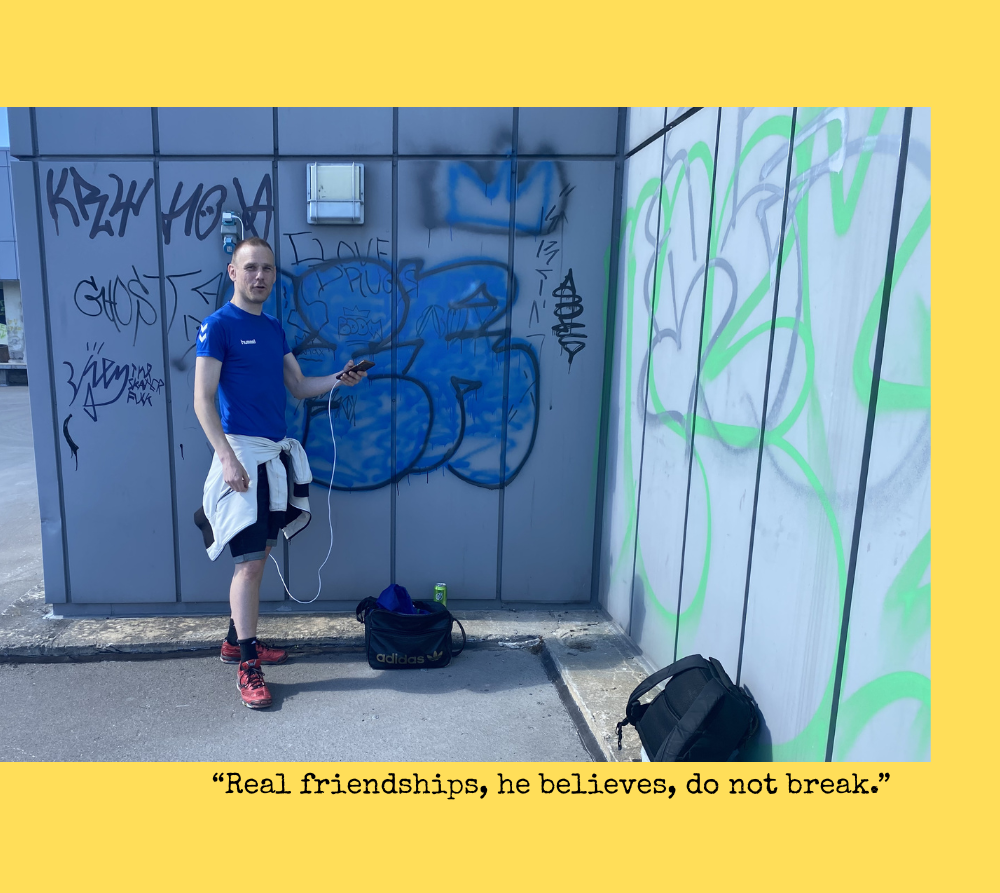
When we talk about friendship, he is equally simple.
Real friendships, he believes, do not break.
They come without demands or conditions.
You let people be who they are.
You do not try to turn them into something else.
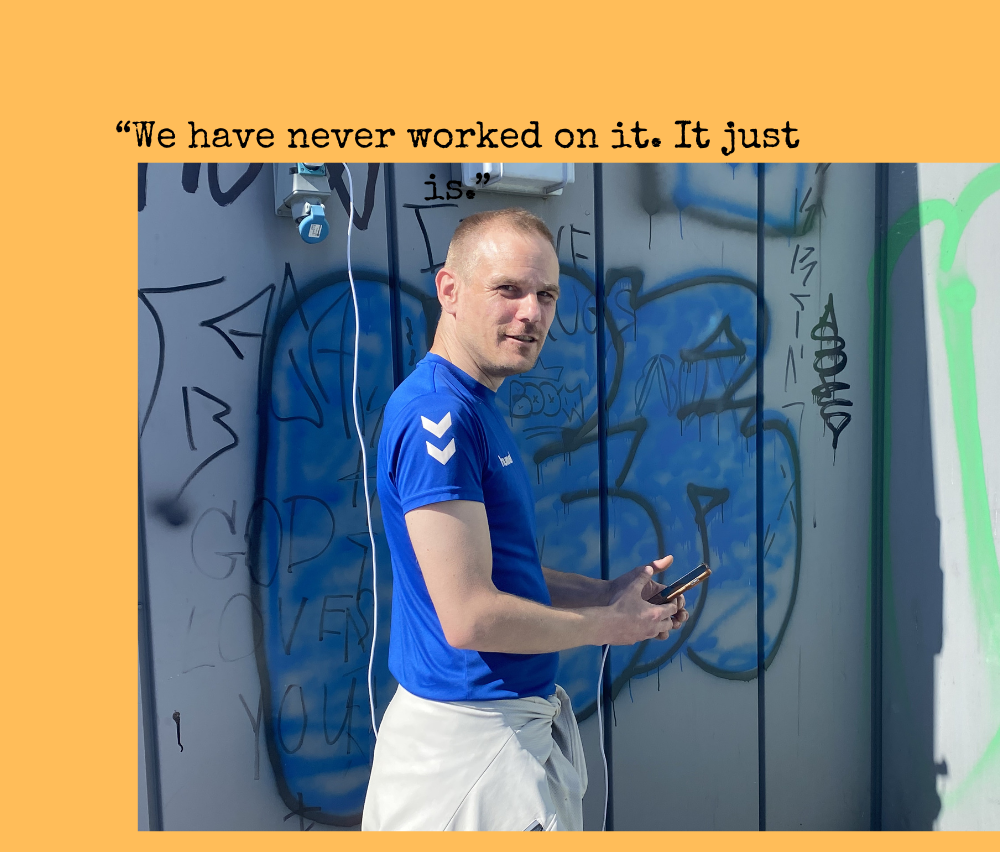
I ask him why we are still friends.
He shrugs slightly.
“We have never worked on it,” he says.
“It just is.”
People who do not know him very well might experience him as a little much.
A little loud.
A little too outgoing.
It does not bother him.
The people who want contact will make contact.
That is simply how it is.
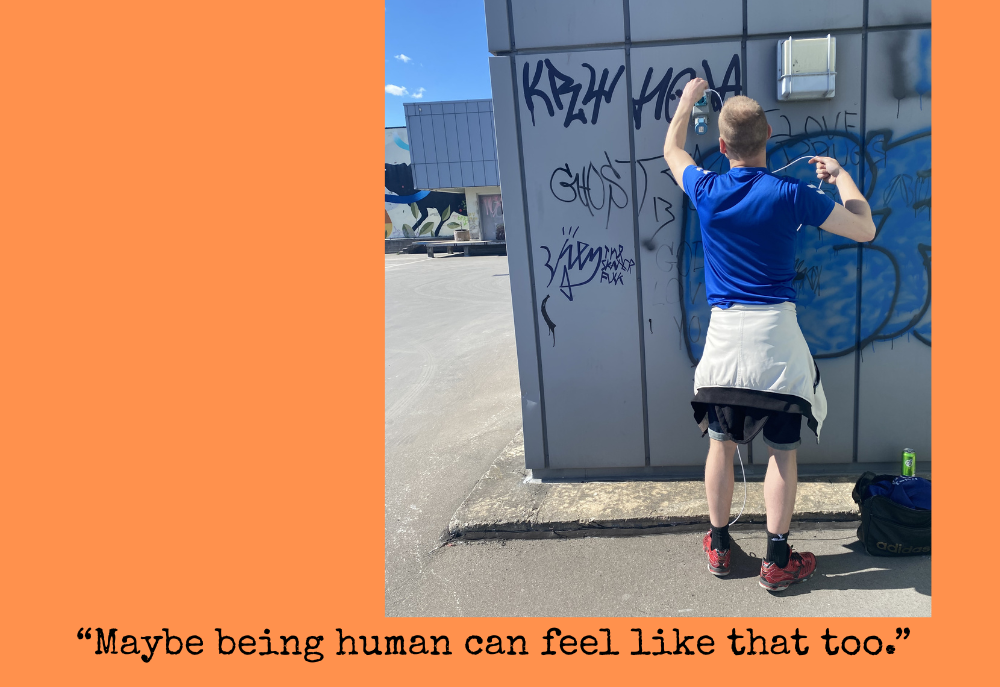
When I ask who he is when nobody is watching, we suddenly move from Hamar and Stange to quantum physics.
He brings up the double-slit experiment.
When nobody is observing you, maybe you are a little bit like a particle and a little bit like a wave.
Not entirely one thing.
Not entirely the other.
A kind of state of movement.
He compares it to Minecraft and GTA.
The games only draw the part of the world you are actually looking at.
The rest exists somehow, but it has not fully rendered yet.
Maybe being human can feel like that too.
Humour, however, is easier.
He likes it when things go slightly wrong.
Slapstick.
People slipping.
Situations that escalate quickly and unexpectedly.
A little Jackass.
A little home video chaos.
If he were to be described in one sentence, he hopes people would simply say:
“He is a good guy.”
And the quality he is most proud of in himself?
The ability to talk.
The ability to connect with people.
A perfect Saturday is not complicated either.
In summer, it is sitting outside.
Good food.
A good beer.
And good friends nearby.
Or simply a quiet day at home with food and a movie.
Picking up a shrimp or two.
I officially release him from the interview so he can return to his more digital world.
Tove returns from her shopping trip.
She has had a good time and is full of energy for conversation.
Christer is still deeply inside his own world, focused on the music, while Tove and I talk our way through everything from intergalactic radiation to the mess underneath the living room table.
That is how it has always been with us.
We can start somewhere in outer space and end up under the coffee table without finding the transition particularly strange.
But even good conversations have to end.
Now it is time for Christer and me to begin our journey towards the next appointment.
An hour ago, there was heavy rain, lightning, and thunder.
Now the sun is shining.
Time to leave.
We find the bus back to Hamar, and this time I buy my own ticket.
On the bus, it is warm.
I have to take off my shirt and sit in a tank top all the way through the green landscape.
There are not many passengers onboard either.
Since we are the first ones on the bus, we choose our own double seats further back.
Strategically placed on the right side.
That way, we avoid the worst of the sunlight.