Some People Never Fully Unpack
Some people unpack the moment they arrive. Others leave a backpack in the corner for weeks. An essay about belonging, restlessness, and the quiet question of whether some of us are simply built for the spaces in between.

Some people unpack the very day they arrive.
Their clothes go into the wardrobe. Their toiletries find their place in the bathroom. Chargers are neatly organised. Suitcases disappear into closets, basements, or attics as though they had never existed.
I've always suspected these people were made from a different material than the rest of us.
Because there's another kind of person.
The ones who never quite unpack.
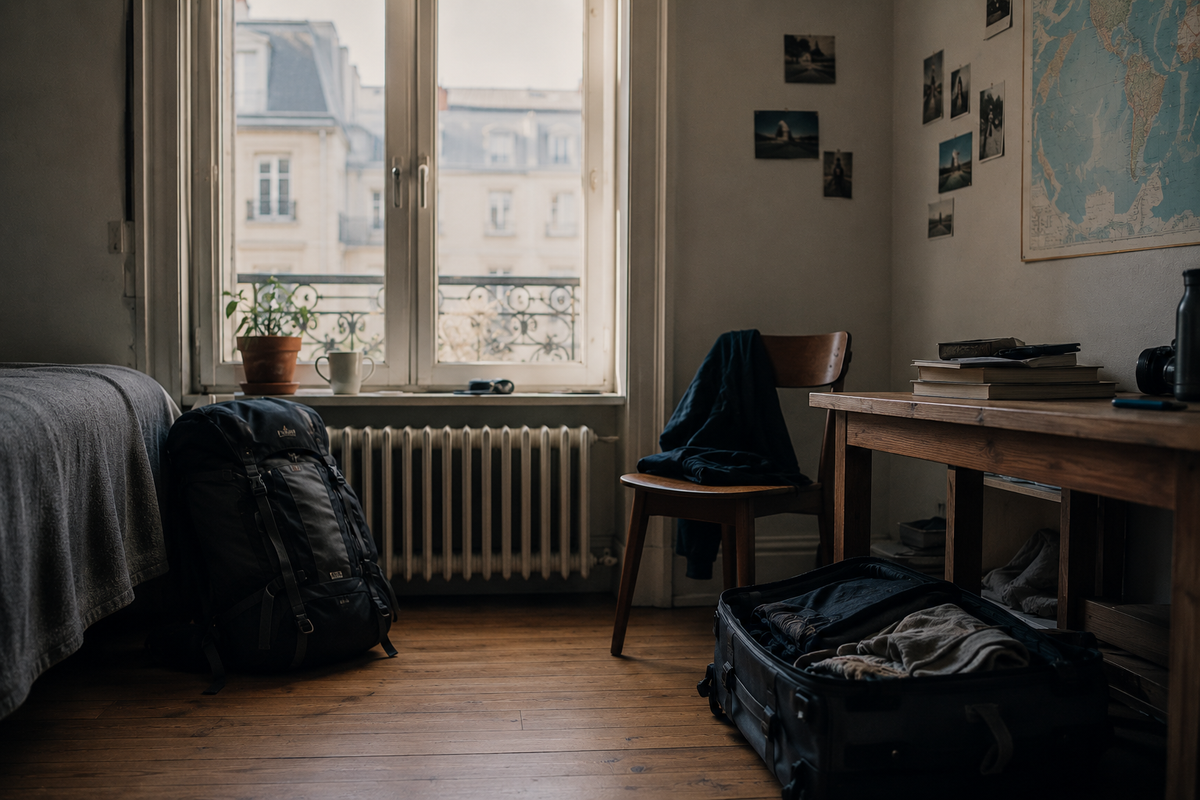
The backpack is still standing in the corner. The suitcase remains open. There's a sweater draped over a chair that's technically still travelling.
You've arrived.
But only partly.
If you never fully unpack, you've never completely moved in.
And that doesn't just apply to houses.
It applies to life.
I left home when I was fifteen.
Now I'm forty.
And I'm still not sure I've arrived.
I've lived in many places and travelled to even more. Every time I begin to find my rhythm, learn the sounds of a place, discover which café makes the best coffee and which park bench catches the last evening sun, another reason appears to pack everything up again.
Sometimes it feels as though I never quite finish unpacking before it's time to pack everything away.
That may sound romantic.
It isn't.
Out of old habit, there's still an extra lighter at the bottom of my backpack.
And a toothbrush.
Not because I need them right now.
But because part of my brain still believes I might.
It's remarkable how much of a person's life can be stored in a state of readiness.
Many people like to think this only applies to backpackers.
It doesn't.
Some people carry their lives in a backpack.
Others in a suitcase.
Some in cardboard boxes.
The principle is the same.
You meet them everywhere.
People who always seem to be on their way somewhere.
Their passport is always within easy reach.
They say things like,
"We'll see where I am in six months."
And they mean it.
It's not necessarily about a love of adventure.
I think it's often about personality.
Some people build nests.
Others build exits.
When I come home after a long trip, my belongings can easily remain untouched for weeks.
The food comes out.
The dirty laundry too, if I'm in an unusually good mood.
The rest can wait.
The backpack stays where it is, quietly reminding me that movement is still possible.
That the world hasn't completely closed itself off.
Perhaps that's why some of us struggle to put down roots.
Not because we don't long for security.
But because we're not entirely sure what we'd have to give up in order to find it.
It's a good question.
What is it, really, that people are protecting themselves from when they never quite unpack?
I don't know.
If I did, perhaps I wouldn't be one of them.
Maybe it's fear.
Maybe it's hope.
Maybe it's the quiet suspicion that there's always something interesting waiting around the next bend.
I've met many people like that over the years.
Professionals.
Passport in the inside pocket.
Ready for almost anything.
Able to sleep almost anywhere.
They look relaxed.
But they're always just a little bit prepared.
As though life might suddenly call out,
"The bus is leaving."
And they're already standing by the door.
Perhaps that's the difference between freedom and restlessness.
When you're free, you can choose to leave.
When you're restless, it feels as though you have to.
Those aren't the same thing.
And of course it wears you down.
Living in a constant state of readiness is like holding a muscle tense for decades.
Your nervous system never quite clocks off.
And yet the alternative isn't easy either.
For some people, the thought of an empty backpack is almost as unsettling as the thought of a full one.
Because what happens if you finally unpack?
What happens if you actually stay?
I don't have any good answers.
Only a suspicion.
That some people may never completely belong to one place.
That some of us are built for the spaces in between.
For train stations.
For hotel rooms.
For arrivals and departures.
For the feeling that something is still waiting somewhere ahead.
And maybe that's okay.
Maybe the half-packed backpack in the corner isn't a sign that you're missing a home.
Maybe it is home.
Or at least part of it.