The 43-Krone Mirror
A trip to the recycling centre should have been free. It almost was. Then there was the mirror.

Today I went to the recycling centre.
As so many times before, I'd managed to accumulate a pile of junk large enough to suggest that I either owned a cargo van or desperately needed professional help.
I have neither.
Fortunately, a kind woman from the local council came to my rescue. She showed up with a large box truck and the sort of expression that suggested this was probably far from the worst she'd ever seen.
So I filled it.
Kilos of small beams, pipes, and assorted bits of steel I'd been saving without any real plan. Wooden boards that might come in handy one day. Several five-foot rolls containing what had to be hundreds of square metres of paper and at least as much plastic sheeting. Large bags of carefully sorted waste. An old computer monitor. A rolling suitcase filled with cables for electronics that no longer exist. Several casualties of hard plastic.
I could probably have started a small civilisation with the lot.
The recycling centre was fairly busy. Not crowded, just busy enough that you found yourself exchanging polite nods with other people who had also reached that stage in life where they had to deal with the consequences of years of this might be useful someday.
We parked beside the metal container.
Sorting everything went smoothly.
Metal here.
Wood there.
Plastic over there.
Electronics in the corner.
The best part of all, I remember thinking, was that it was free.
That was the exact moment the universe decided it was time to teach me something.
Once the truck was empty, I was left holding a single object.
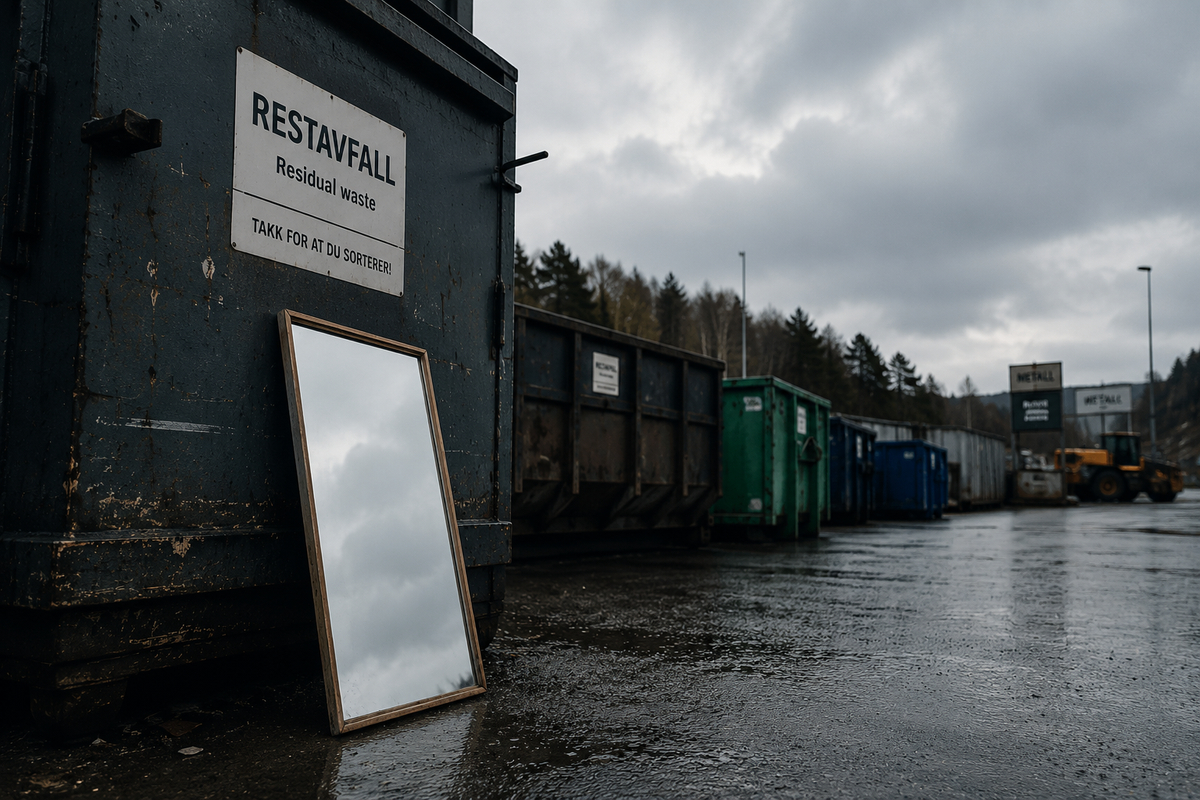
A mirror.
Not a particularly large one. Thinner than I am and roughly hip-high. It didn't look expensive. For years, its main contribution to society had been showing me a man who really ought to tidy up more often.
I walked over to the professionals, who were standing around drinking coffee and discussing life in general.
"Residual waste," one of them said.
Before I even reached them, another employee pointed toward a container I hadn't noticed before.
There it was.
The only container that cost money.
Apparently, they were well prepared for people to be financially ambushed by a mirror.
I suspect it happens more often than you'd think.
Of course.
I kept my thoughts to myself. After all, the people drinking coffee weren't the ones who wrote the rules.
The procedure was surprisingly elaborate.
First you press a button.
Then a small gate opens.
Then you throw away the mirror.
Then you walk back and press the button again.
The gate closes.
Then you pay.
Forty-three kroner.
They accept Vipps.
They accept credit cards.
They are, in other words, exceptionally well prepared for people to be financially ambushed by a mirror.
Even so, I couldn't help feeling slightly cheated.
You can dispose of an entire trailer full of timber free of charge. Metal, electronics, probably ten cubic metres of tightly rolled plastic—nobody bats an eye.
But a mirror?
A mirror whose wooden frame had started coming apart in one corner?
I'd practically donated half an industrial estate for free.
But a mirror the size of a slightly overambitious serving tray?
That's where they draw the line.
Suddenly it felt like ordering an extra dipping sauce at the airport.
Forty-three kroner, please.
An otherwise pleasant visit ended with the strange feeling that I'd somehow been outsmarted by something that had spent years reflecting my face back at me.
The very last thing that mirror ever did...
...was cost me money.