The Digital Babel
We generate more data than ever before, yet spend countless hours trying to make our systems understand one another. The problem isn't a lack of information. It's that every system still speaks its own language.

How I Stopped Worrying and Learned to Love Simply Being Frustrated by Observation.
Imagine a body.
Not the kind of body that appears in art history books or gym advertisements. Not a body bathed in oils and wrapped in romantic or erotic fantasies.
No.
This is a bureaucratic body.
A body made of paper.
We are in France towards the end of the eighteenth century. In a dimly lit office, a clerk with a bad back and limited career prospects sits behind a desk. Before him lie piles of documents. Letters of complaint. Lists of grievances. Notes from farmers, priests, merchants and noblemen.
Taxes are too high.
The harvests are too poor and bread has become too expensive.
The neighbour is an idiot.
The local lord has bought himself a new wig, and nobody likes it.
The information exists. The problem isn't a lack of information. The problem is the sheer volume of it.
How do you find patterns in a mountain of frustration?
How do you turn ten thousand individual complaints into one shared understanding?
The answer is simple:
You build a system.
A database.
You categorise.
You put things into boxes.
In this case, the result wasn't merely better record-keeping.
The result was revolution.
The point is that the French Revolution didn't happen because people lacked data. It happened because the information already existed everywhere—but it only gained power once someone managed to bring it together.
Two hundred years later, we have exactly the same problem.
Only with worse coffee and more passwords.
Instead of stacks of paper, we stare into spreadsheets. Instead of messengers, we have APIs. Instead of handwritten complaints, we have dashboards, reports and analytics platforms.
Data exists in abundance.
Yet we spend enormous amounts of time trying to make it talk to itself.
A source with suspiciously good connections—and a name that also happens to be a type of pasta—once described this as "the paradox zone."
Everything already exists.
Every click.
Every conversion.
Every digital movement.
The information has been recorded, stored and catalogued with almost religious precision.
But it sits behind walls.
Behind logins.
Behind subscription models.
Behind systems that all speak different languages.
So we do what humans have always done when systems refuse to cooperate.
We write scripts.
We glue things together with improvisation, optimism and a healthy dose of panic.
We live somewhere between abundance and fragmentation.
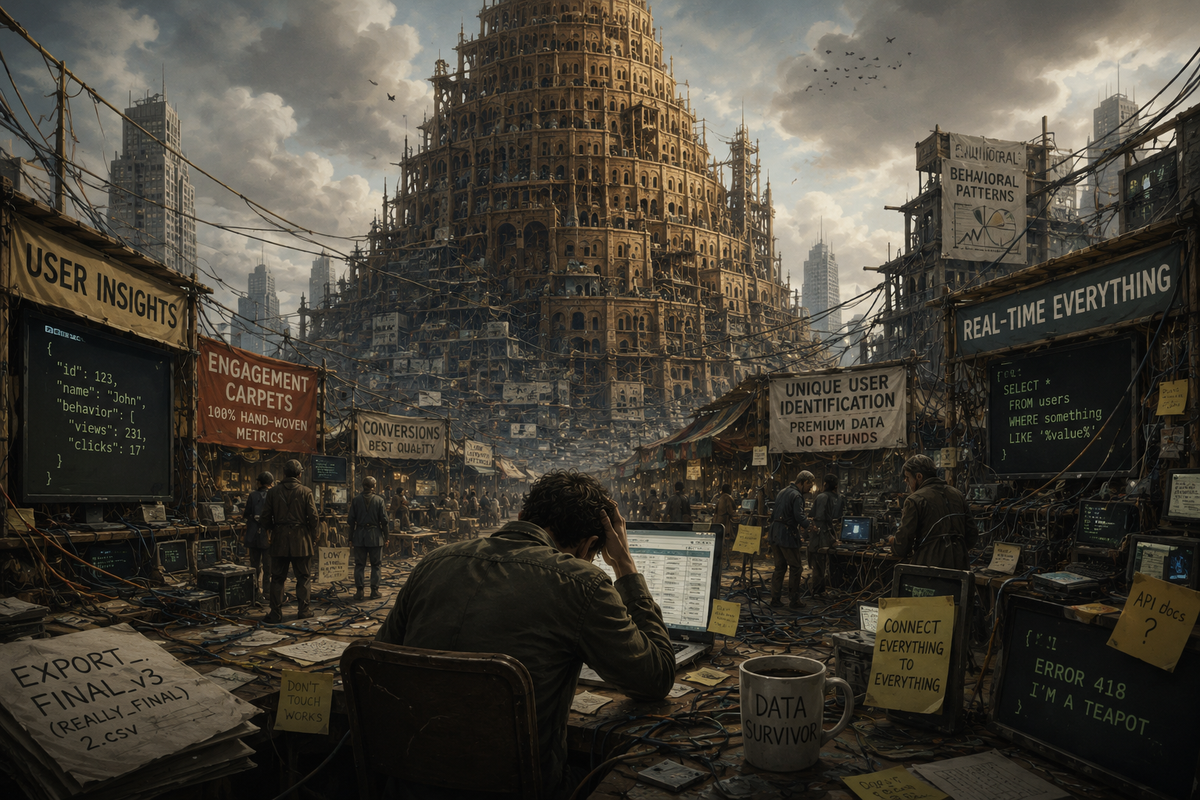
The Tower
History shows that whenever humans discover an information problem, we almost always try to build a tower.
One system.
One solution.
One place where everything comes together.
The Romans did it. They didn't build roads only for soldiers, but for tax registers, censuses and glorious administration.
The Library of Alexandria was, in many ways, the world's first attempt to gather all human knowledge under one roof.
The internet age did exactly the same thing.
Google wanted to organise the world's information.
Facebook wanted to organise the world's relationships.
Everyone wanted to build a tower.
The problem is that towers have an unfortunate habit of collapsing.
Not necessarily physically.
But culturally.
People love efficiency—right up until efficiency starts keeping tabs on them.
That's when we rebel.
And build new systems.
The cycle begins again.
The Bazaar
When the tower fails, the opposite instinct emerges.
The bazaar.
The open marketplace.
Everyone builds their own solutions.
Everyone offers their own formats.
Everyone speaks their own language.
It's creative.
It's alive.
It's complete chaos.
Imagine a marketplace where one stall sells beautiful rugs woven from conversion data, while the neighbouring stall specialises in "unique user identification."
That's what parts of today's digital ecosystem feel like.
You negotiate access.
You build bridges between systems that were never designed to communicate.
It works.
But only just.
The bazaar creates innovation because it has to.
Sooner or later, everyone starts longing for something else.
The Protocol
Historically, it is rarely the tower or the bazaar that wins.
What wins is the protocol.
The boring, invisible solution.
The rules everyone agrees to follow.
Email works because different providers follow the same basic standards.
The telephone network works because everyone agrees on how signals should be handled.
The internet works because millions of systems speak a common language.
Nobody owns that language.
Everybody uses it.
Perhaps this is where the future lies.
Not in one gigantic platform.
Nor in a thousand improvised integrations.
But in a common language for data.
A format everyone understands.
A system where every organisation still owns its own data, but information flows freely without some unfortunate analyst having to spend three sleepless nights rewriting a CSV file.
The technology isn't really the difficult part.
The difficult part is people—with their pride and their habits.
History is full of examples.
Standardised railway gauges.
Shipping containers.
Standard internet protocols.
Humanity's greatest advances often don't come from new inventions.
They come from people agreeing on how existing inventions should work together.
The Art of Gluing Things Together
Perhaps that's why this fascinates me.
Because this isn't really about marketing.
It isn't even about technology.
It's about something far more human.
We create order.
Then we create chaos.
Then we create a new order.
And then we complain about that as well.
The glue holding today's data systems together is almost an art form in its own right.
Tiny scripts written at three in the morning.
Improvised solutions.
Temporary fixes that have somehow remained temporary for six years.
They're the folk art of the data world.
In a hundred years, they ought to be displayed in museums.
"This script," a guide will explain, "was written by an exhausted analyst fuelled by cold pizza and existential dread. Notice the subtle desperation in the error handling."
The paradox zone is frustrating.
But it's also where the future is being built.
With ever more glue.
History may not repeat itself.
But it certainly rhymes.
And right now, it sounds as though someone is trying to compose an extraordinarily complicated limerick inside a server room.
—
P.S. The receipt for the gin and tonic is attached. It forms part of the dataset. I expect reimbursement.