
The Interview Queen

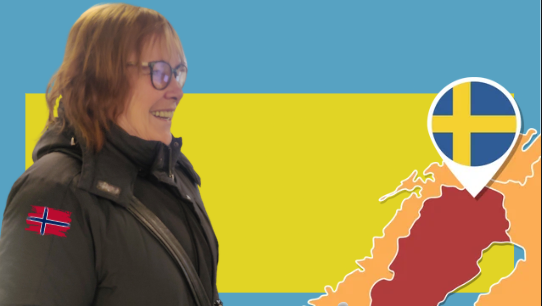
More than half a million phone calls. Thousands of "I don't knows." And just as many moments that never made it into a report. Yet the numbers have never been what mattered most to her. It's always been the people behind them.
Lillehammer is best known for the lingering glow of the 1994 Winter Olympics. On this particular winter afternoon, however, the city is about something entirely different.
I've come here to meet a woman who has spent more than twenty-five years asking strangers questions.
Inside Norstat, she's known simply as Agent 1064.
Among colleagues, she's something of a legend.
Over the course of more than half a million telephone interviews, she has spoken to a cross-section of the Norwegian population so vast that even London's most talkative red telephone boxes might feel a little envious.
But who is Anette, the woman behind the statistics?
What makes someone devote so much of a lifetime to listening to strangers? And how do you spend more than two decades hearing "I don't know" as one of the most common answers without losing your curiosity?
Those are the questions that bring me to Toppen Bar, on the eleventh floor of the historic Aktiemølla Hotel.
The journey begins as the automatic doors glide open with almost theatrical precision. The hotel carries itself with quiet confidence. Warm lighting, polished interiors, and the cold stone beneath my feet serve as a reminder that, despite the comfort inside, this is still Lillehammer in the middle of winter.
Originally built as a mill in 1850, the building has lived several lives before becoming a hotel. Today, it provides the setting for my meeting with one of Norway's longest-serving interviewers.
Her name is Anette.
Or, as most of her colleagues know her—
Agent 1064.
"So," I begin, "half a million interviews. What does that actually mean?"
Anette smiles softly and turns her gaze towards the snow-covered landscape beyond the window.
"It means I've heard a great deal," she says. "People don't just share opinions. They share stories. That's what fascinates me. Sometimes they're deeply moving. Other times, they're wonderfully entertaining."
From Stenungsund to Lillehammer
By the time I arrive upstairs, Anette is already seated at our table. A cup of black coffee rests in front of her. She greets me warmly, yet there's something unmistakably professional in her expression—a quiet I've-heard-it-all-before confidence that probably comes from several hundred thousand conversations.
I begin with a simple question.
"Tell me about life in Stenungsund."
She laughs.
"Oh, those were good years. Though I can probably admit now that I wasn't always entirely innocent."
She tells me about growing up on Sweden's west coast and about her first job at a factory that produced clothing labels for brands including Levi's.
"We were young, and we had fun. And yes," she says with a grin, "I may have ridden in the back seat of a few stolen cars before I turned eighteen."
Life took a different direction in 1978. At eighteen, she moved to Lillehammer after accepting a job at a Norwegian mountain lodge.
"It was a big adjustment," she says. "But Lillehammer has always had a charm of its own."
The Telephone Directory Years
When Anette joined Norstat in 1997, the company was still young, and telephone interviewing was as much a craft as it was a profession. Everything was done by hand, relying on curiosity, experience, and a generous measure of patience.
"We sat there with the telephone directories," she recalls, lowering her eyes towards her coffee. "You had to learn the patterns. Alta in February? Forget it. It was like calling into an Arctic wilderness. People had more important things to worry about than answering the phone. Stavanger when it was raining? Almost as bad. But Trondheim—Trondheim was always dependable. People picked up."
She laughs at the memory, though there's unmistakable pride behind the stories.
In those days, the telephone directory was the industry's lifeline. It wasn't simply a matter of finding phone numbers. You had to develop an instinct for when people were most likely to answer, which parts of the country were responsive, and how the rhythm of everyday life varied from one region to another.
Every interview began the same way: by keying in the telephone number by hand.
"We became remarkably fast—and remarkably accurate," Anette says with a smile. "Of course, every now and then we'd dial the wrong number. Sometimes we'd get a telling-off. Other times, we'd end up sharing a good laugh."
Improvisation was an essential part of the job as well. When response rates were low in certain areas, the interviewers had to think creatively.
"We realised fairly quickly that some places were simply easier to reach than others. So yes, there were occasions when we'd make a few extra calls to places where people actually answered the phone."
I ask whether that wasn't edging into questionable statistical practice.
Anette shrugs, smiling.
"We probably didn't always follow the strictest statistical principles," she admits. "But we got the job done, and we did it well. Our clients were happy, and at the time, that was what mattered most."
As the years passed, the methods became more refined and the work increasingly professional. But that evolution didn't happen overnight. It took countless discussions, plenty of trial and error, and, perhaps most importantly, an endless supply of coffee.
"We took real pride in making it work," she says. "We knew that what we were doing mattered—not just to our clients, but to everyone who took the time to share their opinions with us."
Yet, in the end, what made those early years memorable wasn't the telephone directories or the methods.
It was the people.
The People Behind the Numbers
"There was a real pioneering spirit in those days," Anette says. "We were a small team that genuinely wanted to make it work, and we had a lot of fun doing it."
She remembers colleagues who competed—good-naturedly—to see who could complete the most interviews, and an office where laughter was never in short supply.
One of her favourite stories involves a colleague who became increasingly frustrated with a region where almost nobody answered the phone.
"He started imitating the local dialect," she laughs. "And it actually worked. Perhaps a little too well. Before long, respondents were asking whether he knew people in the area, and it became rather difficult to keep a straight face."
As our conversation drifts back to those early years, I notice a hint of nostalgia in her voice.
"It was never just about numbers and statistics," she says. "It was about people. Stories. Moments. We heard so many strange things, and so many wonderful ones. If there's one thing I miss most, it's that direct connection with people."
She looks out across the snow-covered rooftops of Lillehammer. For a moment, I wonder if she's thinking about the countless voices that have travelled through a telephone receiver over the years.
Because no two working days are ever quite the same for an interviewer.
"One thing never changes, though," she says with a smile. "Every day begins with coffee. Lots of coffee."
Eventually, you find your rhythm.
"The first call is always the hardest. But once you've made it, everything starts to flow. It's almost meditative. You listen, you ask, and then you listen again."
Some conversations feel like catching up with an old friend.
Others take far more unexpected turns.
She remembers one elderly man who answered the phone with a lengthy stream of colourful language.
"I remember thinking, This is going to be difficult. Then he burst out laughing and said, 'I'm only joking!'"
On another occasion, she reached a woman who seemed far more interested in talking about her grandchildren than participating in a survey.
"I learned everything there was to know about little Petter and how he'd just learned to ride a bicycle," she says, laughing. "I didn't get a single survey question answered."
Those conversations may never have followed the questionnaire.
But they're often the ones that stay with you.
"It's about more than data and statistics," Anette says.
"It's about people."
Over the years, Anette has called plenty of people who would have preferred never to receive a phone call from Norstat.
"Some people can be downright rude," she says. "But I always try to stay friendly. It's never about me."
She recalls a receptionist she encountered repeatedly through different surveys.
"Eventually he said to me, 'You must be the most stubborn person I've ever met.'"
He said it with a smile, and over time the two of them developed a kind of mutual respect.
Between the calls, there's another world entirely.
In the staff room, stories are exchanged over coffee, along with increasingly inventive explanations for why people simply can't take part in a survey today.
"We compete with each other a little as well," she says. "Who gets the first respondent? Who completes the most interviews?"
She laughs.
"One colleague even started collecting the strangest excuses people came up with. My favourite was, 'I can't talk right now—I have a dirty fish in my hand.'"
She shakes her head.
"We laughed until we cried."
Those are the moments that give the working day its personality.
As her shift draws to a close, Anette likes to remain at her desk for a few extra minutes.
"I spend a little time replaying the day in my head before I go home."
Because some conversations stay with you.
Some because they're funny.
Others because they're simply bizarre.
And some because they're quietly moving.
"I think a lot of people really just need someone to listen," she says. "That's what empathy is. Being present."
Over nearly three decades, she has watched the industry transform completely. When she first started, every telephone number was dialled by hand and every questionnaire completed manually.
"We were practically human calculators," she says with a smile.
Then computers arrived.
"It was like handing a hammer to a fish. I had absolutely no idea what I was doing."
She laughs at the comparison, but there's truth behind the joke.
Technology has transformed the way the work is done.
She only hopes it never replaces the human connection.
"It's never just about numbers or statistics," she says. "It's about understanding people. Behind every single number is a human story."
Perhaps that's also why she still enjoys the job after all these years.
It has never really been about the numbers.
It's always been about the people behind them.
From Telephone Directories to Algorithms
Anette laughs when she talks about the youngest people entering the industry today.
"They've grown up with a smartphone in their hand," she says. "But some of them are completely thrown when they're faced with an ordinary keyboard and a mouse."
Training new employees, she explains, sometimes begins with the absolute basics of using a computer.
"We joke that we're teaching Computing 2.0."
She's quick to point out, however, that she wasn't exactly a technology expert herself when she started.
"I couldn't use a computer either. But we didn't have a choice. We had to learn."
Over the years, she's watched the workplace transform beyond recognition. The telephone directories have disappeared. Numbers are no longer dialled by hand. Instead, sophisticated systems automatically connect interviewers with respondents and guide them through each survey.
"It's incredibly efficient," she says. "We no longer spend time on the repetitive tasks, which allows us to focus on the conversation itself."
Even so, there's one thing she misses about the old days.
"When you had to dial every number yourself, you felt more responsible for each conversation. You were more present somehow."
She falls silent for a moment.
"Sometimes I think we've lost a little of that human touch."
Anette has no doubt that the transformation will continue.
"In ten years, it might be robots doing my job."
She smiles, though there's a trace of melancholy behind the remark.
"It's a little sad. But it's probably where we're headed."
If she could offer one piece of advice to new colleagues, it would be the same principle she's lived by throughout her career.
"Give it time. Stay curious. Don't give up."
Technology will continue to evolve.
Fortunately, people will continue to be people.
"We've come a long way since the days of the telephone directory," she says. "But there are some things we'll never be able to replace."
Because even in a world of automation, algorithms and artificial intelligence, Anette believes the most important part of the job still happens in the meeting between two people.
Even if that meeting takes place through nothing more than a telephone line.
Life's Simple Pleasures
When Anette isn't wearing a headset with a questionnaire on her screen, she finds her peace in Lillehammer.
The town has been her home for decades. From her house, she looks out across Lake Mjøsa and the rolling hills beyond.
"It's a daily reminder of how fortunate I am," she says.
Toppen Bar offers a view of its own this afternoon. Below us, Lillehammer lies wrapped in soft winter light while Mjøsa stretches southwards like a silver ribbon between the hills.
Her free time is built around life's quieter pleasures.
One of her favourites is walking along the Mesna River.
"The river is beautiful in every season," she says. "But spring is something special. When everything begins to wake up again, there's a feeling that's hard to describe."
It's easy to understand what she means. After several hours spent talking about telephone lines, interviews and working life, it becomes clear that nature is where she goes to recharge.
There is, however, one place that continues to pull at her.
Crete.
The moment the island is mentioned, her face lights up.
"I love Crete. If I ever won the lottery, I'd buy a holiday home there without a second thought."
She talks about the long sunny days, the sea, the people, and the slower pace of life.
"It's the perfect counterbalance to everyday life. Just imagining waking up to the sound of the waves and the smell of the sea makes me happy."
For someone who has spent much of her life listening to other people, it seems that Lake Mjøsa and the Mediterranean offer the same rare luxury:
A little silence.
Stories Between the Lines
It doesn't take long before our conversation drifts beyond Norstat.
Anette has a remarkable talent for finding herself in situations that, in hindsight, sound more like short stories than everyday life.
Once, she walked into a shop without realising it was being robbed.
"I hadn't the slightest idea what was going on," she laughs. "I just thought things seemed a bit chaotic."
It wasn't until she noticed the staff standing with their hands above their heads that she realised what was happening.
Fortunately, everyone got out safely.
Another story dates back to her years working at a hotel in Sandefjord.
One day, actress and revue legend Kari Diesen checked in.
"She gave me a signed LP and a five-hundred-kroner tip."
Anette still laughs at the memory.
"It felt completely surreal."
Once she starts telling stories, they seem to arrive one after another.
The common thread is simple:
They're all about people.
As I listen, it strikes me that Anette has spent almost her entire working life in service. First in hotels, then meeting tourists, and later through hundreds of thousands of telephone conversations.
Perhaps that's why she seems so completely at ease with strangers.
Right Place, Wrong Time
Anette describes herself as someone who often finds herself in unexpected situations.
"I've been in the wrong place at the wrong time more often than I can count," she says with a smile. "But at least it usually leaves me with a good story."
There's something about the way she tells these stories that keeps them from ever sounding dramatic.
If anything, she seems more fascinated than shaken by them.
"I think it comes down to not taking yourself too seriously," she says. "Life is full of coincidences. Sometimes you just have to lean back and let things unfold."
She shrugs.
"And afterwards, at least you'll have something worth telling."
Looking Ahead
As our conversation draws to a close, I ask Anette what she imagines life will look like once she retires—a day that, after nearly three decades, is no longer all that far away.
She smiles before answering.
"I won't have to spend all day on the telephone," she says. "That will be different. But I think it'll be nice too. Maybe I'll finally have the chance to listen to people without a questionnaire in front of me."
She laughs at her own observation.
"I've actually been toying with the idea of writing a book about it all. I think I'd call it My Life at Norstat."
It's hard not to notice how deeply she cares about the place where she's spent so much of her working life. Few people stay long enough to witness both constant change and remarkable continuity.
When I mention how much the company has grown—with offices now spread across several countries—she simply shrugs and smiles.
"Well," she says dryly, "it's Kamprad's people running the show now... if we're to believe what you've uncovered."
She lets the remark hang in the air for a moment.
It's the kind of ending that doesn't need explaining.