
The Invisible Cities: The City of Gifts
RABAGAS enters the world of livestream economies — a digital city built on attention, status, and human connection. From virtual roses and ranking systems to agencies and invisible labour, this is a journey into one of the internet’s fastest-growing communities.

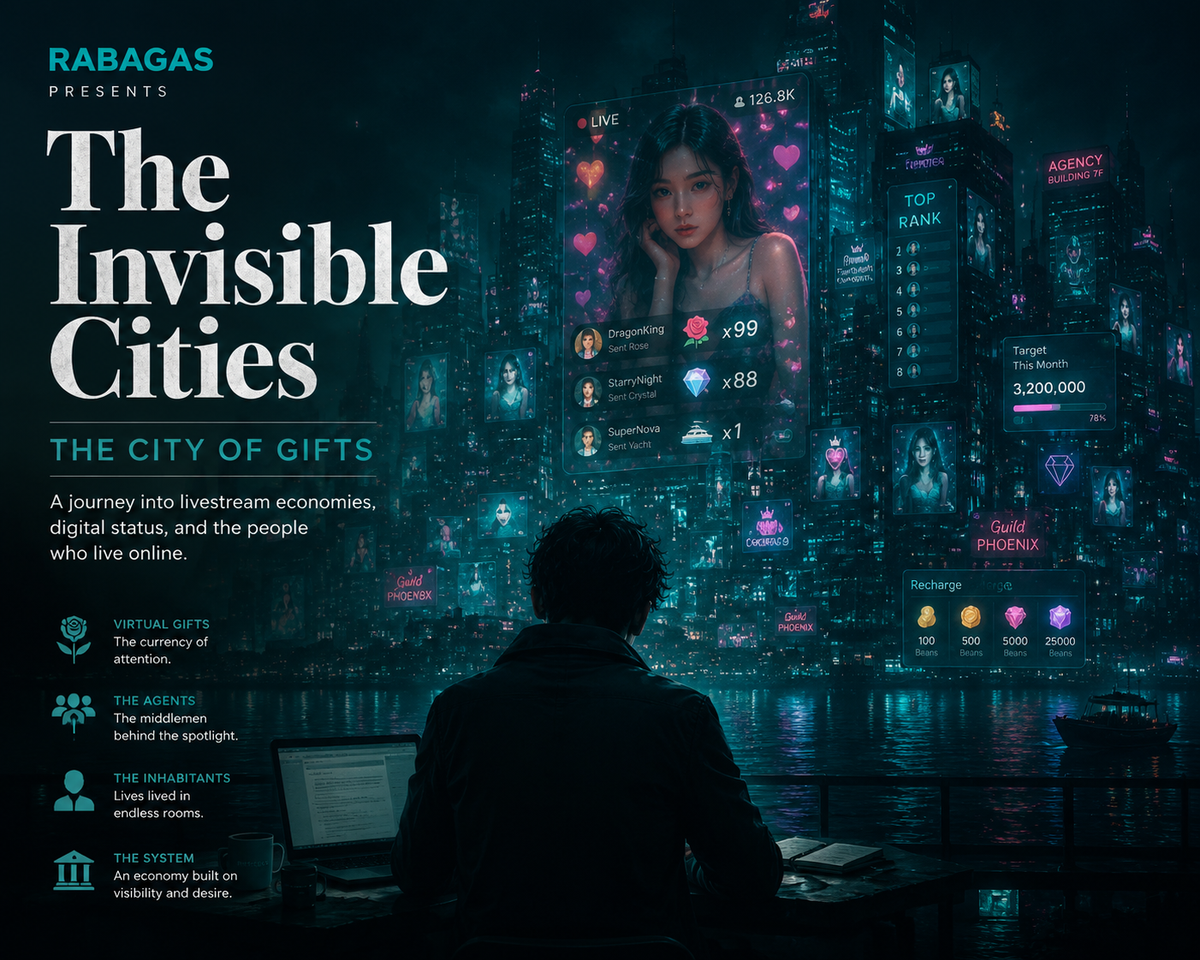
Inside a digital city where attention is currency, visibility is survival, and a virtual rose can become real money.
Part 1
The Biggest Mistake Jonas Ever Made at a Morning Meeting
The coffee machine had already made up its mind.
It was not in a good mood. It was not operational either. It had entered some kind of passive protest against anything resembling work, structure, or hope.
It produced half a cup of coffee per person — just enough to give the human body the false impression that the day might still be manageable — before retreating again with a sound that resembled a small animal regretting its decision to exist.
Hampus stood leaning against the kitchen counter, staring at it as if it owed him money.
“This machine isn’t just broken,” he said. “It is ideologically opposed to us.”
“It’s Swedish,” Ragna replied. “Same thing.”
Ulrikk had already started looking for a theory.
He often did that when things stopped making sense. If reality was unclear, the only reasonable explanation was that someone had documented it badly.
Jonas, on the other hand, was already sitting at the table looking like he had been trapped in a meeting for several hours before the meeting had even started.
He had not said a word yet.
That was usually a bad sign.
The morning meeting at the RABAGAS editorial office was not a meeting in the traditional sense. It was more a collective state of chaos that happened to occur at the same time every day.
There was no agenda, only a shared understanding that something probably needed to be produced before the day was over.
There was also one rule:
Anything could become a story.
That was the rule Jonas would come to regret more than any other in his adult life.
Hampus clapped his hands.
“Okay. We need something big. Something that actually matters.”
Ragna flipped through her notebook without looking up.
“We already have three stories that matter. Two of them are wrong, and the third one is a coffee machine that has developed a personality.”
The coffee machine responded with a weak, irritated beep.
Ulrikk leaned forward.
“What about livestreaming?”
The room went quiet.
Not dramatically quiet.
More the kind of silence that appears when a room is unsure whether it has just heard something stupid or something dangerous.
Jonas looked up.
“Livestreaming?”
He said it as if the word was new to him. As if it needed to be tested before it could be approved.
Ulrikk nodded enthusiastically.
“Yes. It’s everywhere. People broadcast themselves live all the time. And there is a lot of money involved. Virtual gifts and things like that.”
Hampus slowly turned around.
“Virtual gifts?”
“Yes,” Ulrikk said. “Like… digital flowers. Or diamonds. Or dragons. People buy things and send them to people who are sitting there talking.”
Ragna looked up for the first time.
“So we have gone from journalism to medieval tribute economics in three sentences.”
Jonas leaned forward slightly.
“But who gets the money?”
That was the moment it happened.
The small moment when an idea stops being a comment and becomes a responsibility.
Hampus smiled.
“That,” he said, “is an article.”
Jonas laughed.
A little too quickly.
“No, I just… wondered.”
Hampus leaned across the table, like a judge who had already delivered the verdict but was waiting for the accused to understand the consequences.
“Jonas. You have written what, an A4 page about the time you saw a strange cloud over Elverum?”
“It was meteorologically interesting.”
“You are responsible for this.”
It was not a suggestion.
It was an administrative event.
Ragna put down her pen.
“I can help with the research if there is actually something here. But this could easily become a rabbit hole.”
Ulrikk was already smiling.
It was not a reassuring smile.
It was the smile of someone who had just discovered a door in a wall where there should not have been a door.
“I’m joining Jonas,” he said. “There are probably some interesting economic structures here.”
Jonas looked at both of them.
He tried to find a way out that did not involve losing face, his job, or his dignity.
He found none.
“Okay,” he said.
And at that exact moment, it stopped being an idea.
It became a project.
The coffee machine made a sound that suspiciously resembled laughter.
Jonas was already regretting it before they had opened a single tab.
It did not start with research.
It started with what all major problems in 2026 start with:
a search bar.
He typed:
“livestreaming economy”
Then:
“What is BIGO Live”
Then:
“why do people send money online”
Then he stopped.
Because the internet, as usual, responded by opening a room much larger than the question.
BIGO Live was not just an app.
It was a company.
And the company was not just a company.
It was part of something bigger.
Jonas leaned back.
“It’s a corporation,” he said.
“Everything is a corporation,” Ragna said from another desk without looking up.
Ulrikk had already opened something that looked like an ownership chart.
It was the first time Jonas had seen one of those maps up close.
It did not look like information.
It looked like someone had tried to draw a spider that had received bad news.
“JOYY Inc.,” Ulrikk read. “They own BIGO.”
“Okay,” Jonas said. “That sounds manageable.”
He said it out loud.
As if he was trying to convince himself.
Ulrikk continued.
“And they have several other platforms. Likee. imo.”
“imo?”
“Yes.”
“What does that mean?”
“I don’t think it’s an abbreviation,” Ulrikk said. “I think it’s just… an attitude.”
Jonas felt the small shift in his body.
It was not panic yet.
Just the faint feeling that something had become slightly larger than expected.
He opened a new tab.
Then another.
And another.
It was no longer research.
It was momentum.
The coffee machine made another sound.
This time it sounded like it had completely given up.
Ragna stood behind them.
“Just so we are clear,” she said, “if this turns out to be one of those stories that starts with ‘we were just going to take a quick look,’ then I was right from the beginning.”
Jonas nodded without turning around.
He was already inside.
And he did not know it yet, but this was the moment when he stopped being someone who wrote small observations.
And became someone who disappeared into them.
Without a return ticket.
The coffee machine coughed.
And the day continued.
Part 2
Seventeen Tabs and a Rising Sense of Panic
It started calmly enough.
It always does.
Jonas had imagined research as a fairly organized process: open a few articles, maybe read a couple of reports, write down some notes, feel slightly smarter, and then continue with life.
The internet had other plans.
The first problem was not the information.
It was the amount of it.
The second problem was not the amount either.
It was that everything pointed somewhere else.
The third problem was that Jonas could no longer remember why he had started looking into this in the first place.
His screen had evolved into something resembling a control room for a small, but deeply confused, space station.
Seventeen tabs.
Maybe eighteen.
He was not entirely sure.
One tab:
“What is BIGO Live?”
Another:
“JOYY Inc. investor relations”
A third:
“virtual gifting economy explained”
A fourth:
“why do people gift streamers money”
At some point, it stopped being a list and became more of a condition.
Ulrikk had already disappeared into his own system.
He was standing behind Jonas, but mentally he was somewhere completely different.
“This is interesting,” Ulrikk said. “This is basically a closed economy with external capital injection through microtransactions driven by emotional rewards.”
Jonas did not turn around.
“Can you translate that into Norwegian?”
“People buy digital things because they like people who talk on the internet.”
“Okay. I understand that.”
“But it is much more complicated.”
“Of course it is.”
Ragna sat further back in the room.
She had not entered the chaos yet.
She was observing it.
She had a talent for waiting until systems started revealing themselves before getting involved.
“Have you found anything concrete yet?” she asked.
Jonas hesitated.
Not because he had found nothing.
Because he had found everything.
And everything was connected to something else.
“BIGO is owned by JOYY,” he said.
“Yes,” Ragna replied.
“JOYY is a publicly traded company.”
“Yes.”
“They make livestreaming their main source of income.”
“Yes.”
“It is… very big.”
Ragna nodded.
“That is why we are looking at it.”
Jonas slowly turned back to the screen.
There was something almost physical about that kind of information.
It filled the room.
Not with answers.
But with responsibility.
He clicked further.
An organizational chart opened.
It was the first time he really saw how everything connected.
BIGO Technology.
JOYY Inc.
Investor structures.
Regional markets.
Subsidiaries.
It did not look like a company.
It looked like an organism that had grown in the dark, without anyone entirely deciding what shape it should take.
“It’s like an octopus,” Jonas said.
“Everything is an octopus if you stare at it long enough,” Ragna replied.
Ulrikk laughed quietly to himself.
“No, but this is actually interesting. Look here—”
He pointed.
Jonas leaned closer.
A number.
A percentage.
A revenue stream.
Then another.
And there, almost randomly placed, something that looked small but was not:
virtual gifts.
“That is where the money comes from,” Ulrikk said.
Jonas stared.
“From… gifts?”
“Yes. People buy digital things and send them to streamers.”
“Why?”
Ulrikk shrugged.
“Because they want to be seen.”
Something about that sentence changed the room.
Not dramatically.
Just slightly.
As if the air had become heavier.
Jonas opened another tab.
Then another.
Then another.
He was beginning to understand the dangerous part of this kind of research.
It was not that information was difficult to find.
It was that there was no natural stopping point.
Everything led somewhere else.
Everything demanded more understanding.
And everything was connected to money.
Ragna stood up.
She walked over and looked at the screen over his shoulder.
“Okay,” she said. “But remember one thing.”
Jonas turned around.
“What?”
She pointed at the screen.
“This is still only the surface. Once you start understanding how people actually operate inside these systems, that is when it becomes interesting.”
Jonas nodded.
But he had already lost some of his feeling of “surface.”
To him, this already felt deep.
Far too deep.
The coffee machine in the corner made a sound.
The same old sound.
Half mechanical.
Half resigned.
Hampus entered the room, glanced at Jonas, and stopped.
“How many tabs do you have open?”
Jonas did not count.
He just looked.
“Seventeen.”
Hampus nodded.
“You are officially in the danger zone.”
“Danger zone for what?”
“For believing you are in control.”
Nobody laughed.
Because nobody entirely disagreed.
Jonas turned back to the screen.
He was just going to find one more thing.
Just understand one more piece.
But the problem with BIGO was already becoming clear, even though he was not ready to admit it yet:
It was not one thing.
It was many things pretending to be one.
And now Jonas was inside all of them.
Part 3
How to Make Money From an Animated Rose
There is a moment in every good research project when journalists believe they understand the system.
It is usually at that exact moment that the system starts laughing at them.
Jonas had reached that point.
He sat in front of the screen with a kind of cautious confidence, as if he had managed to crack a code that was never really meant to be cracked.
“Okay,” he said. “I think I understand it.”
Nobody answered immediately.
Not because they agreed.
Because they knew what was coming.
Ragna leaned back in her chair.
“Say it out loud.”
Jonas pointed at the screen.
“People send money to streamers.”
“Yes,” Ulrikk said.
“Through virtual gifts.”
“Yes.”
Jonas nodded, as if he was building a bridge while already walking across it.
“And these gifts are basically just digital objects.”
“Yes.”
“Like roses. Or diamonds.”
“Yes.”
He smiled slightly.
“So it is… it is basically like a tipping culture, just with animations.”
The room went quiet.
Not because he was right.
Because the explanation was too simple.
Ragna looked at him.
“That is level one,” she said.
Jonas leaned back.
“Okay. What is level two?”
Ulrikk opened his mouth, but Ragna got there first.
“That they are not just tips.”
She leaned forward.
“They are a language.”
Jonas blinked.
“A language?”
“Yes,” Ragna said. “An economic language. A social language. A hierarchy language.”
Ulrikk nodded enthusiastically.
“It is like… status. You buy visibility in a room that is designed around visibility.”
Jonas stared.
“So… the more you pay, the more you are seen?”
“Often, yes.”
That was where Jonas made his mistake.
He started laughing.
Not loudly.
Just a little.
“So people buy digital roses to be seen on the internet?”
Ulrikk looked at him.
“Yes.”
Jonas leaned back in his chair.
“That is actually… kind of beautiful.”
Ragna raised an eyebrow.
“No. It is an economy.”
But Jonas had already gone a little too far into the thought.
He opened a new tab.
“BIGO virtual gifts list”
And there they were.
The roses.
The diamonds.
The small animated explosions of colour and sound.
And there was something uncomfortably concrete about them.
This was not a collection of abstract graphs.
It was not invisible finance.
It was an animated rose that cost money.
Jonas pointed at the screen.
“How much does one of these cost?”
Ulrikk leaned closer.
“Some cost a few cents. Some cost a few dollars. Sometimes much more for the bigger effects.”
“Much more?”
“Yes. There are gifts designed for… spectacle.”
Ragna nodded.
“And they appear on the screen while everyone is watching.”
Jonas sat quietly for a moment.
Something shifted in his mind.
Not an insight exactly.
More like a small change in position.
“So… it is basically a competition to be seen?”
“Partly,” Ragna said.
“And a competition to show that you can afford to be seen,” Ulrikk added.
Jonas looked at the screen again.
Suddenly, the roses were no longer cute.
They were not symbolic either.
They were small digital signal flares.
He leaned forward.
“But who gets the money?”
There it was.
The question hiding underneath every one of these systems.
Hampus, who had been standing in the doorway unnoticed for a while, answered before anyone else could.
“Now you are entering the next layer.”
Jonas turned around.
“The next layer?”
Hampus walked into the room and leaned against the wall.
“The streamer gets something. The platform gets something. Sometimes an agency gets something. And sometimes… something disappears somewhere in between that nobody really talks about.”
The last part was said a little more quietly.
Jonas noticed.
There was a difference between information and experience.
Hampus was speaking from the second category.
Ulrikk had already started writing something down.
“Agencies,” he muttered. “That is interesting.”
Ragna looked at him.
“No. That is the next chapter.”
Jonas leaned back.
He had not noticed it himself, but he had stopped laughing.
He was still looking at the digital roses.
But they no longer looked like toys.
They looked like work.
And a system that depended on someone constantly paying to be seen.
The coffee machine coughed in the corner.
As if trying to remind them that it too had once served a purpose.
Jonas did not close the tabs.
He opened more.
It was no longer research.
It was a kind of sinking.
And somewhere in the back of his mind, a quiet and uncomfortable thought began to take shape:
If this was only roses…
what came next?
Part 4
The Agencies
There is always a point in a project where it stops being about what you thought you were investigating, and starts being about the people who make a living from the thing you are investigating.
For Jonas, that point arrived with a word that sounds like logistics, but behaves more like an entire underground economy:
Agencies.
He did not like the word.
It did not have the same immediate colour palette as “roses,” “gifts,” and “livestreaming.” It was grey. Corporate. Excel spreadsheets. Agreements that were rarely fully explained, only implemented.
“Okay,” Jonas said. “What exactly is an agency?”
Ulrikk answered before anyone else had time to breathe.
“It is an intermediary structure that optimizes revenue flow between platform, streamer, and audience.”
Jonas looked at him.
“You cannot just create sentences that sound like they were written by a printer.”
Ulrikk nodded, slightly offended but not discouraged.
“Fine. They help streamers make more money. And they take a share.”
Ragna added, without looking up from her notes:
“And they control them.”
The room went quiet.
The coffee machine beeped softly in the background, as if it also wanted to contribute to the conversation but had given up trying to form a coherent argument.
Jonas leaned forward.
“Control them how?”
Ragna turned one page.
“Schedules. Targets. Bonus requirements. What they should say. When they should be online. Who they should collaborate with.”
She looked up.
“It is not just an economic model. It is a work schedule disguised as entertainment.”
Ulrikk nodded, excited again.
“It is actually fascinating. You have a system where emotional presence becomes labour.”
Jonas frowned.
“That sounded like something you say to avoid explaining it in simpler terms.”
“It is simpler,” Ulrikk replied. “But less accurate.”
Hampus walked in carrying a cup that looked like it had been through a war.
“You are already at agencies?”
Jonas looked up.
“Is that… fast?”
Hampus laughed.
“That is like saying you opened the fridge and immediately started discussing the inheritance settlement of the house.”
Ragna leaned back.
“We need to understand the structure early.”
Hampus nodded.
“Fine. Then you need to understand one thing.”
He pointed at the screen.
“No streamer here is really just a streamer.”
Jonas felt the sentence land with a certain weight.
“What are they then?”
Hampus shrugged.
“Product. Labour. Identity. Dependency. Audience.”
He paused.
“And sometimes just a number in a system that gets adjusted every week.”
Ulrikk had already opened something new.
“Look here,” he said. “There are ranking systems. Level systems. Bonus ladders.”
Jonas stared.
“So it is a game?”
Ragna answered dryly:
“No. It is work using game mechanics to hide the fact that it is work.”
That landed harder than Jonas would have liked.
He leaned back.
It was no longer just roses and diamonds.
It was not only virtual gifts.
It was structure.
Layer upon layer of expectations, performance, and payment.
And in the middle of it all: people trying to remain visible enough to exist inside the system.
Ulrikk pointed again.
“Here is something interesting. Agencies often recruit streamers actively. They offer coaching, equipment, growth strategies.”
“Like a talent agency?” Jonas asked.
“Yes,” Ragna said. “But with more… continuous presence.”
Hampus leaned against the wall.
“And less ability to say no.”
That last sentence stayed in the room a little longer than the others.
Jonas realized he was no longer just collecting information.
He was collecting patterns.
“So agencies make money from streamers who make money from gifts that people buy to be seen,” he said slowly.
Ulrikk smiled.
“Now you are starting to see it.”
Jonas did not entirely like that phrase.
“I do not like the expression ‘starting to see it.’”
Ragna looked at him.
“That is because it means you have not seen all of it yet.”
The coffee machine made a sound that could have been laughter again, but this time it sounded more like coughing.
Jonas opened another tab.
Then another.
Then another.
But this time, it felt different.
It was not just information opening up.
It was a labour market.
A system.
An economy that was invisible from the outside, but functioning anyway.
He leaned back.
“How big is this, really?”
Hampus answered without hesitation:
“Bigger than you think. Smaller than you are going to like.”
And that was the first time Jonas understood that this was not just an article series.
It was an entrance.
And once you had stepped into a system like this…
there was no guarantee you would find your way back out the same way you came in.
Part 5
The Residents
There is a moment in every investigation when numbers stop being interesting.
Not because they have been understood.
But because they are overtaken by people.
For Jonas, that moment came when he stopped looking at BIGO as a system and started seeing the traces of the people who actually lived inside it.
“Okay,” he said. “But who actually uses this?”
Ragna answered without looking up.
“People.”
Jonas nodded slowly.
“Yes, but… what kind of people?”
Ulrikk turned the screen towards them.
“Streamers. And viewers. And some who are both, depending on the time of day.”
Hampus leaned against the wall.
“And those who do not entirely know the difference.”
The room went quiet.
Not the kind of silence that means something is uncomfortable.
More the kind that appears when something is larger than the language available to describe it.
Jonas opened a new tab.
But this time, he was not looking for structures.
He was looking for faces.
Voices.
Lives.
The first thing he noticed was not the content.
It was the continuity.
People who stayed live for hours.
As if logging off was a violation of some unwritten contract.
“They are always on,” Jonas said.
Ragna nodded.
“Some of them, yes.”
“Why?”
Ulrikk answered first.
“Because the algorithm likes it. Because audiences come and go. Because money arrives in small streams over time.”
Hampus added:
“And because there is no natural ending.”
Jonas leaned back.
It was a sentence that stayed with him.
No natural ending.
He thought about the kind of work he already knew.
There is always an ending.
A shift.
A day.
A break.
This was something else.
“So they just stream… all the time?” he asked.
“Some do,” Ragna said. “Others try to optimize it.”
“Optimize what?”
“Attention,” Ulrikk said.
Jonas stared.
“That sounds like an exhausting thing to optimize.”
Nobody laughed.
Because it was.
The next thing Jonas discovered was that the residents of this system were not simply “streamers.”
They were roles.
Some danced.
Some talked.
Some simply existed inside the room, becoming the background for gift effects exploding across the screen.
And in the middle of it all:
the viewers.
People who did not just watch.
But participated.
“They send messages constantly,” Jonas said.
“Yes,” Ulrikk replied.
“They buy things.”
“Yes.”
“They rank each other.”
Ragna nodded.
“Yes.”
Jonas leaned forward.
“So it is a social network.”
Hampus slightly shook his head.
“It is a social network with a built-in payment system and constant performative presence.”
Jonas looked at him.
“You should stop making sentences more complicated than they need to be.”
“I am trying to be precise,” Hampus replied.
Ulrikk had found something.
“Look here,” he said. “There are ‘families’ and ‘guilds’. Groups of viewers and streamers supporting each other.”
Jonas read the screen.
“So… people organize themselves?”
“Yes,” Ragna said.
“To win?”
Ragna hesitated.
“To stay relevant.”
That word again.
Relevant.
It hung in the room like a currency of its own.
Jonas felt himself beginning to understand something he did not particularly enjoy understanding.
This was not just entertainment.
It was a social infrastructure.
A place where being visible was not a bonus.
It was the entire purpose.
The coffee machine coughed in the corner.
Nobody commented on it anymore.
It had gone from being a problem to becoming something closer to a colleague with a very clear attitude towards workload.
“But what about problems?” Jonas suddenly asked.
Ragna looked up.
“What do you mean?”
“Fraud. Moderation. Fake profiles. Things like that.”
The room went quiet for a moment.
Hampus answered first.
“They exist.”
Ulrikk nodded.
“A lot.”
Ragna added:
“But they are not the main function.”
Jonas frowned.
“They should be.”
Ragna looked at him.
“In a normal system, yes.”
She closed her notebook slightly.
“But this is not a normal system.”
Later that day, Jonas stayed alone a little longer than the others.
The tabs were still open.
They were not disappearing.
They had stopped behaving like individual sources of information and started behaving more like one connected structure he could not quite turn off.
He watched a livestream.
A face speaking.
A room that never became quiet.
Comments flowing past.
Small digital gifts exploding across the screen.
He leaned back.
“So this is where people live,” he said quietly.
He was not entirely sure whether it was a question.
Or a conclusion.
The coffee machine did not answer.
It had already said everything it had to say about the world.
And somewhere in the back of Jonas’ mind, a thought began forming.
It was not finished yet.
But it was not going away either:
If these are the residents…
who is running the city?
Part 6
The Grand Summary
There is always a moment at the end of a project when everyone pretends they are in control.
Not because they actually are.
But because it is the only way to finish something that was never truly designed to have an ending.
Jonas had reached that point.
He sat surrounded by notes, tabs, screenshots, half-finished thoughts, and the faint feeling that the internet had not actually become smaller after he started looking into it.
Only more organized in its lack of organization.
Ragna stood by the whiteboard.
It was one of those rare moments when she was actually collecting the threads instead of simply pointing out that they existed.
“Okay,” she said. “What do we have?”
Jonas looked down.
“A company,” he said. “JOYY. Which owns BIGO.”
He paused.
“Which is a livestreaming platform.”
Ulrikk added:
“Built around virtual gifts purchased to create visibility and status.”
Hampus nodded.
“Distributed through agencies, ranking systems, and constant presence.”
Ragna wrote it down without commenting.
Jonas continued:
“And it has… residents.”
He said the word carefully.
As if it still had not been approved by the language department of journalism.
Ulrikk smiled.
“Users.”
Jonas shook his head.
“No. Residents is more accurate.”
The room went quiet for a moment.
Nobody corrected him.
Ragna turned around.
“And what are we actually looking at?”
That was the difficult question.
Jonas opened his mouth, then closed it again.
He tried to find a sentence that was precise enough to be true, but simple enough to be understood.
“An economy,” he said eventually.
“Yes,” Ragna replied.
“A social system.”
“Yes.”
“A labour market.”
“Yes.”
He hesitated.
Then added:
“A kind of… city.”
Ragna slowly nodded.
“That is not a bad way of putting it.”
Ulrikk looked up.
“A digital city with its own currency, its own status structure, and its own professions.”
Hampus leaned against the wall.
“And its own working conditions that nobody has really written down.”
The coffee machine coughed from the corner.
It had stopped producing coffee a long time ago.
Now it was more of an emotional indicator.
Jonas walked over to the window.
He was not really looking outside.
He just let his eyes rest somewhere that was not a screen.
“But who actually makes the money?” he asked.
It was the question that had been there the entire time.
Ragna did not turn around.
“Everyone and no one.”
“That is not an answer.”
“It is a pattern,” she said.
Ulrikk added:
“The platform takes a share. Agencies take a share. Streamers receive a share. And viewers pay for attention that they themselves help create.”
Jonas slowly nodded.
“So it is circular.”
Hampus shook his head.
“It looks circular from the outside. But inside, it is hierarchical.”
That was a difference Jonas realized he did not particularly enjoy understanding.
Ragna put down her pen.
“Okay. So what is BIGO?”
Nobody answered immediately.
Not because they did not know.
Because the answer required a little more courage than ordinary precision.
Jonas answered first.
“It is a platform that looks like entertainment,” he said.
He paused.
“But functions like an economy.”
Ulrikk nodded.
“And like a social system.”
Hampus added:
“And like a labour market.”
Ragna looked at them.
Then she said:
“And like an infrastructure for attention.”
The sentence stayed in the room.
It almost felt finished.
But not quite.
Jonas sat back down.
He looked at his notes.
There was a lot there now.
Too much for one article.
Too much for one idea.
And still not enough to explain everything he had seen.
“What are we actually writing?” he asked.
Ragna answered without hesitation.
“We write what we know.”
Jonas nodded.
“And what we do not know?”
Ragna looked at him.
“We write around it.”
Later that evening, the office was emptier.
The tabs were still open, but they no longer felt like openings.
More like traces.
Jonas did not close everything.
He knew better now.
Some things do not close.
They simply move somewhere else.
The coffee machine made one final sound.
Not a protest.
Not laughter.
Just a quiet acceptance that this was another story it would never provide coffee for.
Jonas stood there for a moment.
Then said quietly:
“Next time, I am suggesting a story about the weather.”
And there was nobody there to object.
But somewhere inside the system they had just been looking at…
someone was already sending an animated rose onward.