
The Modern Marathon Nobody Talks About
Moving house is often described as a practical task. In reality, it can become a logistical marathon, a financial endurance test, and a surprisingly lonely experience—especially when all you own is a bicycle. An essay about modern life, hidden assumptions, and the invisible cost of starting over.

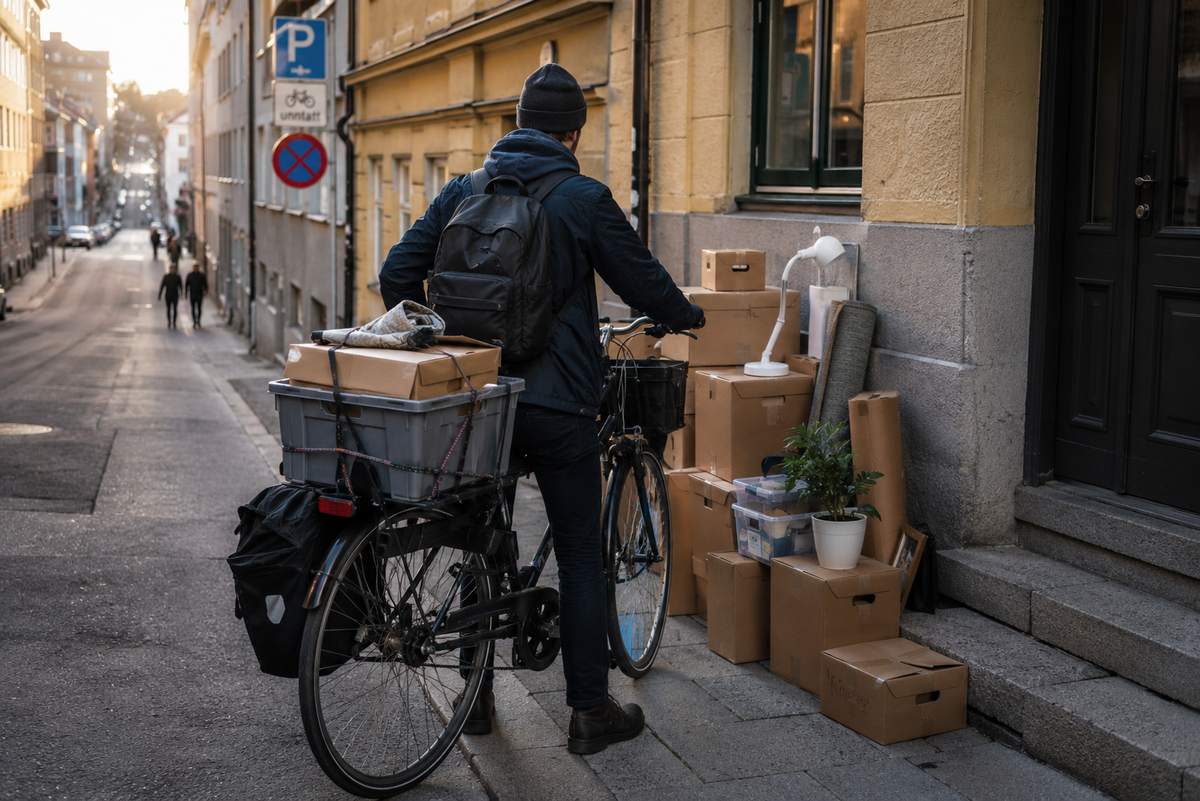
By Ulrikk K. Reen
Moving house is often described as a practical task. For a single adult without a car and without a large support network, it's something entirely different: a logistical marathon, a financial endurance test, and a reminder of just how much modern society assumes everyone owns more than a bicycle.
There are few things in adult life that people talk about as casually as moving.
"You're just moving."
Just.
That word alone ought to be banned whenever moving house is involved.
The truth is that moving is one of the most demanding logistical exercises an ordinary person can undertake. It's part project management, part physical labour, part financial gamble, part psychological stress test, and part social experiment—one that quickly reveals how few people you can actually call when you need help.
If you're also a single adult without a car, without a trailer, without family nearby, and with nothing but a bicycle for transportation, moving stops being a practical project. It becomes something closer to an endurance sport.
First, You Have to Find Somewhere to Live
It sounds simple.
It isn't.
Finding a new place to live is no longer just a matter of discovering an apartment you like. It's an enormous puzzle made up of compromises. You scroll endlessly through property websites, sorting through hundreds of listings, hundreds of photographs and hundreds of carefully worded descriptions that rarely mean what they actually say.
"Quiet tenant wanted" often means they'd prefer it if you barely existed.
"Perfect for commuters" usually means your alarm clock will ring at five in the morning.
"Central location" may simply mean you're living above a nightclub.
"Cosy" almost always means small.
"Charming" means old.
"Unique" usually means something is seriously wrong.
Then come the calculations. You don't want to live too far from work. You'd like to be close to a grocery store and public transport, preferably without needing mountaineering equipment to reach either of them. If you cycle everywhere, you don't want to live at the bottom of a steep hill, but you don't want to live at the top of one either.
All of these things have to be considered at once, because distance measured in kilometres is one thing. Distance measured in uphill climbs is something entirely different.
Then Comes the Interview
When we were children, we imagined that adulthood meant freedom. Nobody told us we'd eventually be attending apartment interviews.
You arrive for the viewing with a smile, doing your best to look normal. You try to appear tidy, responsible and stable; sociable, but not too sociable; financially reliable, but not painfully dull.
Then the interview begins.
Where do you work?
How long have you worked there?
Do you have references?
Do you have pets?
Do you smoke?
How long are you planning to stay?
Are you single?
Do you plan on staying single?
Do you have friends?
Do they visit often?
Do you play music?
Do you cook food with strong smells?
You sit there as a fully grown adult with a full-time job and a steady income, yet somehow feel like a teenager trying to convince someone that you're responsible enough to deserve a bedroom.
And even if the landlord likes you, there's often one final obstacle.
Their partner.
You don't just have to be approved by one person. More often than not, your application has to survive what feels like a tiny private housing committee.
The Gap Nobody Talks About
Eventually, you might find somewhere to live.
Finally.
Only to discover that you can't move in for another two months.
Two months.
What do you do then?
You've already given notice on your old place, but the new one isn't ready. The gap exists, yet almost nobody talks about it. Society seems to assume that everyone has parents with a spare bedroom, friends with an extra sofa, or enough money to spend weeks in a hotel.
But what if you don't?
Do you rent a storage unit? Sleep on different sofas? Move into a campsite? Pack everything you own into storage and spend a month living like a modern-day nomad?
It's a practical problem that thousands of people face every year, yet almost no part of the housing market is designed to solve it.
Then Comes the Great Transportation Exercise
This is the moment you discover just how much of modern society has been designed around people who own cars.
Everything has to be moved: boxes, books, kitchenware, clothes, electronics, small pieces of furniture, lamps, a dining table—everything.
And you own a bicycle.
There are moments in life when you're forced to confront the distance between your own reality and society's expectations. Standing in front of twenty moving boxes, knowing that your entire transport capacity consists of the luggage rack on the back of your bike, is one of them.
That's when the phone calls begin.
You don't really know anyone with a car. Nobody owns a van. Nobody has a trailer. Nobody happens to have five free hours to spare.
It's a strange realization that modern moving is largely based on one of three assumptions:
- You own a car.
- You know someone who owns a car.
- You have enough money to pay someone who owns a car.
If none of those apply to you, moving quickly becomes a logistical nightmare.
Then Comes the Next Surprise
Eventually, you arrive. You unlock the door, step inside your new apartment and collapse among the cardboard boxes. That's when another realization quietly sneaks up on you.
You barely own any furniture.
Everything seemed perfectly adequate in your old place. In the new one, however, it feels as though you've moved into an echo.
Suddenly you need a chair, a table, lamps, storage, curtains, shelves, kitchen equipment—and countless other things you had never even thought about before.
And all of them cost money.
Money you no longer have.
Especially after paying the security deposit, the first month's rent, perhaps two months' rent, maybe a storage unit, a moving van, new bus passes and updated insurance policies.
Moving house is, in many ways, a complete financial reset.