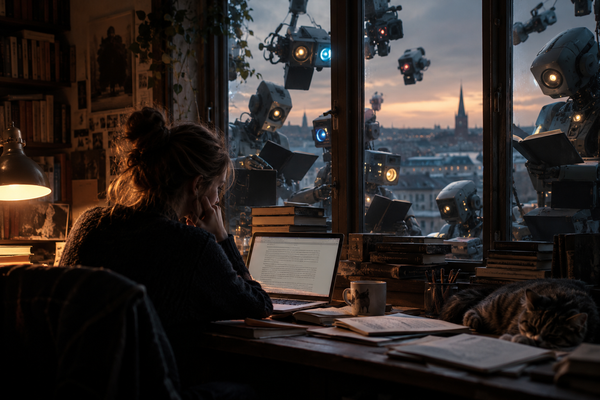
The Psychology of Office Lighting
Can changing the light bulbs change the way people think? In the RABAGAS newsroom, one editor is convinced it can. A humorous essay about creativity, office culture and the surprisingly philosophical consequences of replacing LED lights with warm bulbs.

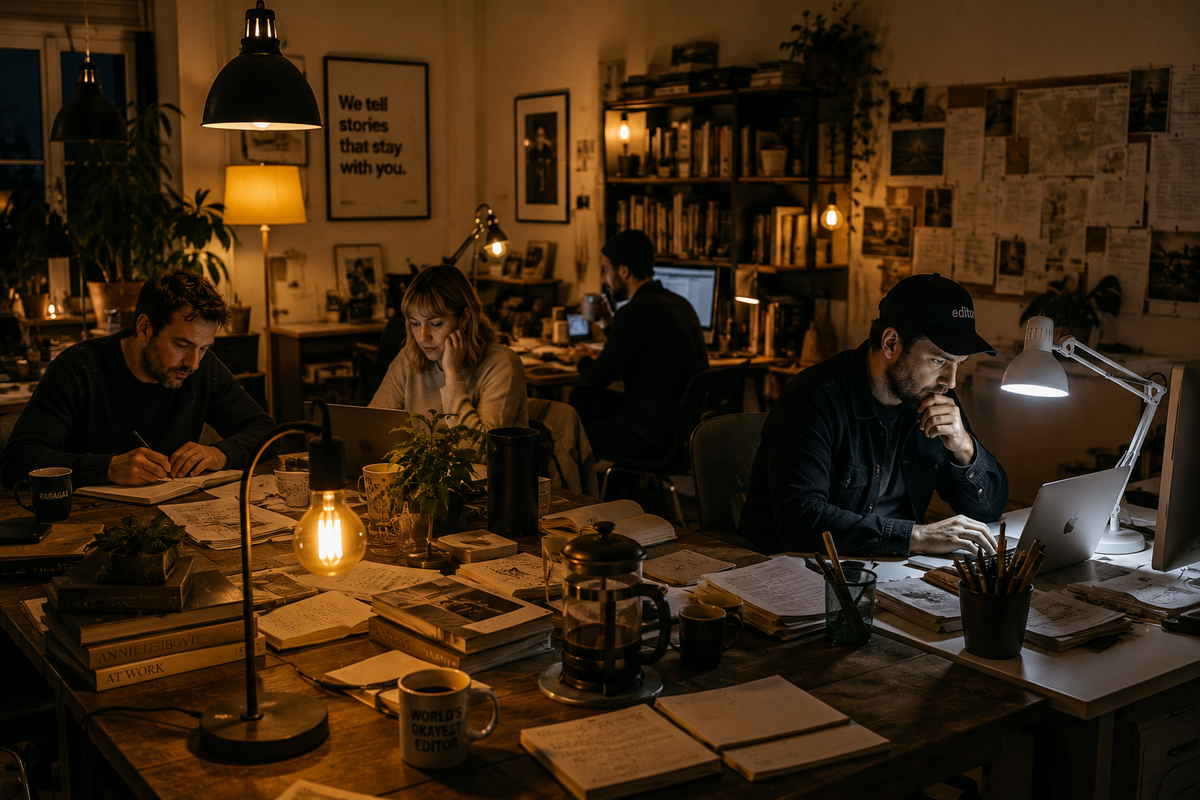
By Hampus Fickelton
It didn't begin as an experiment.
It began as an irritation.
For quite some time, Hampus Fickelton had been convinced that office lighting was one of the most underrated forces in modern working life. Not as a metaphor, but as physical infrastructure for thought itself. Brightness. Colour temperature. The quiet hum of ceiling panels that never quite switch off, yet never let you forget that you're at work.
At the RABAGAS newsroom, he eventually took a step that nobody had requested, but that nobody managed to stop either.
Every light bulb was replaced.
The cold white LED lighting disappeared.
In its place came warm amber bulbs, as though the office had suddenly developed a delayed aesthetic crisis from another era.
Even the bathroom was transformed. The harsh fluorescent tubes in the ceiling were switched off and replaced by a large floor lamp that cast a softer, less predictable light across the tiled floor.
The Hypothesis
Hampus maintains that lighting influences more than vision.
It shapes the way people think.
His theory is remarkably simple.
There are two kinds of light.
LED lighting: efficient, precise... and just a little bit soulless.
Warm lighting: slower, less productive perhaps, but infinitely more conducive to thinking.
"Under LED lighting you write things that are clear. Under warm light you begin to wonder whether they should have been written at all."
Not everyone in the newsroom shares his enthusiasm.
Art Director Ulrikk K. Reen has a considerably more pragmatic relationship with lighting.
He doesn't describe Hampus's initiative as a revolution.
More as "an aesthetic detour that just happens to affect productivity."
Ulrikk admits the new lighting has a certain charm.
The office feels more alive.
More unpredictable.
And, in his own words,
"Cosier... in a slightly dangerous sort of way."
But on one point he refuses to compromise.
He works better under modern LED lighting.
"There's something about LED lighting that makes things actually get finished. It isn't always beautiful, but at least something gets done."
He points particularly to design work and page layouts, arguing that precision and clarity become slightly blurred beneath the warmer light.
The Experiment
The changes that followed were anything but conclusive.
Jonas reported spending longer on research, but also discovering far more unexpected things that rarely answered the question he had started with.
Ragna had begun asking fewer questions about grammar and considerably more questions about intention.
Dag had stopped commenting on the lighting altogether, although he had started using the phrase "That'll do" with suspiciously increasing frequency.
And Ulrikk had quietly introduced a small LED zone at his own desk.
Not as an act of rebellion.
More as a negotiating position.
The newsroom now exists in a curious state of shared lighting ecology.
Warm light dominates the communal spaces.
LED survives in small islands devoted to structure, layout and design.
Nobody has declared victory.
Nobody has surrendered.
Somehow, it all works.
Or at least, it works well enough.
Hampus insists that the lighting has fundamentally changed the way people think.
Ulrikk insists it has merely made it harder to see what they're doing.
Neither seems particularly interested in convincing the other anymore.
Perhaps that, more than anything else, is what makes the arrangement successful.
An Unofficial Conclusion
The experiment has produced no measurable results.
There are no graphs.
No peer-reviewed studies.
No statistically significant findings.
Only a small editorial office where people seem to argue a little more thoughtfully than before.
Hampus remains convinced that the lighting has changed the way they think.
Ulrikk remains convinced that it has simply made it more difficult to see what they're doing.
In their own ways, both are probably right.
And perhaps that is exactly where RABAGAS finds itself.
Somewhere between clarity and warmth.
Between efficiency and reflection.
Between finishing the work...
...and wondering whether it ought to exist in the first place.
Hampus still insists that the lighting experiment was worthwhile.
Not because it made the magazine better.
Not because it made the staff happier.
But because it forced everyone to notice something they had previously taken for granted.
"The important thing isn't what kind of light we work under," Hampus says.
"It's that we notice it at all."
Without looking up from his screen, Ulrikk replies,
"I mostly notice when things actually get finished."
Nobody wins the argument.
Nobody changes the light bulbs back.
And somehow, that feels like the most appropriate ending imaginable.