The Smile Test
It took the Norwegian government weeks to issue my passport. Upwork wasn't convinced. What followed was a surprisingly ordinary experience that left me wondering how much of ourselves we now have to surrender simply to log in.

The Passport That Wasn't Good Enough
Few documents are more difficult to obtain than a passport.
You book an appointment and present yourself at the police station. At least, that's how it works in Norway. You identify yourself using an official document—often your old passport. Fingerprints are taken from both hands, a new photograph is captured, and your signature is registered. Then comes a few days of waiting before the small salmon-pink booklet finally arrives in the completely unprotected mailbox registered to your home address.
The process is hardly quick.
But it makes sense.
A passport is one of the most important documents we own.
Which is why it was such a strange experience to discover that the Norwegian government had fewer problems accepting my identity than Upwork did.
I hadn't planned on working that evening. I simply wanted to log in and read a message from a potential client.
Instead, I was met with a barrier.
To regain access to my account, I first had to verify my identity.
It wasn't the first time I had been asked to prove who I was online. Banks do it. Government services do it. I've even gone through extensive Know Your Customer (KYC) procedures with companies that are legally required to verify the identity of their customers for regulatory reasons.
This felt different.
Upwork wanted my passport.
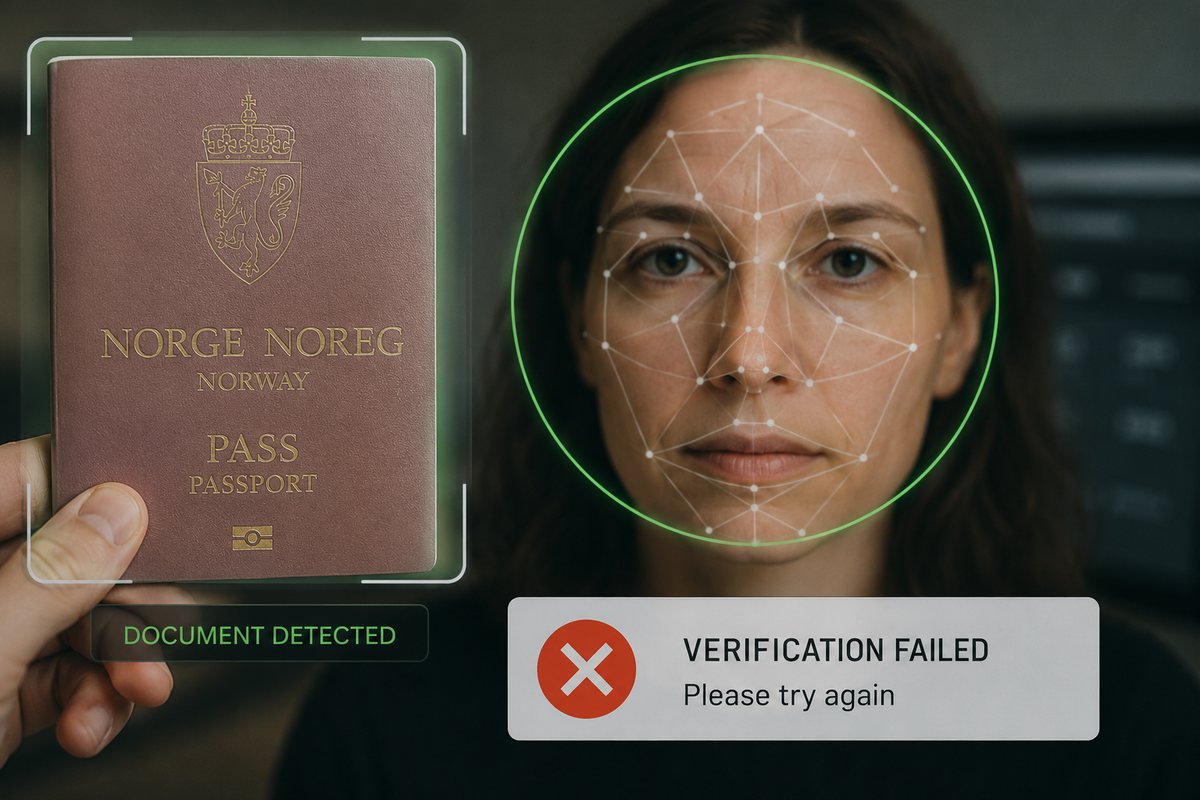
I retrieved it, activated my webcam, and held it up exactly as the instructions described. A green frame appeared around the document. I adjusted the angle. Moved it closer. Pulled it back. Tilted it toward the light. Tried again.
The system couldn't find what it was looking for.
So I tried again.
And again.
After a while, the whole thing began to feel almost absurd. A passport issued by the Norwegian authorities after a fairly rigorous process apparently couldn't be read by a standard webcam.
Eventually, the system gave up and instructed me to use my phone instead.
That worked almost instantly.
The contrast was difficult to understand. The webcam sitting only a few centimetres from my face failed repeatedly. A handheld photo taken with my phone was accepted without hesitation.
I assumed the worst was over.
It wasn't.
The next step was my face.
A circle appeared on the screen, following my movements. I was instructed to position my face correctly, look directly into the camera, and smile.
Not at another person.
At a system.
So I did exactly as I was told.
Then I waited.
The response came quickly.
Verification failed.
I tried again.
Another smile.
Another wait.
Another rejection.
Little by little, the process lost every trace of normality. Late that evening I found myself sitting alone in front of my computer, trying to convince a piece of software that I was the same person shown in the very document it had already accepted.
It was a peculiar situation.
No alarms were sounding. Nobody threatened me. Nobody demanded money. Everything unfolded politely, methodically, behind a clean and reassuring user interface.
Yet the outcome remained exactly the same.
I couldn't get in.
I couldn't read my messages.
I couldn't access my own account.
Only then did I begin asking questions that had never occurred to me before.
Why was this verification necessary?
Who was actually evaluating these images?
More importantly, where were they stored?
And for how long?
How many other people, somewhere else in the world that very evening, were sitting in front of a screen, trying to smile in just the right way simply to be allowed to do their job?
When the Questions Began
It wasn't until I had regained access to my account that I began thinking about what had actually happened.
Not because the experience had been dramatic. Quite the opposite. It had been remarkably ordinary. Nobody raised their voice. Nobody issued threats or ultimatums. The entire process was polite, orderly, and wrapped in a user interface that constantly reassured me this was simply another routine step on the journey.
Perhaps that's how modern control works.
It no longer arrives in the form of uniforms, stamps, or government offices. Instead, it appears as a green circle on a screen, a carefully worded paragraph about security, and a button labelled Continue.
I had been through identity verification before. Banks are required to know their customers. Gambling companies operate under strict anti-money laundering regulations. These procedures can be cumbersome, but at least they exist within a legal framework that is easy enough to understand.
With Upwork, however, something felt different.
I wasn't opening a bank account.
I wasn't transferring large sums of money across international borders.
I simply wanted to log into a freelance platform, read my messages, and communicate with potential clients.
Yet access to my account depended on surrendering my passport, my face, and my biometric data.
That was when the questions began.
Not the big questions about artificial intelligence or surveillance capitalism. Those came later.
The first questions were much simpler.
Where were these images stored?
Who had access to them?
How long would they be kept?
Was Upwork handling this information itself, or had the verification process been outsourced to another company? And if so, who was that company, and under which legal framework were they operating?
Finding clear answers turned out to be surprisingly difficult.
Perhaps I was asking the questions in the wrong order.
Or perhaps, like most people, I had simply never stopped to think about what actually happens in the moment we hold a passport in front of a camera and click Accept.
We do it more and more often.
At airports.
With banks.
On dating apps.
On cryptocurrency exchanges.
On freelance platforms.
Little by little, we have become accustomed to the idea that our face is no longer just our face.
It has become a key.
A key that grants—or denies—access.
And perhaps that quiet process of adaptation is the most interesting part of this entire story.
The Face as a Passport
It is easy to dismiss an experience like this as a minor inconvenience—a routine technical check. A few minutes in front of a camera. A passport held up to a lens. A smile recorded by a piece of software. Then you move on.
That was my first reaction as well.
Yet something about the experience continued to linger long after it was over.
Not because I believe digital platforms should never be allowed to verify the identity of their users. Quite the opposite. There are perfectly legitimate reasons for identity verification. Fraud is a real problem, and both clients and freelancers have a genuine interest in knowing that the person on the other side of the screen is who they claim to be.
So the question is not whether identity verification is legitimate.
The question is where we choose to draw the line.
Only a few years ago, a passport was primarily something you carried through an airport or presented at a border crossing. Today it is increasingly becoming a universal key to the digital world. At the same time, our face is quietly acquiring a new function. It is no longer simply something other people see. The most personal thing we possess has become an identifier—something that can be analysed, compared, measured and ultimately approved or rejected by software.
Perhaps this is simply the natural direction of technological progress.
Perhaps it is the price we pay for a society in which more and more of our working lives take place on digital platforms.
But progress does not relieve us of the responsibility to ask difficult questions.
Who is accountable when an algorithm gets it wrong?
What happens if a verification doesn't fail for one evening, but permanently?
What happens when there is no human being to speak to?
And what rights should users have to know what information has been collected about them, how it is being used, and when—if ever—it will be deleted?
I eventually discovered that the last question was far more difficult to answer than I had expected. Understanding exactly what information had been stored about me, and how it was being processed, became a much larger undertaking than the verification process itself.
That was the moment I realised the story was no longer about a passport that failed to satisfy a webcam.
It had become a story about the relationship between individuals and the digital platforms we have gradually come to depend upon. Platforms that ask for ever more information about us, while most of us accept their terms almost without thinking—not because we necessarily agree with them, but because choosing not to participate increasingly feels like choosing to opt out altogether.
That, more than anything else, was what stayed with me.
Not that I had been asked to show my passport.
Not that I had been asked to smile at a camera.
But how astonishingly normal the entire experience felt.
As though it were the most ordinary thing in the world that access to my work should depend on an algorithm deciding whether my face was acceptable.
Perhaps that is why experiences like this deserve to be written about.
Not because they prove that someone has done something wrong.
But because they remind us how quietly profound changes often take place.
Not through dramatic political decisions or public debate.
But through a green circle on a screen.
And a button labelled Continue.