
Touch Creates Connection
Long before sexuality, there is touch. The need to be held, comforted and reassured follows us throughout our lives, even as modern society teaches us to keep our distance. An essay about intimacy, trust and one of humanity's oldest languages.

By Ulrikk K. Reen
Reprinted from the archives and adapted for modern readers.
It isn't just about sex.
That may be the single most important point this essay makes.
Long before sexuality enters the picture, there exists another human need: the need for closeness. To be held. To feel that another person is there.
Yet many of us learn early in life that the body is somehow a problem.
Children notice the differences between boys and girls long before they understand what those differences actually mean. They're curious. They explore the world the way children always have.
At the same time, they begin to learn that certain kinds of touch are forbidden.
"Don't touch."
"Leave it alone."
"You're too old for that now."
The messages arrive early, often without explanation.
Parents who rarely hold hands teach their children something as well. Not through words, but through absence. Hugs become less frequent. Sitting on a parent's lap quietly disappears. A kiss on the cheek becomes increasingly rare.
Gradually, an understanding takes shape:
Touch is something to be limited.
Something to be controlled.
Something that perhaps even ought to be hidden.
But the need itself never disappears.
Among older children, it often reveals itself through play, teasing and physical exploration. Pushing, wrestling, running and chasing may look like competition, but often contain something else:
A desire for contact.
When puberty arrives, this becomes even more obvious.
Most young people eventually discover that the prohibition against closeness cannot last forever. Hands find one another. Kisses happen. The body begins speaking a language no one ever taught them, yet one they somehow understand instinctively.
For many young people, touch is almost as important as sexuality itself.
Perhaps even more important.
Sex may be a destination.
Touch is a process.
Through touch, people learn to read one another. A hand against a cheek. Fingers running through someone's hair. An arm around a shoulder.
These are not simply actions.
They are communication.
The one who reaches out offers something of themselves.
The one who is touched answers in return.
Between them, a dialogue emerges that needs no words.
This is where sexuality acquires its emotional foundation.
When people naturally seek one another out, they strengthen the trust between them. They reassure each other that the other person is still there. That the connection remains.
Later, that trust becomes part of a sexual relationship.
It makes closeness feel safe.
It makes vulnerability possible.
It makes rejection less frightening and mutuality easier to achieve.
Without that sense of safety, sexuality may still exist.
But something is missing.
When touch is used only as a signal for sexual activity, it loses much of its human meaning. It becomes a request for an act rather than an expression of closeness.
Over time, a relationship can survive on routine alone.
But routines rarely create intimacy.
What began as a living encounter between two people risks becoming an obligation.
And obligations have a tendency to lose their value when they are no longer nourished by something deeper.
That is why touch is often at its most important when it has no destination.
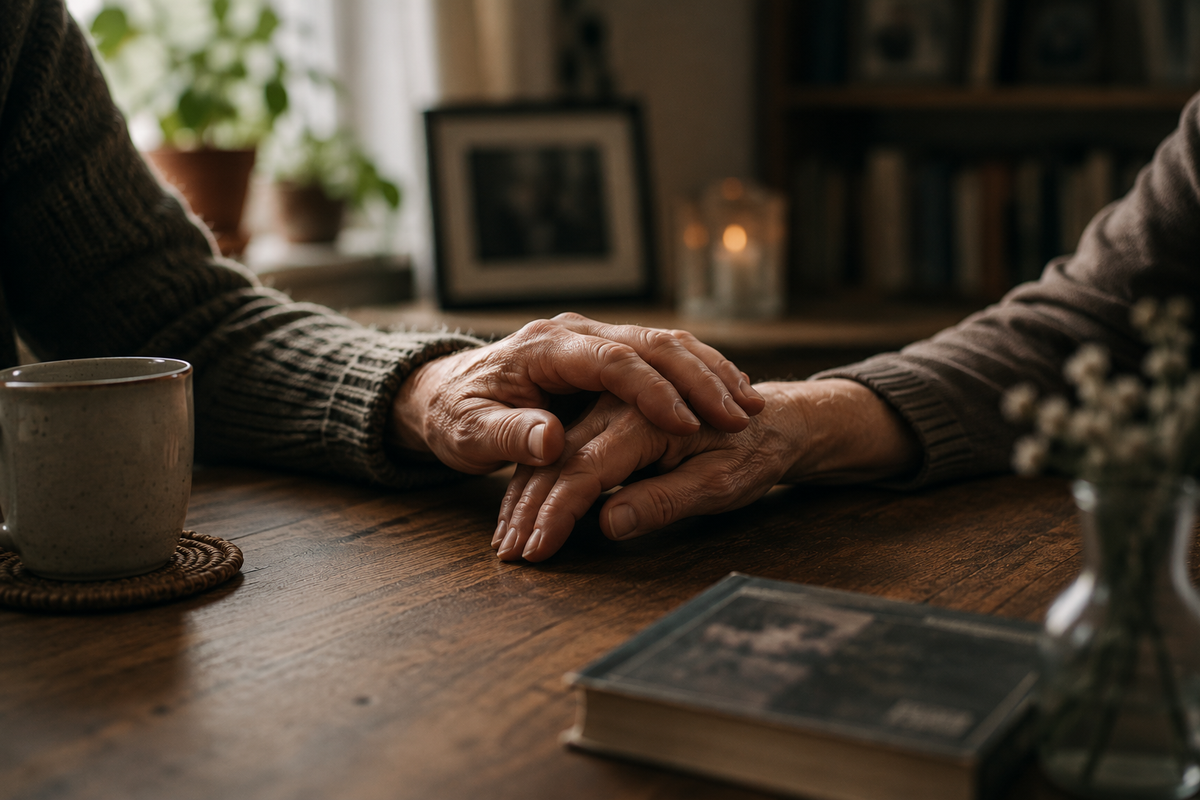
A hand resting on a shoulder.
A gentle stroke across someone's back.
Walking home arm in arm.
One human simply reaching for another.
Not because something is about to happen.
But because the connection itself has value.
The Forgotten Touch
We hug small children without thinking about it.
We lift them.
Carry them.
Hold them close.
But the older people become, the less often they receive the same kind of care.
It is a paradox.
Because the need for closeness does not disappear with age.
Eyesight may weaken.
Hearing may fade.
Voices may grow quieter.
Bodies may lose their strength.
But the ability to feel warmth, safety and human connection remains.
Many older people live with a loneliness that is not caused by the absence of other people, but by the absence of touch.
A handshake.
A hand held just a little longer than necessary.
A hug that isn't in a hurry to end.
Small gestures like these can mean more than we realise.
Perhaps because they remind us of something fundamental.
We don't simply want to be seen.
We want to be met.
Touch is among the very first languages we ever learn.
An infant can distinguish safety from insecurity long before it understands speech.
Perhaps we never truly forget that language.
Perhaps we carry it with us throughout our entire lives.
If that's true, then touch is not merely part of sexuality.
It is part of being human.
A language that existed before words.
And one that often says more than words ever can.
There is a persistent misunderstanding in archival work:
That the past is finished.
That a document ceases to matter once it has been dated, catalogued and placed inside a box.
This essay quietly refuses to accept that idea.
Our own time is filled with words like consent, boundaries, safety and regulation. Many of them are necessary. Some of them are fragile.
Sometimes we speak as though we invented these questions ourselves.
We didn't.
We've simply placed more layers between ourselves and them.
Beneath all the systems, interfaces, screens and protocols, the same human need still exists:
The need to be touched.
Masters and Johnson wrote before intimacy could be optimised, tracked, measured and simulated. Before signals could replace contact.
What they describe cannot be scaled without losing something essential.
It cannot be automated without becoming hollow.
For them, touch was not a transaction.
It was a conversation.
Mutual.
Continuous.
Vulnerable.
This essay has its limitations. It reflects the era in which it was written. It contains assumptions we would challenge today, and blind spots we can now recognise with relative ease.
That is precisely why it belongs in an archive rather than a museum.
Its value does not lie in its authority.
It lies in its insistence.
Its insistence that intimacy is not a problem to be solved, but a practice that must be maintained.
Between people.
Over time.
With risk.
An archive is not a mausoleum.
It is an engine room.
And some documents keep running long after the age that produced them has disappeared.
This is one of them.
— Ulrikk K. Reen