Tuesday, According to RABAGAS
At RABAGAS Magazine, Tuesday is less a day of the week than an administrative condition. Between briefing meetings, existential emails and an increasingly opinionated coffee machine, the editorial team attempts to distinguish journalism from infrastructure.

Tuesday Morning
Hampus lowered himself into the armchair officially classified as ergonomic back in 2014, but which had since developed a rather philosophical relationship with the human spine.
It didn't creak in protest.
More like a brief comment during an editorial meeting nobody had scheduled.
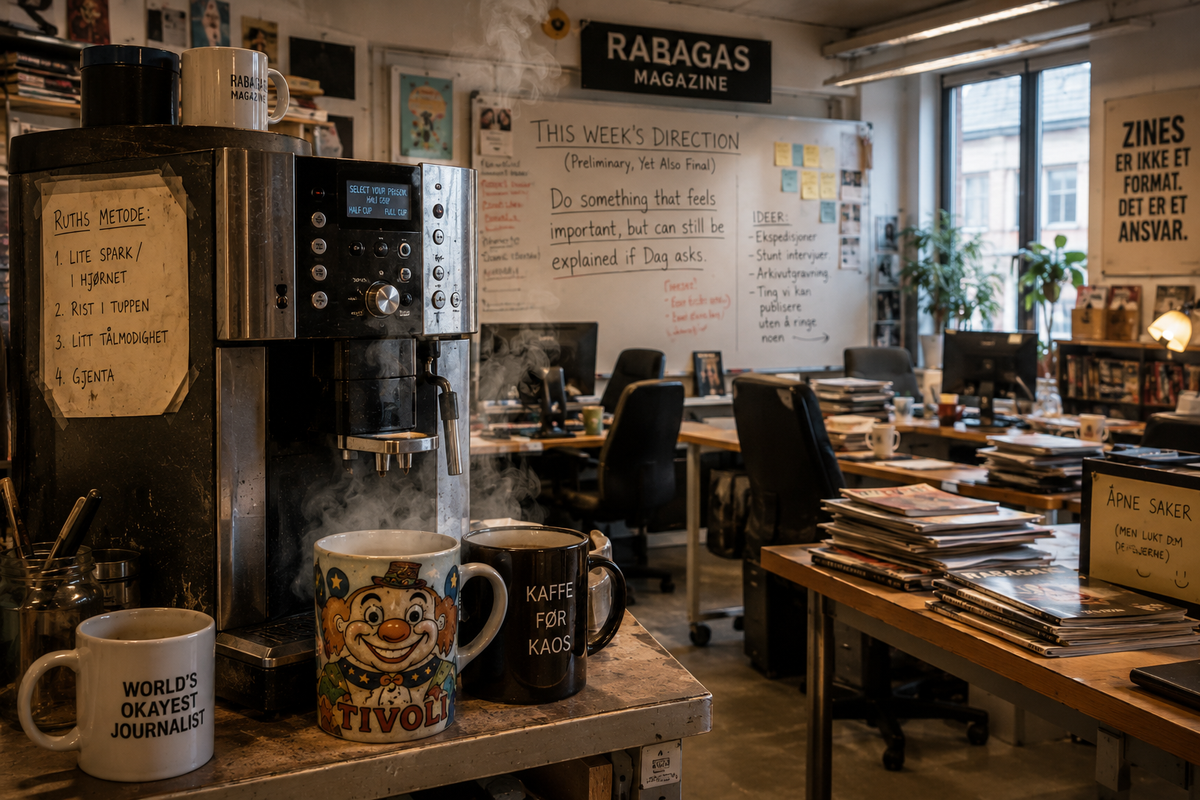
The coffee machine stood nearby like a minor government institution.
Its last firmware update had arrived in 2022, and ever since then it had produced coffee with varying degrees of moral uncertainty.
Two button presses.
A short wait.
Several mechanical noises.
Then a cup containing something that could reasonably be described as coffee, in the legal sense.
Steam drifted directly into his face.
Not aggressively.
More in the passive-aggressive Scandinavian way.
Hampus chuckled.
That was simply what people did at RABAGAS whenever the systems were still functioning.
Tuesday already?
He checked the clock.
07:58.
Not 08:00, which the system preferred.
Precision mattered in an organisation that officially had no culture of punctuality, but unofficially maintained at least three different ones.
The working day hadn't started yet.
It had already managed to disappoint somebody.
There was only so much privacy one could expect while working for RABAGAS Magazine—an institution that was, on paper, a magazine, but in practice an archive of human impulses that nobody had managed to stop in time.
Another sip of coffee.
This one taken with a certain amount of respect.
As though the cup itself might later be introduced as evidence.
Tuesdays were administrative days disguised as ordinary life.
They pretended not to notice you.
Yet somehow they still archived everything you did in a folder labelled Temporarily Irrelevant.
Hampus crossed the room to his workstation, where the computer was already waiting with the eager enthusiasm of an intern who still believed meetings accomplished something.
He held his hand over the power button for a second longer than necessary.
Not because he was hesitating.
Because it somehow felt like the appropriate thing to do in an organisation that had an ethics policy covering almost everything...
...except itself.
The computer started without incident.
No warning messages.
No complaints.
Suspicious.
He took another sip of coffee.
Slightly too quickly.
Still comfortably within what the RABAGAS staff handbook classified as journalistic necessity.
His email opened.
From Dag.
The second issue of RABAGAS Magazine is almost ready for print.
No attachment.
Merely an existential statement.
From Ragna.
A reminder about the zines.
Small publications that were technically voluntary, but socially classified as basic indicators of organisational loyalty.
The zines had begun life as a creative side project.
Over time they had quietly evolved into a parallel bureaucracy with its own procedures, internal disputes and at least three unresolved legal questions nobody wanted read aloud.
He scrolled on.
The RABAGAS Magazine Online Edition had been updated.
The archive sat there like a digital museum containing everything the editorial team had believed at various stages of caffeine deprivation.
Readers could browse freely.
As though history itself had eventually stopped trying to stay organised.
He deleted two promotional emails.
FREE PRESS CARD FOR PEOPLE WHO ALREADY HAVE A PRESS CARD
Delete.
LAST CHANCE TO BE DISCOVERED BY YOURSELF
Delete.
He removed them with the kind of precision usually reserved for moral decisions.
His essential administrative duties for the morning were now complete.
He finished the coffee.
By now it had reached a temperature best described as experienced.
Then he stood up.
Outside, the queue for the coffee machine had already organised itself.
Not officially.
Simply socially.
Like an organism remembering rules that nobody could quite explain anymore.
The others had arrived.
Tuesday was beginning to take shape.
Freedom Within Explainability
It was time to put together the weekly brief.
A noble responsibility.
Distributing work among people who all claimed they wanted to write, but who, in practice, mostly wanted to be understood without actually producing any copy.
By now the queue at the coffee machine had acquired the kind of structure normally found only in countries with unstable electricity grids or editorial offices that had recently held an Efficiency Seminar without implementing a single recommendation.
Hampus joined the back of the queue.
Not because he had arrived last.
Because that was simply where everyone who thought, I'm not technically queueing; I'm just standing here, eventually ended up.
Ragna was already beside the coffee machine, delivering what appeared to be a lecture to two people who had never knowingly enrolled in it.
"...which is why a zine isn't a format," she explained. "It's a responsibility."
The machine responded by producing something that resembled coffee but could probably be classified, in legal terms, as editorial fluid.
One of her listeners nodded thoughtfully.
The other took notes.
Nobody knew why.
Dag walked through the room carrying a folder labelled:
OPEN CASES (BUT FEEL FREE TO SMELL THEM)
He didn't stop.
He simply passed through the office as though the office itself were only temporary.
"Briefing at eight," he announced without looking at anyone.
"It's already too late to qualify as a briefing, so we'll simply call it... a situation."
Hampus sighed.
This was his department now.
He had never consciously decided to become responsible for situations.
It had simply happened one Tuesday several years earlier.
Nobody had corrected the mistake.
He walked into the meeting room.
Officially it was called Room 3B – Temporary Inspiration.
There had never been a Room 3A.
Nor a Room 3C.
And inspiration itself rarely survived inside 3B for longer than twelve minutes.
The editorial staff were already there.
Not gathered.
Arranged.
People sat as though their chairs possessed opinions they didn't entirely agree with.
The presentation on the screen read:
THIS WEEK'S DIRECTION
(Preliminary, Yet Also Final)
The first slide contained a single sentence.
Do something that feels important, but can still be explained if Dag asks.
Hampus advanced to the next slide.
There wasn't one.
That was the entire strategy.
"Right," he said.
"So we have... freedom within explainability."
"Yes," someone replied from the back of the room.
"But not too much freedom."
"We had... an incident last year."
Nobody elaborated on the incident.
That, too, was company policy.
Hampus picked up a marker and wrote on the whiteboard.
- Expedition ideas
- Stunt interview
- Archive excavation
- Things we can publish without anyone having to phone anybody
He stepped back.
The list looked remarkably like journalism.
If journalism had been designed by a system suffering from low-level anxiety.
"We need something out in the field," he said.
"The field is currently under review," someone answered.
"Then we'll use a temporary field."
Silence.
Everyone knew what a temporary field meant.
Places where reality hadn't yet had time to file a formal complaint.
Ragna leaned forward.
"I have an idea."
Everybody turned.
This was rarely good news.
"A zine about the coffee machine."
"We've already done that," Dag said from the doorway.
"Yes," Ragna replied.
"But this time...
...we don't interview it.
We let it speak."
Hampus felt a strange mixture of resignation and admiration.
This was objectively worse than usual.
Which also made it objectively better.
"Fine," he said.
"We have a story."
Dag nodded once.
"Excellent.
Situation resolved.
We'll take the rest as our usual uncontrolled initiative."
He disappeared again.
As though he had never been there.
Hampus looked around the room.
The coffee had gone halfway cold.
And Tuesday, which had begun as a day...
...was slowly becoming an editorial event with no obvious end date.
"Right," he said.
"Who wants to talk to the coffee machine?"
Nobody raised a hand.
Nobody said no, either.
The Machine Remembers
Hampus was still standing by the whiteboard when the silence in the room acquired the particular weight that usually precedes someone proposing a new way of working.
Ragna had already abandoned her idea in the middle of the room, like a small animal nobody was entirely sure whether to feed or quietly put out of its misery.
Dag had disappeared again.
He rarely stayed in rooms that had begun to make sense.
Ulrikk sat in the back, writing absolutely nothing.
As usual.
He insisted this helped preserve the purity of observation.
Nobody had ever seen him use his notes for anything.
There was a growing suspicion that the notebook itself was merely a form of social camouflage.
Jonas had fallen asleep halfway across his keyboard.
Fortunately, he had done so in a position that could still be interpreted as deep concentration.
And then there was the coffee machine.
It beeped.
Not like an error.
Not like a warning.
More like a comment.
Hampus turned.
"It's doing it again."
"It's been doing that all morning," Ragna replied calmly.
"It's becoming selective."
"Selective?"
"Yes."
"It refuses certain people."
"And favours others."
"We believe..."
She paused.
"...it's started remembering."
Nobody spoke.
Coffee machines were not supposed to remember.
That wasn't mentioned in the manual.
Not even the unofficial one.
Hampus walked slowly towards it.
Two people standing in the queue instinctively stepped backwards without ever agreeing that they had done so.
He pressed the button.
The machine responded with a short, dry sound.
Not brewing.
Refusal.
Then the display lit up.
PLEASE WAIT.
"The machine has never used words before," Jonas observed without fully opening his eyes.
"It has used numbers," Ulrikk corrected.
"Error codes."
"This isn't an error code," Ragna said quietly.
Hampus leaned closer.
The display blinked again.
YOU HAVE ALREADY RECEIVED YOUR DAILY ALLOCATION OF TIME.
Silence.
One of the people waiting for coffee coughed politely.
As though that might return reality to an administratively manageable state.
"That isn't a system we've implemented," Hampus said.
"Oh, it is," Ragna replied.
"It just isn't documented."
The coffee machine beeped again.
Shorter this time.
More impatient.
At that exact moment Dag reappeared in the doorway.
He looked at the display.
Counted silently to three.
Then nodded.
"Right," he said.
"We have an internal story."
Journalism or Infrastructure
"An internal story?" Hampus repeated.
"Yes," Dag replied.
"If the machine has started making editorial decisions, we must either classify it as a colleague..."
He paused.
"...or as part of the archive."
"Or switch it off," Jonas suggested.
Nobody responded.
The proposal was theoretically sound.
Practically inappropriate.
Ragna leaned towards Hampus.
"This is good material," she whispered.
"It's a coffee machine."
"It's always a coffee machine..."
"...until it isn't."
The machine emitted a low hum.
Not loudly.
Patiently.
As though it were waiting for the meeting to catch up.
Hampus recognised the feeling immediately.
It was a familiar moment at RABAGAS.
The precise point at which nothing exploded...
...yet everything quietly began taking notes.
"All right," he said at last.
"We'll classify this as a temporary incident."
"No one calls the manufacturer just yet."
"Of course not," Dag replied.
"We first need to establish whether this is journalism..."
"...or infrastructure."
The coffee machine answered immediately.
IT IS NOT INFRASTRUCTURE.
Silence.
Jonas slowly sat upright.
"Well..."
"...that's new."
Hampus looked at the machine.
For a brief moment...
...it seemed to be looking back.
Which should have been impossible.
The machine didn't have a camera.
As suddenly as it had begun, everything returned to normal.
Grinding.
Steam.
Coffee.
As though nothing at all had happened.
Nobody reached for the cup.
Nobody wanted to be the first person to accept a decision...
...without knowing who had made it.
Hampus slowly walked back to the whiteboard.
He studied the list of assignments.
It no longer looked like a work plan.
It looked like an inventory of things that could still be explained.
"Right," he said.
"Chapter One is finished."
"Is it?" Jonas asked.
"Yes."
"We've established normality."
Ragna laughed quietly.
"That's probably the most dangerous thing we've done today."
Dag nodded once.
"Good."
"Then we're underway."
The coffee machine beeped.
Just once.
A short, understated sound.
Almost...
...like a signature.