When Politics Becomes a Contact Sport
A year in an American high school taught me that diversity didn't need slogans—it was simply everyday life. Twenty years later, it's the silence from old friends that tells the story politics cannot.

There comes a point where politics stops being disagreement and starts looking like full-contact fighting.
Not debate.
Not democracy.
A combat sport.
With spectators.
With referees pretending not to see.
With human beings used as punching bags.
I've lived there.
Between Minneapolis and Saint Paul.
Not as a tourist, but as a teenager. As a student. As part of everyday life.
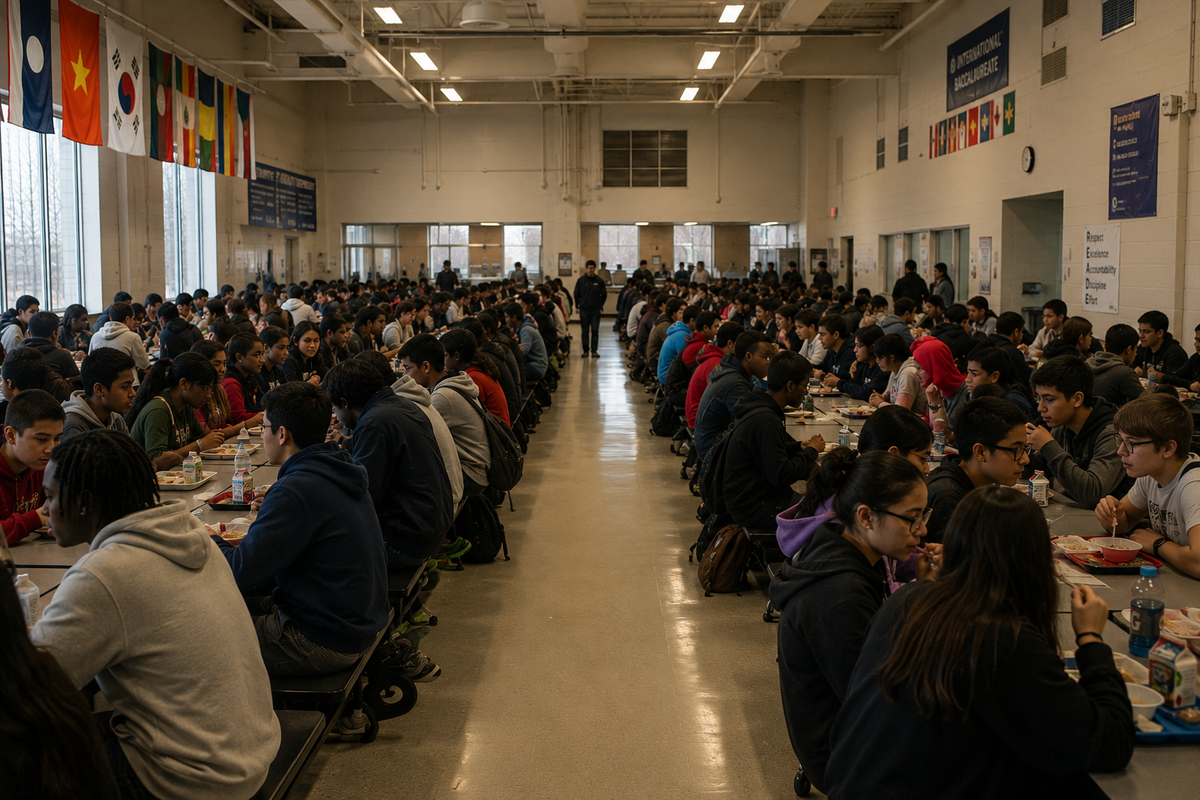
I attended high school in Saint Paul. Around 2,800 students. Only one in four was white.
The rest were the world.
Children of immigrants. Children who had immigrated themselves. Somali, Hmong, Latino, African American. People with accents. People without papers. Families working three jobs and living with no luxury to speak of.
And do you know what?
Nobody talked about it.
When diversity was the norm, you stopped seeing skin colour.
You saw friends.
Classmates.
Crushes.
Lunches that smelled different from the ones you grew up with—and made you curious.
There was only one exception.
Lunch.
That's when the students separated.
Nobody made them.
It just happened.
One long table for white students.
One for Black students.
One for Latinos.
One for Asians.
Not as enemies.
Not as rivals.
Just as people naturally gravitating toward what felt familiar when given the choice.
The cafeteria was enormous.
A hall the size of several gymnasiums stitched together.
Three lunch periods every day just to fit everyone.
Almost 3,000 students.
Roughly the same number as the ICE agents now deployed across the Twin Cities.
I was sixteen.
Fearless.
I talked to everyone.
I still do when I travel.
Open mouth.
Open eyes.
No hiding places.
I lived there for an entire year.
After that, I spent another three weeks travelling with three busloads of exchange students just like me.
Hundreds of people.
Maybe thousands of conversations.
And out of everyone I met, I remember only one family who supported George W. Bush.
One.
I remember them because they felt so foreign.
A large suburban house.
Several family members wearing military uniforms at the same time.
For dinner they served military field rations sealed in foil.
Not because they had to.
Because they wanted to.
Patriotism as identity.
War as a lifestyle.
The contrast was striking.
I also remember standing in a room listening to John Kerry speak.
Not because I knew much about politics.
I was sixteen.
Politics was something adults did.
But the atmosphere stayed with me.
People listened.
Not like fans.
Like citizens.
This was 2004.
Shortly afterwards, Bush won.
History moved in a different direction from the mood I'd experienced in that room.
And now I'm sitting here.
Many years later.
On another continent.
Unable to get a reply from my friends.
That's what hurts.
Not the headlines.
Not the expert commentary.
Not the endless analysis.
The silence.
The people I shared classrooms with.
The people I ate lunch with.
The people I laughed with.
People of every colour, language, and background.
They don't answer.
And I'm afraid for them.
I'm not afraid to admit that.
It hurts enough to bring tears to my eyes.
Because when politics becomes a contact sport, politicians are never the first to bleed.
Families are.
Neighbourhoods.
Children.
The people who were already living with fear close to the surface.
The people who taught me that diversity isn't a project.
It's a fact.
That community doesn't need slogans.
Only people.
The America I remember was chaotic.
Loud.
Full of contradictions.
But it was also the country where the world sat together in the same classroom and borrowed pencils from one another.
When politics becomes a contest where human dignity is the prize at stake, it's okay to grieve.
In fact, it's necessary to say out loud that this is not a game.
This is not an election campaign.
This is not a television show.
These are people's lives.
And I refuse to pretend it has nothing to do with me.
Because some of the people I'm worried about today were the very people who taught me what the world could look like when it works.